Fossibot F1200: our full review

With 1024 Wh, 1200 W and a price typically seen around 420 €, the Fossibot F1200 bets everything on simplicity: no app, no Bluetooth, no Wi-Fi. The energy it actually delivers swings sharply with the power drawn, from 80 % at low charging power to 91 % at full power, a gap that also explains the fan noise. One more thing worth knowing before buying: the warranty that actually applies is 2 years, not the 5 years highlighted on the product page.

Our rating
4.2/5
Capacity and efficiency: 4.3 out of 5 (weighting 25%)Capacity4.3Delivered power: 4.5 out of 5 (weighting 25%)Power4.5Recharging: 4.3 out of 5 (weighting 15%)Recharging4.3Ports and control: 3.7 out of 5 (weighting 15%)Ports3.7Build and endurance: 3.9 out of 5 (weighting 12%)Build3.9

How is this rating calculated?

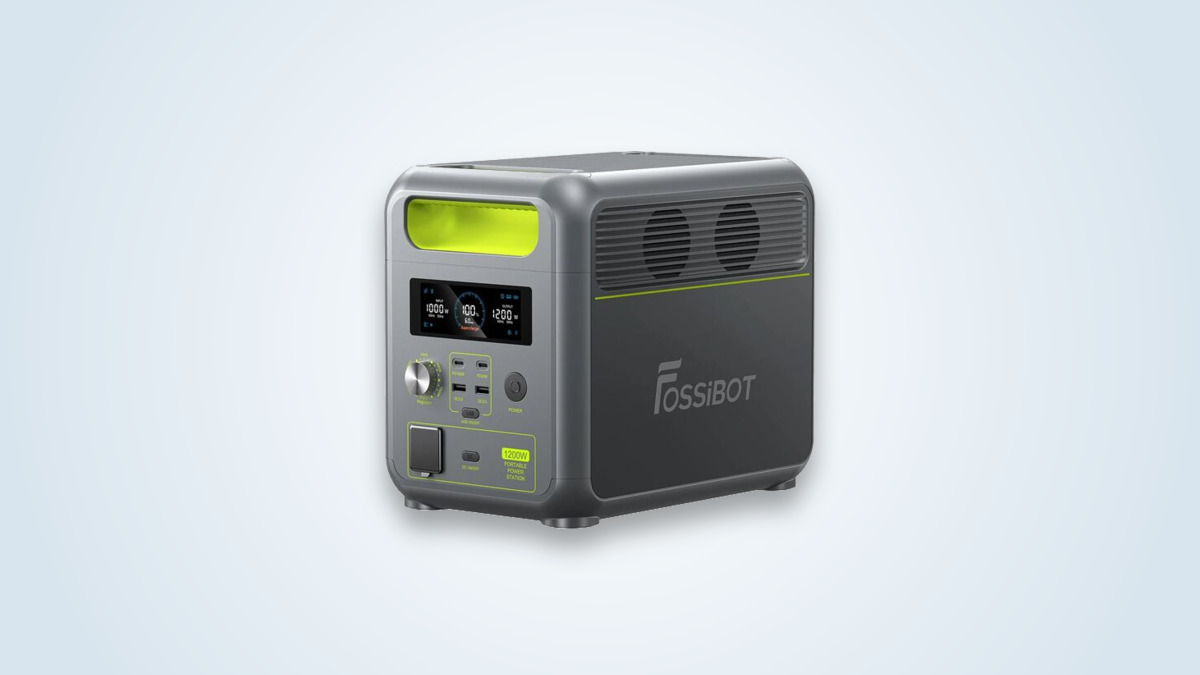
Compact Fossibot F1200 portable power station, LCD screen and adjustment dial visible

The essentials

The Fossibot F1200 delivers on its easiest claim to verify: on mains power, it goes from 0 to 80 % in 49 minutes and reaches 100 % in 70 minutes. Its real-world efficiency shifts noticeably with the load drawn, from 80 % at low power up to 91 % at 1200 W, a gap that also explains why the fan becomes clearly audible as soon as the station is put to work. Its 1200 W continuous output stays modest next to same-capacity competitors that reach 1800 W, and it is not enough for a resistive appliance like an electric kettle. Without an app or Bluetooth, it is controlled entirely on the unit itself: a simplicity that comes at the cost of any remote consumption monitoring. One point is worth knowing before buying: the manufacturer's product page advertises a 5-year warranty, but its official warranty policy names the F1200 among the models covered for 2 years, with no extension mechanism. Two years is therefore the term to count on. A station that recharges quickly and is well priced, provided you accept that term and its continuous power limits.

Strengths

  • Fast mains recharging: 49 minutes to 80 %, 70 minutes for a full charge
  • Good efficiency at full load: up to 91 % of capacity delivered at 1200 W
  • UPS function with automatic switch to battery on a mains outage, useful for a sensitive device
  • One of the lowest prices in its capacity class, stable for close to two years
  • Compact format and contained weight (11.5 kg) for 1024 Wh

Limitations

  • Efficiency drops to about 80 % at low charging power (200 W), against 91 % at full power
  • Fan clearly audible under load, with no decibel measurement available to pin down the exact level
  • 1200 W continuous output insufficient for a resistive appliance like a kettle (around 2000 W), which trips the overload protection
  • A real warranty of 2 years, while the manufacturer's product page advertises 5
  • Solar input capped at 200 W, modest next to comparable stations
  • Mains sockets positioned at the back of the unit, an awkward spot in daily use
Fossibot F1200: see the full details and price →

On paper: simplicity as the central argument

With 1024 Wh of LiFePO4 capacity, 1200 W of continuous output (2400 W peak) and a price typically seen around 420 €, the Fossibot F1200 positions itself as a notably cheaper option than direct competitors of the same capacity. Its most visible selling point: no app, no Bluetooth, no Wi-Fi. Everything is set from the LCD screen and a dial that adjusts mains charging power from 200 to 1000 W.

1024 Wh
claimed capacity
1200 W
continuous output (2400 W peak)
420
typical price seen

1024 Wh claimed, 80 to 91 % actually delivered depending on the load

The capacity actually delivered is not a single figure: it depends directly on the power being drawn. At low load (200 W), delivery works out at about 80 % of the claimed figure. It climbs to 83 % under 400 W, then to 91 % at full power of 1200 W. This mechanism is typical of this type of station: the inverter draws a roughly fixed amount of conversion power, which weighs proportionally more on a small load than on a large one. In practice, the F1200 is more efficient for large, brief loads than for small appliances run over long periods.

Real efficiency delivered according to the charging power drawn200 W80 %400 W83 %1200 W91 %
Efficiency measured at each charging power step, out of the 1024 Wh claimed.

A clearly audible fan, with no objective measurement available

The fan becomes clearly audible as soon as the station is put under sustained charging or discharging load. This noise comes from the same mechanism as the variable efficiency described above: conversion losses turn into heat, which the fan has to clear. No decibel measurement with a stated instrument and distance is available for this model, so it is not possible to give a reliable figure, only to describe the phenomenon in qualitative terms.

1200 W continuous: enough for most needs, not for a resistive appliance

The 1200 W of continuous output covers most everyday uses: a computer, lighting, a small fridge, light power tools. The limit shows up with high-power resistive appliances: a standard kettle, around 2000 W, exceeds the available continuous output and trips the overload protection. Other appliances of similar power but with a gentler start-up, such as a drill (around 700 W) or an espresso machine (around 1400 W), run without issue. The difference comes down to the nature of the load: a heating element that draws continuously calls on the full rated power throughout, while a motor or a pump only pulls hard at start-up.

Charging: the clearest strength

On mains power, the Fossibot F1200 goes from 0 to 80 % in 49 minutes and reaches 100 % in around 70 minutes, at full charging power (1000 W, adjustable via the dial). On solar power (200 W maximum), expect more like 6.5 to 9 hours depending on sunlight. Via a 12 V car outlet, more than 10 hours are needed.

No app, no Bluetooth: simplicity or a real limitation?

The total absence of an app, Bluetooth and Wi-Fi is the F1200's central marketing argument, presented as a mark of reliability: less embedded software, fewer possible points of failure. This choice has a direct trade-off: no remote consumption monitoring, no scheduled charging, two functions available on several direct competitors fitted with an app. The compromise is straightforward: simpler electronics and fully local control, against the absence of the connected functions now common on a good share of recent stations.

Warranty: 2 years in the official policy, 5 years on the product page

The official product page highlights a 5-year warranty covering the whole unit. The warranty policy published on the manufacturer's own site places the F1200 in a first category instead, named alongside the F800, F2400 and F3600 Pro, covered by a 2-year limited warranty; solar panels and batteries fall into a second category, at 1 year. No extension mechanism appears there. The term a buyer can count on is therefore 2 years, whatever the marketing line on the product page says. In practice, a failure occurring between month 25 and the fifth year would not be covered by the text the manufacturer publishes itself.

Careful not to confuse it with the F1800

The Fossibot range includes another model close in name and in capacity: the F1800, which shares exactly the same 1024 Wh battery but with higher continuous output (1800 W instead of 1200 W). A buyer comparing spec sheets quickly on capacity alone can easily mix up the two references. Always check the stated power output, not just the Wh capacity, before comparing a figure found online with the F1200's own numbers.

Full set of ports, a few questionable ergonomic choices

The F1200 offers 7 outputs in total: two 230 V mains sockets with pure sine wave output, two USB-C ports (100 W and 20 W), two USB-A ports (18 W) and one 12 V car outlet. Enough to power several appliances at the same time. Two ergonomic points stand out: the mains sockets sit at the back of the unit, an awkward spot in daily use, and the screen stays on permanently with no automatic shutoff under low solar input, which adds slightly to standby consumption.

Who it suits, who it does not

It suits anyone looking for a simple back-up or portable station, with no setup and no app, on a tight budget and with moderate power needs (no high-power resistive appliance).

It does not suit anyone who needs to monitor consumption remotely, schedule charging times, or occasionally plug in a resistive appliance close to 2000 W. It is also not a good fit for anyone looking for long coverage: the warranty that applies is 2 years.
In one sentence: a station that recharges quickly and is well priced, provided you accept its continuous power limits and a 2-year warranty.

The rating in detail

Our rating
4.2/5
Capacity and efficiency 4.3
Delivered power 4.5
Recharging 4.3
Ports and control 3.7
Build and endurance 3.9
Noise not measured
Fossibot F1200: see the full details and price →

The product and its alternatives

Fossibot F1200

Fossibot F1200

$512.72 (12)

With 1024Wh, 1200W continuous output and a 0-80% recharge in just 49 minutes, the Fossibot F1200 keeps things simple, no app, no Bluetooth.

View product
EcoFlow Delta 3 Classic

EcoFlow Delta 3 Classic

See price (6)

EcoFlow's most affordable portable power station: the power of the Delta 3 range, now lighter, quieter and easier on your wallet.

View product
Anker Solix C1000

Anker Solix C1000

See price (22)

With 1024Wh, 2000W output and a full recharge in 49 minutes via HyperFlash, the Anker Solix C1000 Gen 2 is one of the fastest-charging stations on the market.

View product
Jackery Explorer 1000 v2

Jackery Explorer 1000 v2

See price (31)

1070Wh and 1500W in a compact, lightweight station: enough to run a fridge, a kettle or all your devices, camping or during a power outage.

View product

Need help choosing?

Frequently asked questions

It varies with the power drawn: about 80 % of the claimed capacity at 200 W, 83 % at 400 W, and up to 91 % at full power of 1200 W. The inverter draws a roughly fixed amount of conversion power, which penalizes small loads more heavily.

No, in most cases: a standard kettle (around 2000 W) exceeds the 1200 W continuous output and trips the overload protection. Appliances of similar power but less resistive in nature (a drill, an espresso machine) run without any issue, however.

Two years. The official product page states 5 years, but the same manufacturer's warranty policy names the F1200, along with the F800, F2400 and F3600 Pro, among the models covered by a 2-year limited warranty, with no documented extension mechanism.

No, and it is a deliberate choice by the manufacturer: no app, no Bluetooth, no Wi-Fi. Everything is controlled from the LCD screen and a dial, which simplifies use but removes any remote consumption monitoring.

On mains power at full charging speed (1000 W), it goes from 0 to 80 % in 49 minutes and reaches 100 % in around 70 minutes. On solar power (200 W max), expect roughly 6.5 to 9 hours depending on sunlight.