The 2026 podium
Three stations stand out from the fifty. They do not target the same buyer and do not cost the same: the first is a fast family model, the second a home reserve, the third a compact all-rounder. Each one dominates its own ground on figures, not on impressions.
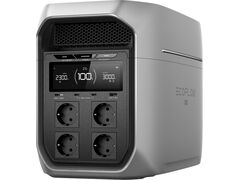
EcoFlow Delta 3 Max Plus
The best in the ranking, and by far the most complete. It is the only one to go past 4.5, and it gets there with no weak point: none of its six sub-scores falls below 4.5. Mains recharge to 80 % in 47 minutes, an X-Boost mode that genuinely works at 3900 W on resistive loads, and the best equipped ports of the top 10.
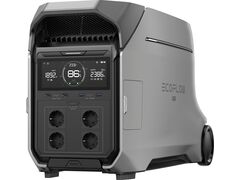
EcoFlow Delta Pro 3
The largest reserve in the ranking, and the best efficiency in the catalog. It returns 98 % of its stated capacity at high loads, which no other station in our catalog reaches. In exchange, its 51 kg pin it to the floor: this is a home reserve, not a travel station.
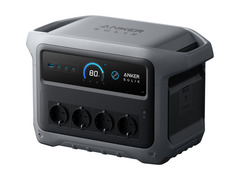
Anker Solix C1000
The best compromise in the ranking for everyday use. A full charge in under an hour, 2000 W genuinely available on a sustained basis, and eleven kilos less than the two models ahead of it. Its build quality score of 4.6 is one of the highest in the catalog.
The right choice for your use case
An overall score summarises, it does not decide for you. A station scored 4.4 because it recharges in fifty minutes does not deliver the same service as a station scored 4.4 because it makes no noise. Here, for six common uses, is the model that comes out on top on the criterion that really matters in that particular case.
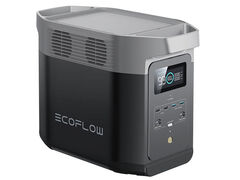
EcoFlow Delta 2
The highest build quality score of the fifty, and by a clear margin. LFP cells rated for 3000 cycles, a five-year warranty, thirteen outputs including four 230 V sockets, and a recharge to 80 % in 51 minutes that matches the claim. Its only real flaw is noise.
Read the full review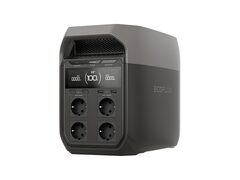
EcoFlow Delta 3
A mains input close to 1500 W that fills 1024 Wh in under an hour, with no accessory and nothing to set up. Worth remembering if you recharge between two trips rather than overnight.
Read the full review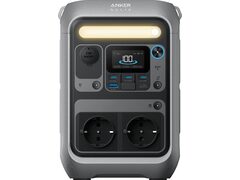
Anker Solix C300
Three USB-C ports, two of them at 140 W and bidirectional: they recharge the station just as well as they power a laptop. It returns more through its USB-C port than through its 230 V socket, which says a lot about the use it is intended for.
Read the full review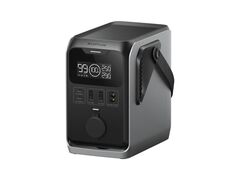
EcoFlow Trail 300 DC
Not a quiet fan: no fan at all, and no inverter either. Silence here is a property of the design, not a compromise. It returns close to 94 % of its capacity through its USB-C port, a figure out of reach for stations with a mains socket.
Read the full review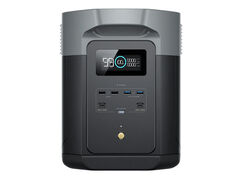
EcoFlow Delta 2 Max
2048 Wh as standard, and up to three times more with two extra batteries. It is the least expensive way to reach a credible backup reserve without buying a 50 kg station straight away. Its fan noise at full charge stays well above what the manufacturer states.
Read the full review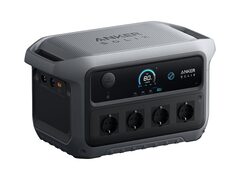
Anker Solix C2000 Gen 2
It reaches 100 % in 58 minutes by combining mains and solar, remains expandable up to 5120 Wh, and weighs four kilos less than the equivalent EcoFlow family model. Its efficiency drops sharply below 200 W: this is not the station to leave plugged into an internet router.
Read the full reviewThe full top 10
The ranking follows the overall score, itself the weighted average of the sub-scores. When two models show the same score, the value before rounding separates them, then real-world efficiency. No manual ordering is involved: the table below is recalculated from the fifty published reviews.
| # | Product | Score | Capacity | Power | Real efficiency | Price |
|---|---|---|---|---|---|---|
| 1 | EcoFlow Delta 3 Max Plus | 4.6 | 2048 Wh | 3000 W | 95 % | $1199 |
| 2 | EcoFlow Delta Pro 3 | 4.5 | 4096 Wh | 4000 W | 98 % | $2799 |
| 3 | Anker Solix C1000 | 4.4 | 1024 Wh | 2000 W | 90 % | See the price on Amazon |
| 4 | EcoFlow Delta 2 Max | 4.4 | 2048 Wh | 2400 W | 87 % | See the price on Amazon |
| 5 | EcoFlow Delta 2 | 4.4 | 1024 Wh | 1800 W | 91 % | See the price on Amazon |
| 6 | Anker Solix C2000 Gen 2 | 4.4 | 2048 Wh | 2400 W | 90 % | See the price on Amazon |
| 7 | Anker Solix C300 | 4.4 | 288 Wh | 300 W | 83 % | See the price on Amazon |
| 8 | EcoFlow Delta 3 | 4.4 | 1024 Wh | 1800 W | 84 % | $529 |
| 9 | EcoFlow Trail 300 DC | 4.4 | 288 Wh | 300 W | no data | $168.99 |
| 10 | Anker Solix C300X DC | 4.3 | 288 Wh | - | 95 % | See the price on Amazon |
The entire top 10 comes from two brands: six EcoFlow and four Anker. The fact deserves to be pointed out rather than celebrated, because they are also the two brands most represented in our reviews, with twenty models between them, and the paragraph on the limits further down explains why that mechanically weighs on the result. What stands out most is that three compact 288 Wh stations appear in it, alongside 2 kWh family models. That is the direct consequence of the way we score power: we judge whether a station holds what it claims, not how many watts it delivers.
How the fifty scores are distributed
The distribution below shows that most of the catalog sits between 4.0 and 4.4. That is normal: the catalog filters at the door, and clearly poor models do not appear in it. The useful gap therefore plays out in tenths of a point, and that is precisely why the sub-scores count for more than the overall score.
The ten finalists in detail
For each of the top ten, here is the detail of the six sub-scores, what really sets it apart, and what you have to accept when you buy it. The full reviews, far longer, can be reached from each block.
- Capacity and efficiency4.5
- Delivered power4.6
- Recharging4.5
- Ports and control4.7
- Build and endurance4.5
- Noise4.7
What sets it apart
- Mains recharge to 80 % in 47 minutes, among the fastest in its category
- X-Boost mode that genuinely works at 3900 W on high-power resistive loads
- The best equipped ports of the top 10, scored 4.7
What you have to accept
- Expanding the capacity requires the dedicated battery of this generation
- The stated 25 dB only holds up to 600 W, beyond that the level climbs to around 30 dB
- Capacity
- 2048 Wh
- Power
- 3000 W
- Real efficiency
- 95 %
- Weight
- 22.1 kg
- Price
- $1199
- Cost per kWh
- $585
- Capacity and efficiency4.7
- Delivered power4.3
- Recharging4.4
- Ports and control4.5
- Build and endurance4.5
- Noise4.3
What sets it apart
- Returns between 92 and 98 % of its capacity depending on the load, the best figure in the ranking
- 4096 Wh and 4000 W sustained, with X-Boost up to 6000 W on moderate motor loads
- A noise level of 30 dB at 2000 W, stated with rare precision
What you have to accept
- 51.5 kg: it cannot be moved single-handed, and cannot be loaded into a car without planning for it
- The casing is only certified IP20, so it tolerates neither rain nor splashes
- Capacity
- 4096 Wh
- Power
- 4000 W
- Real efficiency
- 98 %
- Weight
- 51.5 kg
- Price
- $2799
- Cost per kWh
- $683
Anker Solix C1000
The best balance in the ranking between weight, power and recharge speed.
- Capacity and efficiency4.5
- Delivered power4.4
- Recharging4.5
- Ports and control4.5
- Build and endurance4.6
- Noise4.0
What sets it apart
- A full recharge in under an hour, the benchmark in its category
- 2000 W genuinely available on a sustained basis, 3000 W at peak
- Up to 90 % returned on medium to high loads
What you have to accept
- Very audible fan noise during fast charging as well as at high output power
- Efficiency degrades sharply below a few tens of watts
- Capacity
- 1024 Wh
- Power
- 2000 W
- Real efficiency
- 90 %
- Weight
- 11.3 kg
EcoFlow Delta 2 Max
The least expensive route to a home reserve of several kilowatt-hours.
- Capacity and efficiency4.5
- Delivered power4.3
- Recharging4.5
- Ports and control4.6
- Build and endurance4.5
- Noise4.2
What sets it apart
- Expandable up to 6144 Wh with two extra batteries
- Mains recharge from 0 to 80 % in 53 minutes
- X-Boost mode working up to 3100 W on simple resistive loads
What you have to accept
- 44 to 47 dB at full charge, well above the stated 30 dB
- No public data on capacity degradation after several years of use
- Capacity
- 2048 Wh
- Power
- 2400 W
- Real efficiency
- 87 %
- Weight
- 23.0 kg
EcoFlow Delta 2
The best built of the fifty, at the cost of the noisiest fan in the top 10.
- Capacity and efficiency4.5
- Delivered power4.2
- Recharging4.5
- Ports and control4.6
- Build and endurance4.9
- Noise3.9
What sets it apart
- Build quality score of 4.9, the highest in the catalog
- 1024 Wh of LFP rated for 3000 cycles, with a five-year manufacturer warranty
- Four 230 V sockets and thirteen outputs in total, including two 100 W USB-C ports
What you have to accept
- Clearly audible fan noise during fast charging, up to around sixty decibels
- The energy recovered falls to 745 Wh at a draw below 20 W
- Capacity
- 1024 Wh
- Power
- 1800 W
- Real efficiency
- 91 %
- Weight
- 12.0 kg
Anker Solix C2000 Gen 2
Two kilowatt-hours that recharge in under an hour, for less than twenty kilos.
- Capacity and efficiency4.3
- Delivered power4.5
- Recharging4.5
- Ports and control4.5
- Build and endurance4.4
- Noise4.5
What sets it apart
- 100 % in 58 minutes by combining mains and solar charging
- Expandable up to 4096 Wh with a BP2000, and up to 5120 Wh in total
- Only 18.9 kg for 2048 Wh, four less than its direct rival
What you have to accept
- Efficiency falls to 77-79 % below 200 W, against 87 to 90 % at high load
- Real runtime on a fridge reaches 22 hours, far from the 32 to 64 hours stated
- Capacity
- 2048 Wh
- Power
- 2400 W
- Real efficiency
- 90 %
- Weight
- 18.9 kg
Anker Solix C300
The best rated compact model, designed around USB-C before the mains socket.
- Capacity and efficiency4.2
- Delivered power4.5
- Recharging4.6
- Ports and control4.6
- Build and endurance4.4
What sets it apart
- 266 Wh recovered through the USB-C port, against 240 through the 230 V socket
- Three USB-C ports, two of them at 140 W and bidirectional
- Full charge in 1 h 07 on mains, and in 2 h 22 with a simple laptop charger
What you have to accept
- 12.6 W drawn at idle with the outputs switched on: it empties itself in under twenty hours
- 69 % efficiency from the wall to the 230 V socket, well below larger stations
- Capacity
- 288 Wh
- Power
- 300 W
- Real efficiency
- 83 %
- Weight
- 4.1 kg
EcoFlow Delta 3
The fastest recharge of the top 10, with no accessory and no setting to change.
- Capacity and efficiency4.3
- Delivered power4.2
- Recharging4.6
- Ports and control4.5
- Build and endurance4.6
What sets it apart
- A full recharge in 56 minutes, with a mains input close to 1500 W
- Four 230 V sockets, two 100 W USB-C ports and one 12 V output
- 1800 W sustained and 3600 W at peak, enough to absorb a motor start-up
What you have to accept
- X-Boost mode tops out at 2400 W on 230 V, not the 2600 W often quoted
- X-Boost is disabled by default and becomes unavailable as soon as the station is plugged in
- Capacity
- 1024 Wh
- Power
- 1800 W
- Real efficiency
- 84 %
- Weight
- 12.5 kg
- Price
- $529
- Cost per kWh
- $517
- Capacity and efficiency4.4
- Delivered power4.4
- Recharging4.3
- Ports and control4.2
- Build and endurance4.3
- Noise4.8
What sets it apart
- About 93.7 % of the stated capacity returned through the USB-C port
- Recharge to 80 % in 69 minutes using both USB-C ports at once
- 2.6 kg, the lightest of the top 10
What you have to accept
- Efficiency falls to 81 % through the 12 V cigarette lighter socket
- No 230 V mains socket: incompatible by design with any appliance that requires one
- Capacity
- 288 Wh
- Power
- 300 W
- Weight
- 2.6 kg
- Price
- $168.99
- Cost per kWh
- $587
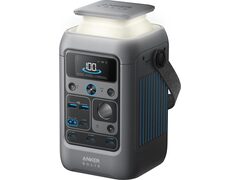
Anker Solix C300X DC
The best efficiency among the compact models, in 2.8 kg built entirely around USB-C.
- Capacity and efficiency4.5
- Delivered power4.1
- Recharging4.3
- Ports and control4.6
- Build and endurance4.3
What sets it apart
- 272.9 Wh returned out of the 288 stated, thanks to an inverter-free architecture
- 80 % reached in about 1 h 30 using two 140 W USB-C inputs
- 2.8 kg with a carrying strap included
What you have to accept
- No 230 V mains socket: any appliance that is not USB-C or 12 V compatible stays out of reach
- No charger supplied in the box, you have to provide one capable of high power
- Capacity
- 288 Wh
- Real efficiency
- 95 %
- Weight
- 2.8 kg
The fifty stations compared
The complete table, with the six sub-scores of every model. Each column is sortable: click a header to reorder the whole set by capacity, by real-world efficiency or by any sub-score. A dash marks data we do not have, never a value of zero.
Click a column header to sort
| Detailed sub-scores | Specifications | ||||||||||||
|---|---|---|---|---|---|---|---|---|---|---|---|---|---|
| # | Product | Brand | Score | Capacity | Power | Recharging | Ports | Build | Noise | Capacity | Power | Real efficiency | Price |
| 1 | Delta 3 Max Plus | EcoFlow | 4.6 | 4.5 | 4.6 | 4.5 | 4.7 | 4.5 | 4.7 | 2048 Wh | 3000 W | 95 % | $1199 |
| 2 | Delta Pro 3 | EcoFlow | 4.5 | 4.7 | 4.3 | 4.4 | 4.5 | 4.5 | 4.3 | 4096 Wh | 4000 W | 98 % | $2799 |
| 3 | Solix C1000 | Anker | 4.4 | 4.5 | 4.4 | 4.5 | 4.5 | 4.6 | 4.0 | 1024 Wh | 2000 W | 90 % | See the price on Amazon |
| 4 | Delta 2 Max | EcoFlow | 4.4 | 4.5 | 4.3 | 4.5 | 4.6 | 4.5 | 4.2 | 2048 Wh | 2400 W | 87 % | See the price on Amazon |
| 5 | Delta 2 | EcoFlow | 4.4 | 4.5 | 4.2 | 4.5 | 4.6 | 4.9 | 3.9 | 1024 Wh | 1800 W | 91 % | See the price on Amazon |
| 6 | Solix C2000 Gen 2 | Anker | 4.4 | 4.3 | 4.5 | 4.5 | 4.5 | 4.4 | 4.5 | 2048 Wh | 2400 W | 90 % | See the price on Amazon |
| 7 | Solix C300 | Anker | 4.4 | 4.2 | 4.5 | 4.6 | 4.6 | 4.4 | - | 288 Wh | 300 W | 83 % | See the price on Amazon |
| 8 | Delta 3 | EcoFlow | 4.4 | 4.3 | 4.2 | 4.6 | 4.5 | 4.6 | - | 1024 Wh | 1800 W | 84 % | $529 |
| 9 | Trail 300 DC | EcoFlow | 4.4 | 4.4 | 4.4 | 4.3 | 4.2 | 4.3 | 4.8 | 288 Wh | 300 W | no data | $168.99 |
| 10 | Solix C300X DC | Anker | 4.3 | 4.5 | 4.1 | 4.3 | 4.6 | 4.3 | - | 288 Wh | - | 95 % | See the price on Amazon |
| 11 | F3600 Pro | Fossibot | 4.3 | 4.3 | 4.6 | 4.2 | 4.6 | 3.8 | - | 3840 Wh | 3600 W | 88 % | See the price on Amazon |
| 12 | Delta 3 Plus | EcoFlow | 4.3 | 4.3 | 4.0 | 4.7 | 4.7 | 4.3 | - | 1024 Wh | 1800 W | 84 % | $549.99 |
| 13 | Power 2000 | DJI | 4.3 | 4.2 | 4.2 | 4.5 | 4.5 | 4.4 | 4.2 | 2048 Wh | 3000 W | 84 % | See the price on Amazon |
| 14 | R600 | Allpowers | 4.3 | 4.3 | 4.3 | 4.2 | 4.4 | 4.3 | - | 299 Wh | 600 W | no data | See the price on Amazon |
| 15 | Delta 3 Max | EcoFlow | 4.3 | 4.4 | 4.3 | 4.2 | 4.1 | 4.4 | - | 2048 Wh | 2400 W | 93 % | $899 |
| 16 | AC200L | Bluetti | 4.3 | 4.2 | 4.3 | 4.5 | 4.4 | 4.0 | - | 2048 Wh | 2400 W | 87 % | See the price on Amazon |
| 17 | River 3 | EcoFlow | 4.3 | 4.3 | 3.8 | 4.6 | 4.2 | 4.6 | 4.7 | 245 Wh | 300 W | 86 % | $239 |
| 18 | R1500 | Allpowers | 4.3 | 4.2 | 4.3 | 4.3 | 4.5 | 4.0 | - | 1152 Wh | 1800 W | no data | See the price on Amazon |
| 19 | Power 1000 | DJI | 4.3 | 4.3 | 4.5 | 4.1 | 3.8 | 4.4 | - | 1024 Wh | 2200 W | 82 % | See the price on Amazon |
| 20 | Elite 200 V2 | Bluetti | 4.2 | 4.5 | 4.2 | 4.1 | 3.9 | 4.2 | - | 2074 Wh | 2600 W | 92 % | See the price on Amazon |
| 21 | AC180 | Bluetti | 4.2 | 4.5 | 4.0 | 4.2 | 4.0 | 4.5 | 4.0 | 1152 Wh | 1800 W | 89 % | See the price on Amazon |
| 22 | River 3 Plus | EcoFlow | 4.2 | 4.2 | 3.9 | 4.2 | 4.5 | 4.4 | 4.4 | 286 Wh | 600 W | 81 % | $258.99 |
| 23 | F1200 | Fossibot | 4.2 | 4.3 | 4.5 | 4.3 | 3.7 | 3.9 | - | 1024 Wh | 1200 W | 89 % | See the price on Amazon |
| 24 | River 2 | EcoFlow | 4.2 | 4.2 | 4.0 | 4.6 | 3.9 | 4.5 | - | 256 Wh | 300 W | 85 % | See the price on Amazon |
| 25 | Delta 3 Classic | EcoFlow | 4.2 | 4.3 | 4.3 | 4.2 | 3.6 | 4.5 | - | 1024 Wh | 1800 W | 93 % | $529 |
| 26 | R4000 | Allpowers | 4.2 | 4.0 | 4.2 | 4.3 | 4.4 | 4.2 | - | 3456 Wh | 3600 W | no data | See the price on Amazon |
| 27 | River 2 Pro | EcoFlow | 4.2 | 4.3 | 4.0 | 4.3 | 4.3 | 4.3 | 3.9 | 768 Wh | 800 W | 90 % | $389 |
| 28 | Explorer 2000 v2 | Jackery | 4.2 | 4.4 | 4.3 | 4.0 | 3.8 | 4.2 | - | 2042 Wh | 2200 W | 94 % | See the price on Amazon |
| 29 | R2500 Plus | Allpowers | 4.2 | 4.0 | 4.3 | 4.1 | 4.4 | 4.0 | - | 2016 Wh | 2500 W | no data | See the price on Amazon |
| 30 | Cube 1000 | Segway | 4.2 | - | 4.0 | 4.3 | 4.4 | 4.0 | - | 1024 Wh | 2200 W | no data | £756.85 |
| 31 | F2400 | Fossibot | 4.2 | 4.2 | 4.5 | 3.9 | 4.0 | 3.9 | 4.1 | 2048 Wh | 2400 W | 88 % | See the price on Amazon |
| 32 | Explorer 3000 v2 | Jackery | 4.2 | 4.0 | 4.3 | 4.4 | 4.0 | 4.0 | 4.2 | 3072 Wh | 3600 W | 85 % | See the price on Amazon |
| 33 | Trail 200 DC | EcoFlow | 4.1 | 4.1 | 4.3 | 3.8 | 3.8 | 4.3 | 4.8 | 192 Wh | 220 W | no data | $109 |
| 34 | P210 | Aferiy | 4.1 | 4.0 | 4.3 | 4.3 | 4.1 | 3.9 | - | 2048 Wh | 2400 W | no data | See the price on Amazon |
| 35 | Cube 2000 | Segway | 4.1 | - | 4.0 | 4.2 | 4.3 | 4.1 | - | 2048 Wh | 2200 W | no data | $1709.13 |
| 36 | Explorer 100 Plus | Jackery | 4.1 | 4.3 | 4.2 | 3.6 | 4.3 | 3.6 | 4.8 | 99 Wh | - | no data | See the price on Amazon |
| 37 | R3500 V2 | Allpowers | 4.1 | 3.9 | 4.3 | 3.9 | 4.4 | 4.1 | - | 2880 Wh | 3500 W | no data | See the price on Amazon |
| 38 | River 3 Max Plus (Wireless) | EcoFlow | 4.1 | 4.1 | 3.9 | 4.0 | 4.3 | 4.3 | 4.4 | 858 Wh | 600 W | no data | £189 |
| 39 | Explorer 300 Plus | Jackery | 4.1 | 3.9 | 4.4 | 4.1 | 4.1 | 4.0 | 4.0 | 288 Wh | 300 W | no data | - |
| 40 | Explorer 500 v2 | Jackery | 4.1 | 4.5 | 3.7 | 4.3 | 4.0 | 3.9 | 4.1 | 512 Wh | 500 W | 94 % | See the price on Amazon |
| 41 | Elite 100 V2 | Bluetti | 4.1 | 4.4 | 3.9 | 4.3 | 4.0 | 3.7 | 4.0 | 1024 Wh | 1800 W | 89 % | $649 |
| 42 | Explorer 1000 v2 | Jackery | 4.1 | 4.2 | 4.2 | 4.3 | 3.9 | 3.5 | 3.8 | 1070 Wh | 1500 W | 88 % | See the price on Amazon |
| 43 | FlashSpeed 600 | Vtoman | 4.0 | 4.0 | 4.1 | 4.1 | 4.1 | 3.8 | - | 499 Wh | 600 W | no data | See the price on Amazon |
| 44 | Vita 550 | Growatt | 4.0 | 4.0 | 3.8 | 4.3 | 4.2 | 4.0 | - | 538 Wh | 600 W | no data | - |
| 45 | Power 1000 Mini | DJI | 4.0 | 4.2 | 3.7 | 4.4 | 3.9 | 4.3 | 3.6 | 1008 Wh | 800 W | 85 % | See the price on Amazon |
| 46 | River 2 Max | EcoFlow | 4.0 | 3.7 | 3.8 | 4.5 | 4.2 | 4.4 | 3.8 | 512 Wh | 500 W | 74 % | £449 |
| 47 | E1500LFP | Pecron | 4.0 | 4.1 | 3.9 | 4.0 | 4.1 | 3.9 | - | 1536 Wh | 2200 W | 87 % | $549 |
| 48 | S300 Plus | Allpowers | 3.8 | 3.6 | 3.7 | 4.1 | 4.0 | 3.5 | - | 288 Wh | 300 W | no data | See the price on Amazon |
| 49 | EB3A | Bluetti | 3.8 | 4.0 | 3.5 | 3.9 | 4.1 | 3.3 | 3.6 | 268 Wh | 600 W | 84 % | See the price on Amazon |
| 50 | Ace 1500 | Zendure | 3.7 | 3.9 | 3.7 | 3.2 | 3.8 | 3.8 | - | - | 1500 W | no data | £410 |
What fifty reviews put end to end reveal
Bringing together fifty evaluations built the same way makes it possible to see things that no single review shows. Three of them are worth the detour.
Real-world efficiency: from 74 to 98 % of the stated capacity
This is the most spectacular gap in the whole ranking, and the one that gets talked about the least. A station stated at 1000 Wh can give you back 740 Wh or 980 Wh, depending on the quality of its inverter and the power you ask of it. Here are the ten best figures in the ranking, out of the thirty-three stations for which we have a usable value.
Cost per kilowatt-hour: a fourfold gap
Dividing the price by the capacity puts figures that are otherwise hard to compare on the same footing. Between the two ends of the ranking the gap is fourfold, and it does not match the gap in scores: the stations that cost the least per kilowatt-hour are not the best rated, and the reverse is just as true. The price used is the one shown on the product page when this page was last updated.
The chart reads from best to worst, and therefore from cheapest to most expensive: here, a longer bar means a more expensive kilowatt-hour.
The brands, and why this ranking does not tell the whole story
The average per brand is published here only for brands represented by at least three models. Below that, an average has no statistical value: six brands in the catalog appear with only one or two products, and their average would mostly say which product we chose to evaluate.
These brand averages stay deliberately rough: they aggregate products from very different ranges and generations. To go further, we pitted the four best-represented brands against each other two by two, on the complete and up-to-date base of our tests, in a series of six duels: EcoFlow against Bluetti, Anker Solix against Jackery, EcoFlow against Jackery, Bluetti against Jackery, Bluetti against Anker Solix and EcoFlow against Anker Solix. The averages there differ slightly from those above, because those duels include the reviews published since this ranking was last updated.
This ranking rewards consistency more than one-off excellence. A brand that lines up four good models comes ahead of a brand with one excellent model and three average ones, which is the behaviour a buyer is looking for: the question is not whether a brand has got one product right, but whether the next one it releases will be good.
One last finding, and the most useful to remember: the correlation between price and score is weak, around 0.31, and the one between capacity and score is just as weak. Paying twice as much does not buy twice the quality, and a 2 kWh station is not mechanically better than a 1 kWh one. That is exactly what this ranking sets out to make readable.
How to choose a portable power station
If you land on this page without knowing where to start, four questions are enough to cut fifty models down to three.
1. How much energy do you actually need?
This is the question that structures everything else, and the one buyers get wrong most often, in both directions. A laptop draws between 45 and 100 W, a motorhome fridge around 40 to 60 W on average over the day, an induction hob 1500 to 2000 W at peak. A 1 kWh station comfortably covers a weekend of camping with lighting, phone charging and a small cool box. A 2 kWh station becomes necessary as soon as a cooking appliance or a power tool enters the equation. Above 3 kWh you are no longer talking about portable use but about home backup, with a weight that rules out moving it on your own.
2. What instantaneous power do you have to handle?
Capacity in watt-hours says for how long, power in watts says what. A 2 kWh station limited to 1000 W will never run a 1500 W space heater, whatever its reserve. Add up the power of the appliances you want to plug in at the same time, add a margin for motor-driven appliances, whose start-up peak goes well beyond their rated draw, and compare that with the figure stated for sustained output, never with the one stated at peak.
3. With or without a mains socket?
A station without a 230 V socket, running entirely on USB-C and 12 V, is lighter, quieter and clearly more efficient, because it avoids the double conversion an inverter imposes. Two models in our top 10 work this way, and they return close to 95 % of their capacity where compact models fitted with an inverter fall to between 80 and 85 %. In exchange, any appliance with a standard plug stays out of reach. The choice therefore comes down to one simple point: are you going to plug in a device that only exists in a 230 V version?
4. Which battery chemistry?
Almost the whole market has moved to lithium iron phosphate, LFP, rated for 3000 cycles or more before dropping to 80 % of its initial capacity, against 500 to 800 cycles for conventional lithium-ion. For the same use, that means a service life several times longer. A station still built around NMC is only justified by a clearly lower weight, and for occasional use.
The two figures marketing never puts forward
The first is real-world efficiency, that is, the share of the stated capacity you actually get back at your sockets. It ranges from 74 to 98 % in our ranking, which means a 1000 Wh station can give you back 740 Wh or 980 Wh. The second is idle consumption, the draw of the internal electronics when nothing is plugged in: a few watts are enough to empty a small station overnight if you leave the outputs switched on.
Our scoring method, and its limits
Each station receives six sub-scores, from 2.0 to 5.0 in steps of 0.1. The overall score is their weighted average, split as follows:
- 25 %Capacity and efficiency
- 25 %Delivered power
- 15 %Recharging
- 15 %Ports and control
- 12 %Build and endurance
- 8 %Noise
Two principles deserve to be spelled out, because they change the result completely.
Power and ports are judged relative to the format. The "delivered power" axis does not measure how many watts a station puts out, but whether it holds what it claims. A 300 W station that really supplies 300 W is scored higher than a 3000 W station that collapses to 2400. The reasoning is simple: the raw figure is already shown in the specifications, next to the score. Putting it back into the score amounts to counting it twice, and mechanically capping every compact product whatever its quality. The same principle applies to the ports, judged complete or incomplete for their class.
An axis with no data is removed, never scored by default. If we have no usable information on the noise of a model, the axis disappears and the weights of the others are recalculated. It is the only honest way to proceed, but it has a consequence worth knowing: out of the fifty stations, only twenty-four have a noise score. A model whose real noise level is known and mediocre is therefore penalized where a model with no noise data slips through the net.
The limits of the exercise, in full transparency
A ranking of this kind has blind spots, and saying nothing about them would help no one.
The catalog is not a representative sample of the market. EcoFlow accounts for sixteen of the fifty models, close to a third, while six brands appear with only one or two products. A heavily represented brand mechanically has more chances of placing a model at the top, simply because it holds more tickets. The ranking says which are the best models among those we have evaluated, not which are the best models on the world market.
The data does not cover every model with the same depth. Thirty-three stations out of fifty have a usable real-world efficiency value, twenty-four have a noise score. A station can therefore be scored on five axes while its neighbor is scored on six.
Real-world efficiency does not come from the same load conditions everywhere. A value obtained at 20 W is mechanically lower than at 500 W, because the inverter draws a fixed amount of power whatever the load. The values on this page are comparable with each other in broad terms, not to the tenth of a point.
One model in the ranking is not a complete station. The Zendure Ace 1500 is a power unit with no built-in battery: it appears in the table because it is covered by a review, but its capacity column is empty and comparing it directly with the others is only indicative.
Prices move, scores do not. The figures shown come from the product pages and are updated regularly, but a promotion can make them obsolete overnight. The scores, for their part, do not depend on the price: we score what a product does, not what it costs. The cost per kilowatt-hour is provided separately, as an indicator.
This page contains links to retail partners. As an Amazon Associate I earn from qualifying purchases. This changes neither the price you pay nor the scores published here: they are established before any partner is chosen.