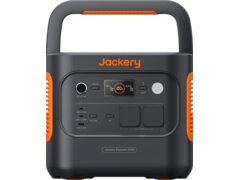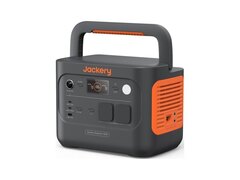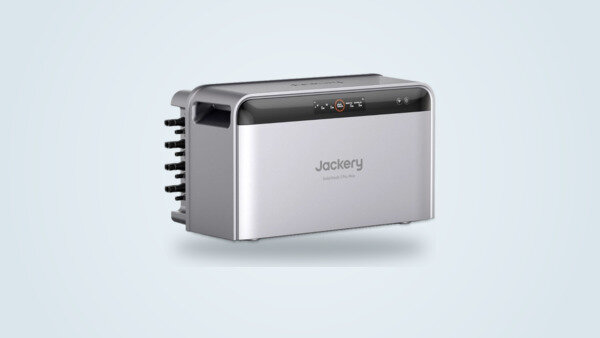
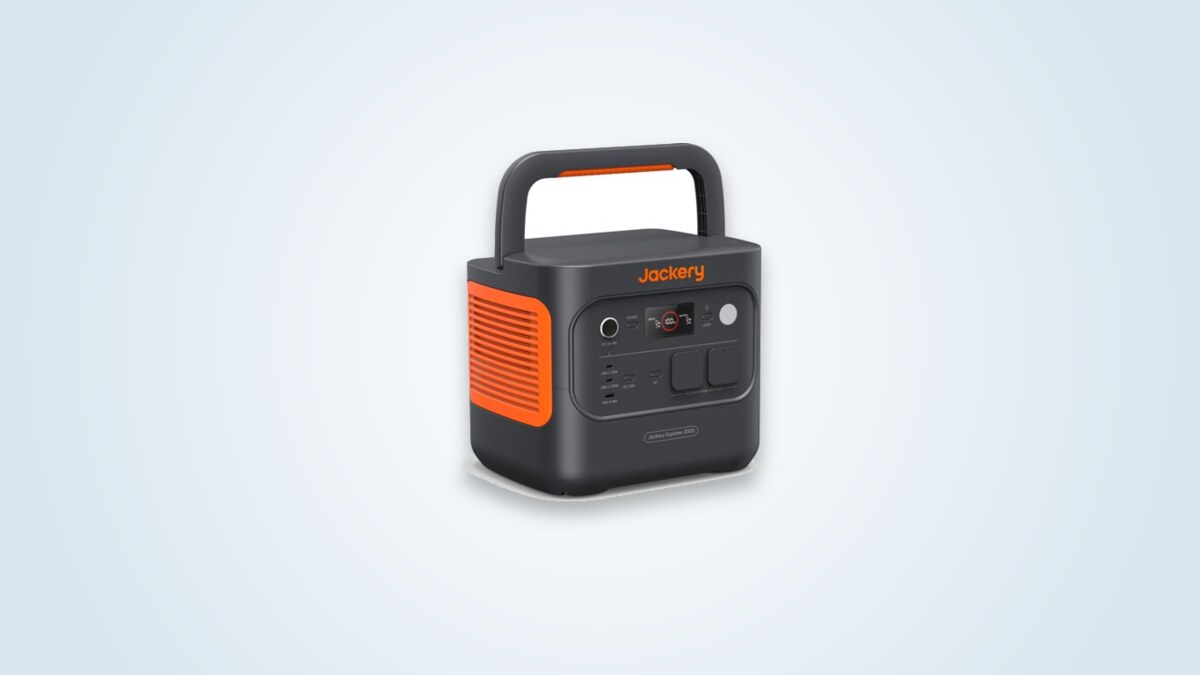
2042 Wh claimed, 1920 Wh delivered: an honest figure, a very strong yield
The 2042 Wh printed on the case is not an optimistic conversion. Fourteen groups of three automotive-grade LiFePO4 cells at 15 Ah each, wired in 3P14S, give 45.6 Ah at 44.8 V, or 2042 Wh, accurate to the volt. The manufacturer spec sheet gives exactly the same value, calculated the same way. Unlike several products covered in this same review series, there is no sleight of hand here between milliamp hours and watt hours.
What the user actually gets back is another matter. Between the inverter, the control electronics and the screen, which stay powered at all times, part of the stored energy never makes it out of the sockets. That works out to around 1920 Wh, or 94 % of the rated capacity, for 2141 Wh drawn from the meter to refill it, meaning a full round-trip efficiency of 89.6 %.
This is a high result for this format, where most stations land between 84 and 91 %. One falling under 75 % would raise questions about its inverter. Here, the figure holds up, and the traceability down to the actual cells lends confidence to the rest of the spec sheet. One caveat, though: this level rests on a single set of readings, with no cross-confirmation, where the category normally sits lower.
2200 W that holds, 4400 W still unconfirmed
The figure that matters day to day is the 2200 W continuous rating, and it holds in practice: a refrigerator, kettle, microwave and job-site power tools all run without tripping the protection, and two 230 V sockets drawing at once do not reduce the power available.
The claimed 4400 W peak is harder to confirm. The only figure available on this point tops out around 3100 W for a short spike, a value that lacks detailed measurement conditions to settle the question. Not solid enough to disprove the manufacturer figure, nor weak enough to dismiss it: best treated as a reservation rather than a conclusion.
Weight remains a strong argument. At 17.5 kg for 2042 Wh, it moves with one hand, while a well-established reference in the same segment, the EcoFlow Delta 2 Max, weighs 23 kg for almost identical capacity. On an object that gets pulled out of the trunk, carried upstairs or moved from room to room, that gap is felt with every use, far more than a peak figure rarely called on.
Two DC inputs, the same architecture as a model already found at fault
On the Explorer 1000 v2, a model in the same range, its two DC charging inputs, in the DC8020 format, are not isolated from each other: the voltage of a solar panel plugged into one, up to 60 V, ends up on the other. In concrete terms, plugging a solar panel into one side and the car lighter cable of a vehicle into the other amounts to applying up to 60 V to a circuit designed for 12 V.
The Explorer 2000 v2 has the same front panel: two DC8020 ports, interchangeable. The manufacturer spec sheet in fact lists the vehicle range (11 to 16 V) and the solar range (16 to 60 V) on one single line, for both ports without distinction, with neither one presented as dedicated to either use.
This specific point has not been electrically tested by any laboratory on this model. Downstream of these two ports, the conversion runs through a simple buck converter, a family of components that does not by nature isolate two inputs from each other: no transformer and no optocoupler at that specific point in the circuit. The only isolation components in the unit handle voltage sensing and communication for the battery, not power delivery to it. The corresponding circuit on the Explorer 1000 v2 shows exactly the same absence of dedicated isolation on that path, consistent with the voltage-leak flaw described above.
None of this proves the voltage leak on this specific model. But nothing indicates that it has been fixed either: same connector, same absence of any warning across the 47 pages of the manual and its five languages, same silence on the spec sheet.
The exact scope of this reservation needs to be gauged carefully. It concerns neither the battery, nor the inverter, nor the safety of the unit for itself: in every other use, the station behaves normally. What is at issue is what can happen to a third-party vehicle plugged into the other end of the cable, in one specific configuration that the manual never explicitly rules out.
An hour forty-five claimed, under a condition that is not spelled out
On paper, a full charge in about 1h45 for 2042 Wh is a good figure. It appears on the manufacturer spec sheet without qualification, but it actually corresponds to the "Emergency Super Charge" mode, which has to be turned on in the Jackery app to become available.
Without this mode turned on, the mains input caps lower, around 1300 W instead of the roughly 1800 W claimed with the mode active, which noticeably lengthens the real charging time. The station remains usable and charges normally without touching it, but the figure printed on the box assumes a step taken in the app, not a simple plug-in.
| Source | Claimed time |
|---|---|
| Mains, fast mode on | ≈1h45 for 100 % |
| 12 V car lighter | 24 h for 100 % |
| Solar, two ports | 400 W max total |
Charging through the car lighter socket, at 24 hours for a full charge, is only worthwhile as a top-up on a long journey, never as a primary method. And the solar input, capped at 400 W across both ports combined, is modest for a reserve of this capacity: it would take more than five hours of full sun just to restore a fifth of the battery.
Under 30 dB, except at full load
"Under 30 dB" is the figure the manufacturer repeats most often on its own product page, presented as the defining feature of how quiet the unit is. A technical note on that same page adds a detail the rest of the presentation does not show.
The exact text of that note: sound level is measured at one meter distance, 30 dB in quiet mode, 45 dB at full load. The figure highlighted everywhere else on the page therefore applies to only one of the two operating modes.
A fifteen-decibel gap is not a detail: it is perceived as roughly a doubling of loudness. The 30 dB rating applies only to partial charge or moderate discharge. It is when drawing on the full 2200 W, typically during a fast mains charge or heavy simultaneous demand, that the unit gets closer to the 45 dB claimed at full load.
No independent sound-level measurement was found for this model: the two figures above come solely from the manufacturer itself. They are therefore not factored into the detailed rating of this review, for lack of external confirmation.
What you can plug in: full on outputs, skimpy on mains sockets
On the front panel, the essentials are there: two USB-C ports, one at 30 W, the other at 100 W, capable of charging a demanding laptop without going through a 230 V socket. Two USB-A ports at 18 W round out the set for small electronics, and a 12 V car lighter output, 10 A maximum, can power standard automotive or camping gear.
| Output | Power |
|---|---|
| 230 V mains sockets | 2, 2200 W total |
| USB-C | 1 × 30 W, 1 × 100 W |
| USB-A | 2 × 18 W |
| 12 V car lighter | 10 A max |
The weak point sits on the mains socket side: only two on the European version, when some rivals of the same size offer three or four. In home use, where several bulky appliances often get plugged in at once, a refrigerator on one side, a freezer or router on the other, a power strip quickly becomes necessary to make full use of the 2200 W available.
Control, on the other hand, is not short of options: a built-in screen for control without a phone, a mobile app for remote monitoring, and a dedicated button to cut the inverter without switching off the whole unit. Enough to work around the two available sockets rather than being badly short of them.
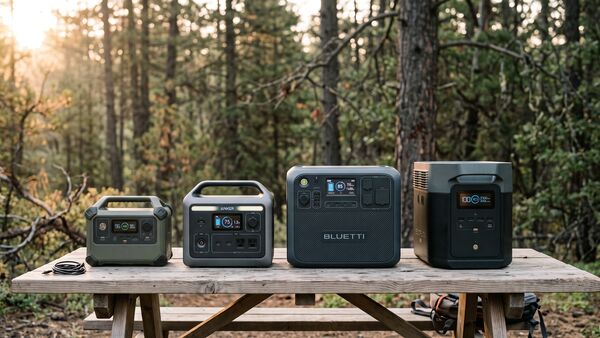
Against the other 2 kWh stations
In this capacity segment, the comparison turns less on watt hours, which stay close from one model to the next, than on weight and output power.
| Criterion | Explorer 2000 v2 | EcoFlow Delta 2 Max | Anker Solix C2000 |
|---|---|---|---|
| Capacity | 2042 Wh | 2048 Wh | 2048 Wh |
| Continuous power | 2200 W | 2400 W | 2400 W |
| Weight | 17.5 kg | 23 kg | 18.9 kg |
Against the EcoFlow, the weight gap stays clear: 17.5 kg versus 23 kg for almost identical capacity, or nearly a quarter less to carry. Against the Anker, by contrast, the gap narrows: both stations weigh under 19 kg, and the difference mostly comes down to 200 W less continuous power on the Jackery, which stays secondary next to 2200 W that is already more than enough for most home uses.
The real differentiator for the Jackery is therefore not being the lightest of all 2 kWh stations on the market (it no longer is, against the newest models), but staying clearly below the segment average while keeping a price among the most accessible for its capacity.
Backup switchover and app: what is claimed, what is experienced
The automatic switchover function, in the event of a mains outage, is claimed at under 20 milliseconds. No independent oscilloscope measurement was found to confirm it: it is a manufacturer figure, to be taken as such.
A switchover time under 20 milliseconds should in theory be enough that a router, a home gateway or a computer stays online through a mains outage without a noticeable interruption, including with sensitive equipment such as an oxygen concentrator or a ventilation device.
The Jackery app, over Bluetooth and 2.4 GHz WiFi, gives access to the charge level, the charging mode and an estimate of remaining runtime. It is not essential, though: the unit works normally for charging and discharging without being connected to it, and turning the fast-charge mode on or off remains the main reason to use it.
Automotive cells, 4,000 cycles, and a two-tier warranty
The cells are prismatic LiFePO4 of automotive quality, fourteen groups of three wired in series. The manufacturer echoes this lineage in its own materials, with charge cycles and technology said to be close to what equips electric vehicles. No independent data contradicts this presentation.
The warranty shown as five years actually breaks down into three base years, plus two additional years thrown in, but only when going through the manufacturer website directly. A purchase through another platform does not automatically guarantee the five years advertised: check the registration terms before counting on it.
No official recall targets this model, and no repeated reports of swelling or structural failure were found. The few individual failures known, a faulty output port or premature charging failure, were handled under warranty, with no identifiable pattern of recurring failure.
Who it suits, and who it does not
It suits anyone who wants to secure a home against outages, without giving up much space or weight for it, anyone charging sensitive or medical equipment thanks to its silent switchover, and anyone who values being able to move a 2 kWh reserve alone.
It does not suit, given what is currently known, anyone planning to use it on solar AND on a 12 V vehicle at the same time: caution calls for avoiding that combination for as long as no independent measurement has confirmed the isolation of its two inputs. Nor anyone looking for generous solar charging, capped at 400 W here when other stations in this segment accept double that or more.