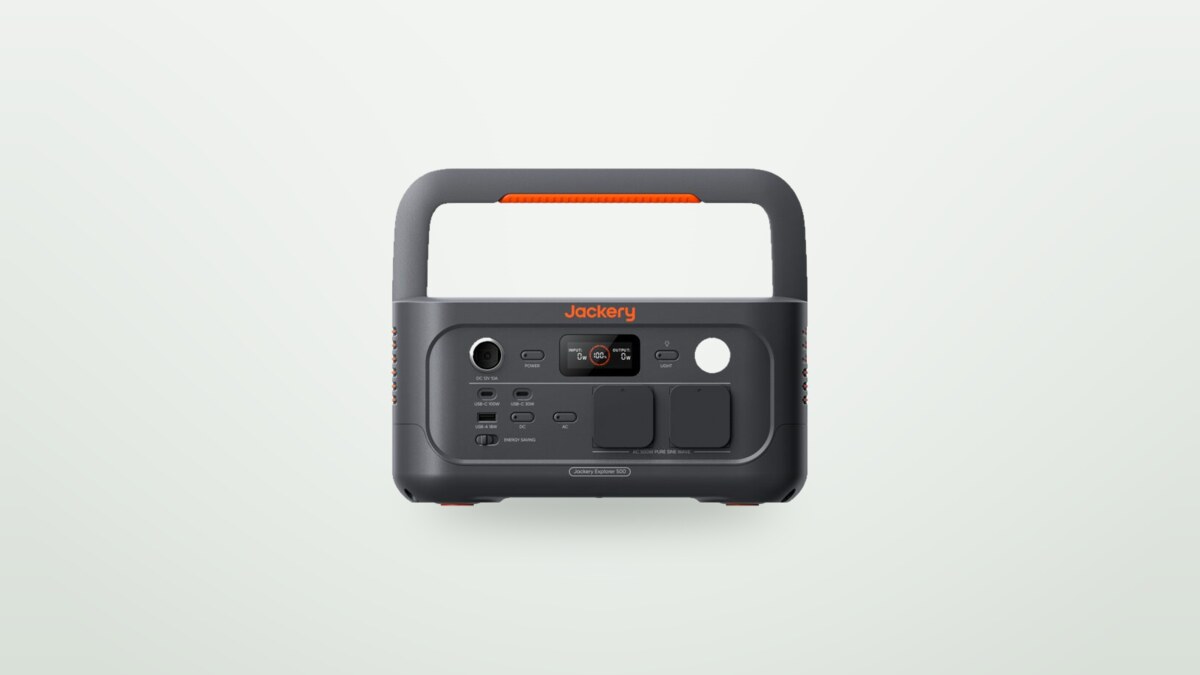
78 minutes for a full charge, not “about 1 hour”
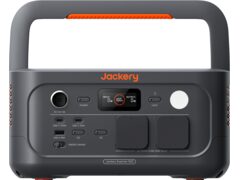
The maker's own official documentation contains an inconsistency: marketing copy advertises a full charge “in one hour”, while the detailed specification table lists 1.3 hours, or 78 minutes. The detailed figure is the closest to reality: the full mains charge takes 78 minutes. One plausible explanation for the marketing shortcut: a combined charge using the mains and two solar panels at the same time was also barely 1 hour, a different scenario from a mains-only charge.
Charging through a vehicle's cigarette lighter socket, meanwhile, takes about 6 hours from an empty battery.
200 W of solar input, double the previous model
The maximum accepted solar power is 200 W, through a DC8020 connector (voltage range 16 to 60 V), against 100 W on the previous model. A single 100 or 200 W panel can be plugged in directly; running two 100 W panels at the same time requires a Y-connector sold separately. A solar charge with two 100 W panels in good conditions takes about 2.8 to 3.5 hours. As is always the case with solar input, the power a panel actually delivers depends heavily on real sunlight conditions and generally stays below its rated output.
1000 W of claimed surge power, but protection cuts in first
Against an 800 W resistive heating appliance, output power climbed only to a little over 700 W before overload protection cut power, after 41 seconds running at reduced power. An 800 W appliance already exceeds the claimed 500 W continuous rating, so this cutoff is partly a normal protection response to a sustained overload. That said, the cutoff threshold actually observed, around 700 W, remains below the claimed 1000 W surge figure, and no independent measurement confirms that this surge value actually holds on an appliance specifically designed to test it.
512 Wh claimed: between 460 and 498 Wh delivered depending on the discharge conditions
The actual delivered capacity does not fully agree depending on the discharge conditions: 498 Wh out of the 512 Wh claimed (97 %) in a continuous discharge, against 460 Wh (89.84 %) in a full discharge using a halogen heater. This gap remains without further cross-confirmation to date.
Operation measured as quiet, with one qualitative caveat
Noise level has been measured in the psychoacoustic sone unit, which reflects perceived annoyance better than a raw decibel figure: 0.5 sone at 100 W of load, 1.7 sone during mains charging, and 2.1 sone at a full 500 W load. Expressed in decibels, noise level stays under 28 dB at 200 W, with no equivalent figure at full load. These measured figures are consistent with generally quiet operation.
One caveat remains, however: perceived fan noise under load varies noticeably, described as noisy in some cases and very quiet in others, with no figure available to settle the contradiction. The unit offers no dedicated quiet mode.
The 10 ms UPS switchover: a claim not yet verified
The maker promotes a UPS function with a switchover time claimed at 10 ms, highlighted in particular for backup IT equipment and for medical uses such as a CPAP machine. No independent, quantified measurement of the actual switchover time has been found to date, nor any feedback on equipment more sensitive than a home router.
Two concrete interface flaws worth knowing before buying
The AC output indicator stays lit even after overload protection has cut power, with no clear signal that plugged-in appliances are no longer actually being powered. This behavior occurs in particular with a heating appliance that triggers the protection.
The screen can also display 0 W of output power while a laptop is, in fact, charging, suggesting that the unit does not correctly detect or display very low output levels.
6000 cycles at 70 %: a figure inflated by the threshold used, not by the chemistry
The maker claims 6000 cycles at 70 % remaining capacity, a figure markedly higher than the 3000 to 4000 cycles at 80 % usually quoted elsewhere in the sector for high-end LiFePO4. The methodological point is this: the end-of-life threshold used (70 %) is more permissive than the usual standard (80 %), which mechanically inflates the displayable cycle count for equivalent cell quality. The two figures are therefore not directly comparable without normalising them to the same threshold. Other LiFePO4 models from the same maker claim similar or higher figures using the same 70 % threshold, which confirms that this is a brand-wide communication choice rather than a standalone performance result for this one model.
With the product only 11 months old, no independent aging test has been able to either confirm or disprove this figure: cycling a battery 6000 times takes several years, even under accelerated cycling.
Against the previous model: real, measured progress
| Criterion | Explorer 500 v2 | Explorer 500 (previous) |
|---|---|---|
| Chemistry | LiFePO4 | NMC |
| Weight | 5.7 kg | 6.4 kg |
| Full mains charge | 78 min | 7 to 8 h |
| Max solar input | 200 W | 100 W |
| USB-C ports | 2, with Power Delivery | None |
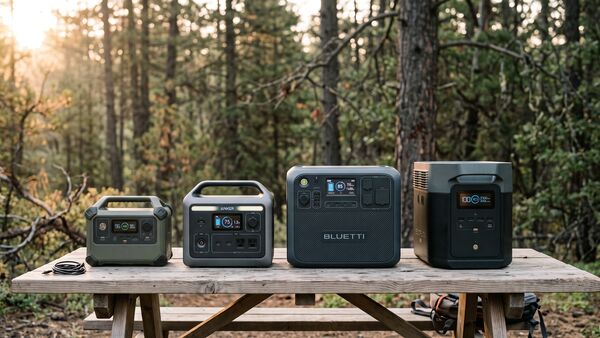
This progress concerns objective characteristics (weight and charge speed in particular), not just marketing claims. One point of caution for the rest of this review: nearly all the head-to-head comparisons against direct competitors actually confuse this previous model with the current version, which skews any comparison taken at face value. No reliable, rigorous measurement comparing the Explorer 500 v2 against direct competitors under a single consistent protocol has otherwise been found to date.
Who it suits, and who it does not
It suits anyone looking for a light, fast-charging station for camping or light nomadic use, running appliances that stay under the 500 W continuous rating.
It does not suit anyone planning to regularly draw on the 1000 W surge power with powerful resistive appliances, nor anyone considering critical medical backup use relying on the UPS function, whose actual switchover time remains, to date, unconfirmed by any independent measurement.