1536 Wh claimed, about 1336 Wh delivered
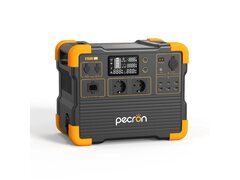
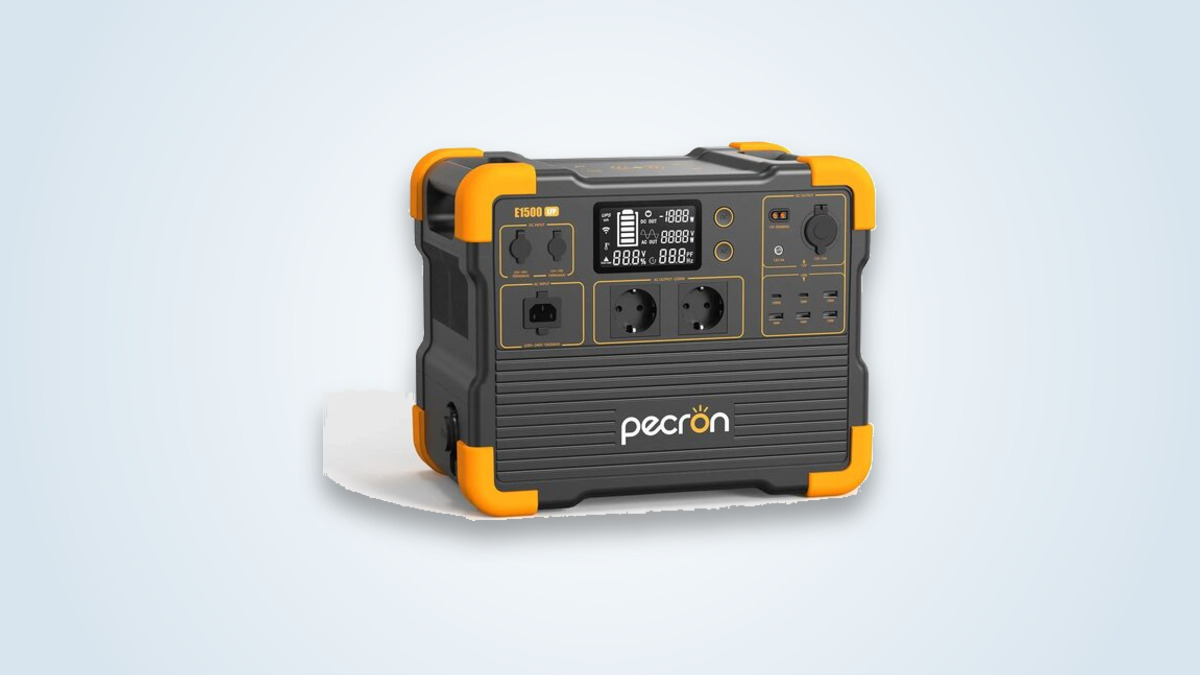
The Pecron E1500LFP packs a 1536 Wh LiFePO4 battery at 51.2 V, a chemistry rated for 3500 cycles before dropping to 80% of its original capacity. Actual output lands around 86 to 87% of nominal, which works out to roughly 1330 to 1340 Wh effectively available at the outlet once the inverter's conversion losses are factored in.
That range fits what you would expect from a pure sine wave inverter paired with a LiFePO4 BMS, and it confirms that the 1536 Wh figure is not inflated. A 90% figure also appears elsewhere, but without methodology details or a raw number behind it, so this review treats the 86 to 87% range as the more reliable one.
1400 W of mains input: charging holds up, the European listing does not
The "80% in 80 minutes" figure promoted for this station assumes a 1400 W mains input. That is indeed the value the manufacturer works with: its European user manual, the one covering the 220-240 V range, lists a mains input of 220 to 240 V limited to 10 A, more than 2000 VA of headroom, and it states a full charge in 1.8 hours. Our own product page holds the same 1400 W figure.
The simplest check is arithmetic. Refilling a 1536 Wh pack at 700 W would already take more than 2h10 without counting a single conversion loss, and closer to 2h30 or 3h in practice. A full charge stated at 1.8 hours is simply impossible at 700 W; it is perfectly consistent with 1400 W. The two figures cannot both be true.
So where does the 700 W come from? From the maker's European store (eu.pecron.com) and its German version, which both show "Mains (700W)" inside a descriptive block copied over from a marketplace listing, a block that breaks off mid-sentence. That page carries no specification table at all. And 700 W happens to be exactly the maximum the manufacturer assigns to this station's GX16MF solar port, rated at 32 to 95 V, 15 A and 700 W. Everything points to a figure copied into the wrong row rather than a throttled European version.
The same fog surrounds solar input itself: depending on the official channel, it is given as 700 W on the GX16MF port or 1000 W on a newer XT60 port. That says little good about the brand's documentation discipline, but it does not call mains charging into question. The practical takeaway for a buyer is simple: the charging promise holds, and it is the seller's listing that deserves a suspicious read, not the product.
2200 W continuous confirmed, 4400 W peak still unconfirmed
On continuous power, the claimed 2200 W holds up well under real loads: an electric kettle, a pressure washer, a space heater, and the combination of a microwave plus a kettle (about 2140 W combined for several minutes) all run without cutting out or overheating.
The claimed 4400 W peak for brief power draws is less certain, however. Beyond continuous power, the device cut off as soon as 2200 W was exceeded, never reaching the 4400 W threshold; it also ran noticeably hot under sustained use at full power. This behavior appears only once in the material available to date, with no confirmation or refutation elsewhere: a serious signal, not yet a firmly established fact, but enough not to take the promoted peak figure at face value.
One more nuance worth knowing: in backup (UPS) mode, available continuous power drops to 1800 W instead of 2200 W. For most home backup uses (fridge, internet box, lighting), this limit remains more than enough, but it is worth knowing for anyone planning to plug in a device close to 2000 W continuous.
Expandable to 7680 Wh, but a battery generation that differs by market
The station accepts one or two additional EP3000-48V batteries (3072 Wh each), taking it to 4608 and then 7680 Wh respectively, a genuine option for investing gradually rather than paying upfront for a very high capacity station. This configuration is confirmed on the current official European stores.
One point deserves attention, though: the maker has updated this expansion battery lineup in the United States, where a new EP3800-48V version (3840 Wh) is now offered, bringing total capacity to 9216 Wh with two units. Neither the compatibility of this new battery with the unit sold in France, nor the availability of this version in Europe, is clearly documented at this point: for a medium-term expansion plan, checking directly with the seller which battery generation remains compatible with the unit bought today is a useful precaution.
A warranty the maker states differently depending on the channel
This station's commercial warranty period varies from one official manufacturer channel to another. The European store lists 3 years. Documentation circulating on the US market describes a different structure, a 2-year base warranty extended to 5 years if the purchase is registered within 30 days. The maker's social media accounts have separately announced a 5-year extension for this specific model, without that announcement being reflected on the European store itself.
Three different figures for the same product, all coming from official manufacturer channels, do not make it possible to say with certainty which duration actually applies to a purchase made in France today. This is a point worth getting confirmed explicitly in writing before buying rather than assuming.
One documented failure case, and limited European support
No safety recall or incident tied to the station itself (as distinct from solar panels from the same brand, which are a separate matter) has been identified. One specific failure case, however, involves a battery management board that stopped correctly recognizing the state of charge, preventing mains charging from starting normally, resolved after several weeks by a component replacement under warranty. This is an isolated, well-described case, not a widespread failure, but the resolution time gives an indication of the response time to expect for a real problem.
On after-sales support, the only phone number listed on official channels is American, with hours aligned to that time zone; European contact is by email only. Stated delivery times for spare parts range from 2 to 10 business days in Europe, but can reach 30 days for some international shipments. On the positive side, extended real-world use has held up reliably overall, with only a few minor software glitches.
Twelve outputs, but only two mains sockets
The output panel remains generous on paper: two 230 V sockets, one high-power 12 V output, a cigarette lighter socket, two additional 12 V outputs, four USB-A ports, two USB-C ports including one at 100 W, and a 15 W wireless charging pad. The real friction point is the number of mains sockets: only two, where several direct rivals offer three or even four at this price point, which makes a power strip necessary as soon as more than two devices are plugged into the mains.
Fan noise stands out as the main friction point in everyday use, though without a reliable decibel measurement to back it up: it is worth treating as a genuine concern rather than as a quantified defect to compare against rival stations.
Who it suits, and who it does not
This station ticks a lot of boxes for anyone looking for large LiFePO4 capacity on a small budget, with the option to expand later and without giving up fast charging. Home backup, camper van use or the occasional job site remain a good fit with its real strengths: honest capacity, continuous power that holds up, a full charge in under two hours and expandability.
It suits less well anyone who needs responsive phone-based after-sales support, anyone who wants to plug more than two devices into the mains without a power strip, or anyone counting firmly on the claimed 4400 W peak. Before buying, the most useful precaution no longer concerns charging power, which really is 1400 W, but the applicable warranty period and the expansion battery generation compatible with the unit on offer: two points on which the maker still contradicts itself from one channel to the next.