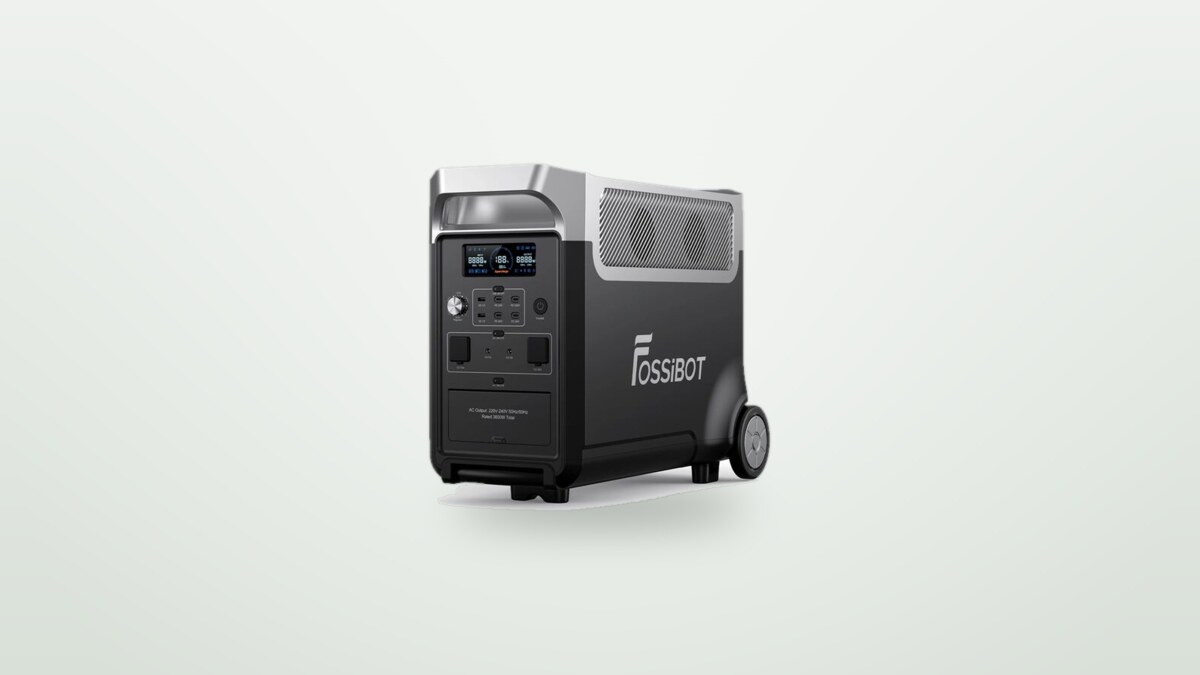
6500+ cycles or 4000+: the manufacturer contradicts itself
Fossibot states two different figures depending on the page. The dedicated F3600 Pro product page, in both its specification table and its descriptive text, states 6500 cycles or more. An official blog post comparing the F2400 to the F3600 Pro instead mentions 4000 cycles or more, in a generic statement about the brand's LiFePO4 batteries that does not appear specific to this particular model. The official F3600 Pro FAQ, for its part, gives no cycle figure at all.
The capacity-retention threshold tied to that figure also varies by page: 50 % of original capacity on one official page, 80 % on another. Verifying 6500 real-world cycles would take several years of daily use, a track record that does not yet exist for a model launched in September 2024. The 6500-cycle figure is used here as the value tied to the dedicated F3600 Pro product page, the most specific and most widely repeated one, but it remains a manufacturer figure not independently audited, with a retention threshold that Fossibot itself does not set consistently.
Continuous power and mains charging: the two figures that hold up
This is the strongest point in the whole picture: in real-world use, continuous power reaches 3640 W, slightly above the 3600 W claim, with no cutout and no thermal throttling. A 2200 W angle grinder is also powered without issue, under partial load.
Mains charging time at 2200 W reaches 2.1 hours, or 2h10, matching the manufacturer's claim of around 2 hours. Combined charging time for the F3600 Pro with its FB3840 extension module reaches 4.3 hours at the same input power, a consistent value since capacity doubles at the same input power. No test of sustained continuous-load endurance over an extended period, with temperature readings or any eventual cutout, was found.
2000 W of solar power claimed, never verified at full output
Solar input is claimed at up to 2000 W split across 2 MPPT inputs. No independent source has verified that ceiling under real conditions, however, for lack of an actual 2000 W panel array connected at the time. The real-world power figures available concern much lower values: a full recharge in under 9 hours with 400 W of panels in summer, and around 200 W in November, under very weak sunlight.
In both cases, the power obtained stays limited by the weather or by the size of the panel array on hand, not by any demonstrated limit of the unit. The 2000 W ceiling therefore remains, to date, a manufacturer figure that is not contradicted but also not independently verified at a power level near the claimed maximum.
UPS switchover at 10 ms: a claim, no independent measurement
UPS mode claims a switchover under 10 ms, with load limited to 2500 W on the dedicated outlets (so not the full 3600 W in UPS mode). No independent, instrumented measurement of this switchover time was found, and no credible field report fills that gap.
The 10 ms figure remains a manufacturer figure repeated as-is: no independent, instrument-backed measurement of it exists.
Noise not measured, control app prone to disconnections
No decibel measurement, at any distance, was found for this model. Perceived noise level varies a great deal with charging power: clearly audible at the maximum of 2200 W while charging, it already becomes noticeable from 400 W. According to the manual, the fan trigger threshold sits between 131 °F and 149 °F (55 °C and 65 °C) on the cooling fins.
On the software side, the control app (BrightEMS, WiFi and Bluetooth) covers the essential functions: percentage tracking, on/off control, charge scheduling. Fossibot has published an official notice acknowledging app connection issues, without the exact detail of which models are affected or how it was resolved being made accessible.
Warranty: 2 years in the official policy, 5 years on the product page
Two official pages pull in opposite directions on this exact point. The dedicated F3600 Pro product page explicitly states a 5-year warranty (60 months). The site's warranty policy, on the other hand, places the F3600 Pro in a first category, named alongside the F800, F1200 and F2400, covered by a 2-year limited warranty; solar panels, batteries and accessories fall into a second category, at 1 year. No extension mechanism appears there. It is that warranty policy, rather than the product page's sales copy, that sets out what the manufacturer undertakes to cover: the term to count on is 2 years.
The warranty, moreover, only covers purchases made through Fossibot's own channels or authorised resellers, a condition that is not always clearly highlighted at the point of purchase. For a unit at this price, that purchase-channel restriction is worth checking before ordering.
| Figure | F3600 Pro product page | Site general page |
|---|---|---|
| Warranty | 5 years (60 months) | 2 years (24 months), F3600 Pro named |
| Cycles claimed | 6500+ cycles | 4000+ cycles (generic text) |
42 kg on wheels: real friction as soon as the ground is not flat
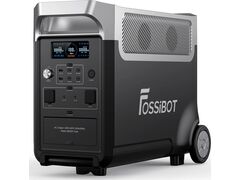
Two wheels and a telescopic handle let you move the unit without carrying it, but only in good conditions. On hard, flat ground (garage, patio, driveway), moving it alone stays manageable. On uneven terrain (grass, gravel, sand), the effort required becomes markedly greater and the wheels clog up quickly. With the FB3840 extension module attached, taking the combined weight past 79 kg, moving it with two people is strongly advised.
This is not a design flaw: it is the logical price of a capacity this size, and the wheels do a good job on suitable surfaces. But the claim of an easily transportable station does not hold up as-is once the terrain gets more difficult.
The FB3840 extension module is real, and performs as claimed
The additional FB3840 module, needed to reach 11520 Wh, is genuinely on sale through several resellers, at a price that varies a great deal with current promotions (roughly 1000 to 1450 € depending on the period). It has its own independent solar input, up to 200 W, and weighs 37 kg on its own.
Once combined with the F3600 Pro, total capacity reaches 6530 Wh out of the 7680 Wh claimed, or 85 %, a ratio consistent with that of the unit alone (see below), for a combined charging time of 4.3 hours at 2200 W. The extension is therefore not just a marketing promise: it performs, in practice, as claimed.
Actually available capacity: around 87 % of the claim
Actually available capacity, distinct from round-trip conversion efficiency, reaches 3360 Wh out of the 3840 Wh claimed for the F3600 Pro alone, or 87 %, and 6530 Wh out of the 7680 Wh claimed for the combination with the FB3840 module, or 85 %. These two close, consistent ratios reflect a structural gap between nominal capacity and actually usable capacity, BMS safety margin included, present identically on both configurations.
No measurement of round-trip conversion efficiency (energy drawn while charging against energy delivered while discharging), on the other hand, was found at any output power. This point remains an area with no independent data.
No recall found, mixed customer-support experiences, a catalog price rarely paid
No recall or safety alert mentioning Fossibot was found, for this model or for the rest of the brand, though this is not a full guarantee of completeness.
Customer support paints a mixed picture, with no clear factor to predict which kind of experience falls to which buyer: repair and replacement times range from about two weeks to more than two months depending on the situation, with support sometimes hard to reach. This is a real risk, not a mere hypothesis.
On price, the catalog tag shown around $1,699.99 is in practice rarely the price actually paid: near-permanent promo codes, not stackable with each other but almost always available, bring the price actually seen down to between 1270 and 1550 € depending on the period. The unit's real value for money is judged on this effective price, not on the starting tag.