2880 Wh: a capacity now stated consistently
Capacity is the first figure a buyer looks at, and this station's has long been a moving target. That is no longer the case: on the official page aimed at the French market, 2880 Wh appears everywhere a reader would look for it, in the product name, in the introductory bullet list, in the specification table and in the presentation blocks further down the page. There is no contradiction left to settle.
The 3168 Wh figure, inherited from the previous generation, has not vanished entirely though. It survives in the page address, in the image file names and in the description written for search engines, all leftovers from a rename to "V2" that was never cleaned up to the end. In practice, a buyer comparing two tabs can still read 3168 in an address bar and 2880 on the page itself. That is confusing, but it is no longer a contradiction about what they are buying.
One deeper unknown remains: no independent measurement of the capacity actually delivered exists for this model. The 2880 Wh figure is a nominal capacity, from which the inverter's conversion losses must be subtracted to get the energy really available at the outlets. Without a measurement, that gap cannot be quantified here.
3500 W claimed, and charging figures that do not line up
The 3500 W continuous rating and the 7000 W peak are advertised consistently on the page aimed at France, with no contradiction found on this particular point. It is the best figure in our catalog, enough to run an induction hob, an oven or heavy power tools without having to choose between appliances. No independent measurement was found, however, to confirm that this power actually holds up under sustained use, or that the 7000 W peak is reachable in practice. On a $1424.00 purchase, that is trust extended to the manufacturer without a safety net.
Charging, on the other hand, contradicts itself on the page itself. The introductory bullet list claims a combined mains plus solar input of up to 4000 W for a one-hour recharge, along with 2000 W of solar charging in 2.5 hours. The specification table a few lines below gives different values: 2000 W maximum on mains input (220-240 V, 10 A), 1300 W maximum on solar across two XT60 MPPT inputs, and 3300 W maximum on combined input. These are not shades of wording, they are two different sets of figures on one single page, and the second is the only one detailed enough to be checkable.
The orders of magnitude in the table do hold together: 2880 Wh at 2000 W on mains alone takes about an hour and a half once conversion losses are counted, which is precisely the duration the manufacturer quotes most often. Adding solar logically brings that down towards an hour. So it is not the promise that is absurd, it is the listing that cannot give the same figure twice for the same specification. And none of these durations has been independently timed.
Four 230 V outlets, and two USB-C ports at 100 W each
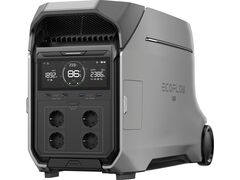
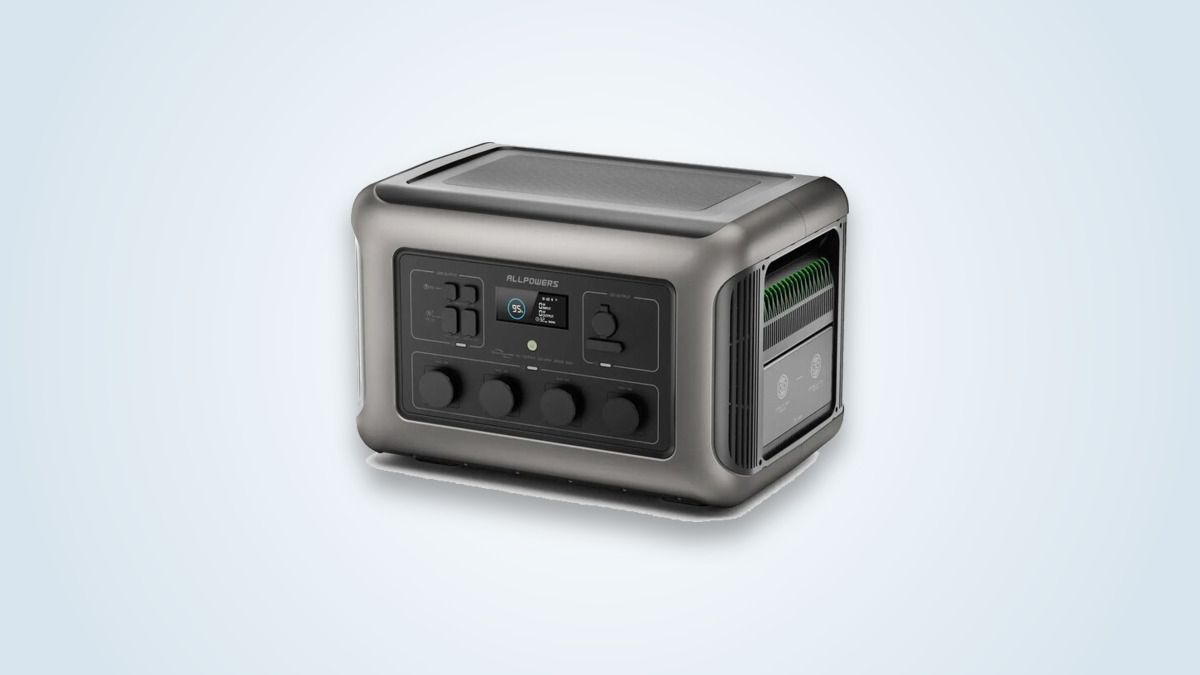
The output panel is one of this station's genuine strengths. Four 230 V outlets, where many rivals at this capacity stop at three, two USB-A ports rated for 120 W in total, a cigarette lighter socket and a DC5525 port sharing the same 120 W, all with an LCD screen, Wi-Fi and Bluetooth for app control.
One point deserves clarifying, because it is often read the wrong way. The manufacturer writes "USB-C x2, 20V 5A, 200W maximum": those 200 W are the total for the pair of ports, not the output of a single one. Each port goes up to 20 V and 5 A, which is 100 W, matching the most common USB Power Delivery tier and enough to charge a laptop at full speed. There is no single 200 W port here, and it is an easy confusion to make when comparing two spec sheets.
B3000 extension: how many units, really?
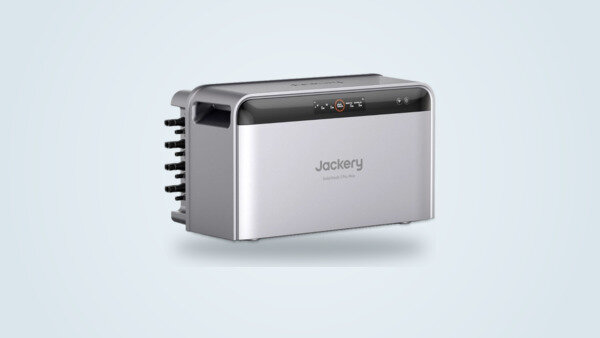
Expandability with the additional B3000 battery is presented as a central selling point of this station, and the manufacturer does sell a station plus battery bundle directly. But the number of B3000 units actually compatible varies widely depending on which official page you check: the French listing's bullet list mentions only one, another page mentions three, yet another allows a calculation of up to 15 units, and a last one mentions around thirty units for a total approaching 100,000 Wh. All these figures come from official manufacturer channels, with none presented as the corrected version of the others.
For a buyer planning a future extension, whether firm or just a possibility, this documentary scatter makes it impossible to know in advance how far the system can really grow without contacting the manufacturer directly for a firm answer. Until that is settled, it is wiser to buy this station for what it offers on its own and treat the extension as a bonus still to be confirmed.
36.95 kg: a machine you install, not one you move
The official specification table gives the weight without ambiguity: 36.95 kg, for 530 x 360 x 345 mm. That is heavy, and above all this station has neither wheels nor a telescopic handle. Two people can carry it; on your own, you set it down once and you do not pick it up often. For home backup installed in a pantry, a garage or a utility room, that is not a problem; for genuinely nomadic use, it is a limiting factor to take into account before buying.
On the reliability front, no recurring failure or safety recall specific to this model has been identified to date, and the LiFePO4 chemistry is rated for more than 3500 cycles with a 5-year warranty advertised on the station. No independent track record exists, on the other hand, on how the battery management system holds up over time for this specific model, the product still being relatively new on the market.
Who it suits, and who it does not
This station makes sense for anyone with a real need for high continuous power: 3500 W is what it takes to pick up an induction hob, an oven or heavy power tools without choosing between appliances. With four 230 V outlets and a UPS switchover advertised at 15 ms, it has the profile of a home backup unit installed permanently, in a utility room, a workshop or an outbuilding.
It suits less well anyone who wants a station they can move: 36.95 kg with no wheels means carrying it with two people, and rarely. It also suits less well anyone who needs verified figures before signing, since for this specific model there is no independent measurement of power, efficiency or charging speed, and the manufacturer's documentation still contradicts itself on charging and on expandability. Before ordering, getting the real input power and the number of compatible B3000 batteries confirmed in writing remains the most useful precaution. Worth noting too: this model is found mainly on direct sale from the manufacturer, with no identified reseller network.