231 Wh actually delivered out of the 286 Wh quoted
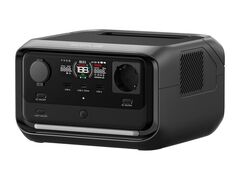
Out of the 286 Wh quoted, the actual delivered capacity measured across several charge levels works out to 228 Wh at the mains output under 100 W and 233 Wh under 600 W, an average of 231 Wh, or about 81 % of the rated figure. On the USB/DC output at low power (12 W), the measured efficiency dips slightly to 220 Wh (77 %). On the 12 V output through the cigarette lighter socket at 120 W, it climbs back up to 250 Wh (87 %).
This efficiency level, around 80 %, stays in line with the average for the River line as a whole, without being exceptional: the inverter and the conversion electronics always consume a share of the stored energy, whatever power is drawn.
A one-hour charge time, sensitive to ambient temperature
X-Stream fast charging promises a full recharge in about 1 hour, with mains input capped at 360 W. Under favorable conditions, that promise holds: a 50 % charge is reached in 48 minutes and a full charge in an even 60 minutes. Under other conditions, the actual measured input power varies between 150 and 340 W depending on ambient temperature, which pushes the full charge time beyond 1 hour. The manufacturer's official documentation confirms that the battery management system adjusts amperage, voltage, and current in real time according to temperature, without publishing a precise figure beyond the maximum input power of 360 W.
The most plausible mechanism is a thermal limitation on the BMS: in warmer weather, or in a poorly ventilated room, actual input power is reduced to protect the battery, which mechanically extends charge time. The 1-hour promise therefore remains achievable, but is not guaranteed under every ambient condition.
Under the quoted 30 dB: true at moderate load, exceeded on fast charging
The quoted noise level of under 30 dB holds true at low and medium load: at low load (300 W), the noise level stays around 28 dB at 30 cm, and the fan stays inactive during normal DC use. At maximum load and at 90 °F (32 °C) ambient, the noise level climbs to 30 to 33 dB at one meter. On fast charging at full power, a peak of 45 dB appears.
The claim of "under 30 dB" is therefore neither false nor entirely true in every circumstance: it accurately describes typical use at moderate load, but not fast-charging peaks or maximum load in a warm room.
UPS switchover at 9 ms, one minor caveat
The automatic switchover to battery on a mains outage is 9 ms, just under the quoted 10 ms. The sensitive equipment connected, desktop PC, monitors, and Wi-Fi router, shows no visible interruption during the switchover. One minor caveat exists: a light may briefly flicker at the moment of switching from mains to battery, which suggests that the transition, although very fast, may not be entirely imperceptible in every case.
Compatibility with sensitive networking and computer equipment
The speed of the switchover (9 ms) makes the River 3 Plus suitable for protecting networking and computer equipment sensitive to micro-outages: router, home gateway, NAS, small server. The Power Manager software is compatible with the NUT (Network UPS Tools) protocol, enabling an automatic clean shutdown of the protected equipment during a prolonged outage, a clear advantage over an entry-level lead-acid UPS, which generally does not offer this software management.
X-Boost at 1200 W: resistive loads get through, motors often trip protection
X-Boost mode allows the rated 600 W output to be exceeded, up to 1200 W, by lowering the voltage delivered, a technique that works well with resistive loads (heaters, kettles, toasters) but is not recommended for electronics sensitive to voltage variation.
In real-world use, the outcome depends heavily on the appliance plugged in. Working without tripping the protection: a small electric heater on its low setting (599 W, with the high setting triggering overload protection instead), a filter coffee machine (though it uses 43 to 45 % of the charge for 6 cups), a 2-slice toaster. Frequently tripping overload protection: kettle, microwave oven, panini press, vacuum cleaner. The outcome nonetheless varies by exact model: a 1000 W microwave oven can, for example, work without tripping the protection, which shows that the behaviour depends on each appliance's startup current draw, not on a binary rule valid for an entire category.
No reliable measurement of how long 1200 W can actually be sustained could be established: this is a genuine blind spot regarding how X-Boost mode holds up over time.
A known restart flaw, and an isolated after-sales case
Across the River 3 line, after a full battery discharge that has shut the unit down, the return of mains power does not automatically reactivate the 230 V output, a manual press of the relevant button is required. A workaround exists: set the minimum discharge limit to 0 %.
An isolated case of an abnormal drop in charge is worth noting (from 100 % to 60 % in 30 minutes with just a phone plugged in that was not recharging, followed by a further loss of charge after a trip with the unit switched off), with after-sales support contacted twice, first answered with a firmware update that had no effect, then left without a reply despite photographic evidence provided. This is an isolated case, to be treated as such rather than as a general reliability trend, but concrete enough to be worth reporting.
No recall concerns this line
EcoFlow carried out a product recall announced in October 2025 that concerns exclusively the DELTA Max 2000 model (reference EFD310), around 25000 units sold between July 2022 and May 2025, for an overheating risk fixed with a firmware update, with no physical return required. The manufacturer explicitly states that no other model is affected. No recall specific to the River 3 Plus, or to the River line as a whole, has been identified.
Against the competition: a direct comparison still to be established
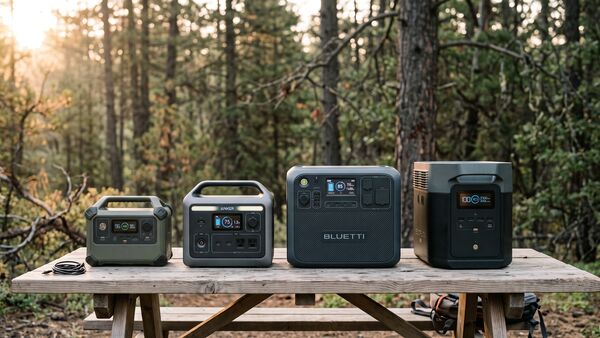
The River 3 Plus is positioned against direct competitors such as the Bluetti EB3A, the Jackery Explorer 300 Plus, or the Anker Solix C300, already presented in a comparison on the product page. No direct comparison under the same conditions is available to date between these products.
This is a genuine blind spot on this market segment, not a judgment for or against the River 3 Plus relative to its competitors.
Who it suits, and who it does not
It suits anyone looking above all for reliable UPS protection for sensitive networking or computer equipment (router, NAS, small server), and who will mainly power resistive appliances (heater, coffee machine) rather than motor-driven appliances through X-Boost mode.
It does not suit anyone planning to regularly power motor- or compressor-driven appliances beyond the rated 600 W output (kettle, microwave, vacuum cleaner), since X-Boost mode proves inconsistent depending on the appliance, nor anyone looking for a quiet environment during fast charging.