What the claimed 1382 Wh are really worth
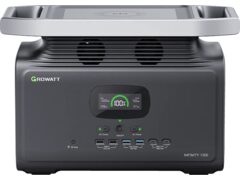
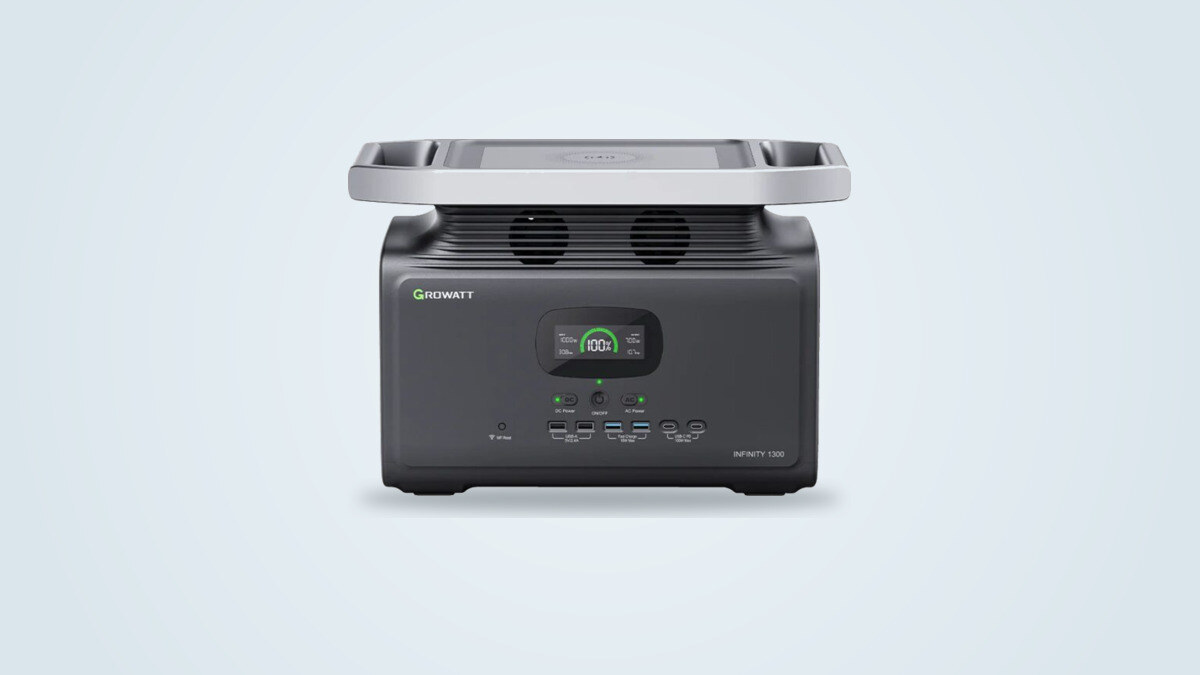
The Growatt Infinity 1300 packs a 1382 Wh LiFePO4 battery, a rated capacity that never fully converts into usable energy once it passes through the inverter or the DC outputs. On the AC (mains) path, the station returns up to 1240 Wh, or 90% of its rated capacity. On the DC path, available output drops to 1139 Wh, or 82%. This gap between the two paths is normal: 230 V conversion runs through a different inverter stage than the 12 V outputs, with its own losses.
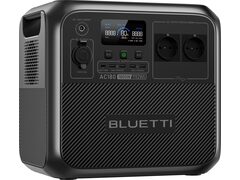
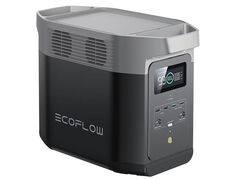
A 90% return on the AC path puts the Infinity 1300 in the upper-average range for its category, close to several LiFePO4 stations in the same price bracket, including the Bluetti AC180 and the EcoFlow Delta 2 (more in the comparison chapter). The gap to the best figures on the market amounts to a few percentage points, not a gulf. The pack itself is rated at 27 Ah, consistent with a nominal voltage of around 51 V typical of a 14S LiFePO4 assembly, the most common configuration at this capacity level.
Mains charging: a claimed 1200 W, with a catch that changes the picture
Growatt rates mains charging at up to 1200 W, for a full charge in about 1h48 (108 minutes) and 80% reached in about an hour. This figure corresponds to a charge starting on a battery that has just had a rest, outside of any thermal constraint.
One detail appears in no marketing material: the charging power actually available depends on the battery's internal temperature, itself tied to how recently it was used. As soon as a discharge has just taken place, mains charging power caps at 800 W instead of the claimed 1200 W, until the temperature climbs back up. This thermal-management behaviour is common on recent LiFePO4 packs, whose BMS deliberately limits charge current to protect cell lifespan, but it doesn't appear anywhere in the Infinity 1300's marketing material. In practice, the 1200 W figure matches one specific scenario, a cold-start recharge, not the most common case of a daily routine that alternates discharge and recharge.
Solar and 12 V: a wide input, real versatility
Solar input accepts a wide voltage range, from 12 to 100 V, up to 800 W and 12 A, managed by a single MPPT controller rated at 99% efficiency. This wide range allows several panel configurations in series without forcing a single layout, a real plus for anyone who already owns panels from another setup. Under good sunlight, a full charge from solar alone takes about 2h30, against 1h48 on mains under ideal conditions.
The station also accepts 12/24 V charging from a car outlet, slower, at around 14 hours for a full cycle: a backup option rather than a primary mode. Pass-through mode, powering devices while charging, is available, useful for a fixed home-backup setup.
1800 W continuous, 3600 W peak: what one charge sequence confirmed
The inverter delivers 1800 W continuous across the four mains outlets, with a claimed peak of 3600 W, a figure consistent with outputs sized for a strong inrush current at startup: a compressor, a compression fridge, certain power tools. This peak reserve doesn't translate into a higher continuous output: it only serves to absorb the brief spike that comes with starting a motor, before its draw drops back well under the 1800 W ceiling.
A charge sequence recorded the inverter at 2500 W for under 5 seconds, below the manufacturer's claimed 3600 W peak. Nothing indicates whether this level corresponds to the unit's real ceiling or simply to the highest point of the specific sequence run at the time: caution is warranted on the peak claim, without dismissing it as unfounded either. On continuous power, on the other hand, nothing calls the claimed 1800 W into question.
14 outputs, a wireless charging pad, and an app that's genuinely there
The line-up is complete for the class: four mains outlets, two USB-C ports up to 100 W each, four USB-A ports (two at 12 W, two at 18 W fast charge), a 132 W car outlet, two DC5521 ports at around 36 W each, and, less common on this size of station, a wireless charging pad built into the top of the unit, up to 15 W.
Remote control runs through the MyGro app, available over Bluetooth then WiFi relay once the unit is paired, with a dedicated WiFi reset button on the front panel. It shows charge state along with incoming and outgoing power in real time, and allows remote monitoring of the unit. The backup power function (EPS) switches to battery in under 20 ms during a mains outage: a laptop plugged into that outlet keeps running with no interruption or restart during the switchover.
| Output | Power |
|---|---|
| Mains (x4) | 1800 W total, 3600 W claimed peak |
| USB-C (x2) | 100 W each, 200 W total |
| USB-A fast (x2) | 18 W each |
| USB-A standard (x2) | 12 W each |
| Car outlet | 132 W (13.2 V / 10 A) |
| DC5521 (x2) | around 36 W each |
| Wireless pad | 15 W max (5 / 7.5 / 10 / 15 W) |
Real-world runtime: what the 1382 Wh deliver day to day
Translated into everyday use, the station's 1382 Wh run a portable fridge for about 11 hours, a CPAP machine for about 18 hours, or an LED work light for about 117 hours continuously. For smaller devices, the same charge covers around 90 smartphone charges, 50 tablet charges, 20 laptop charges or 20 drone charges.
These figures obviously vary with each device's actual draw, but they place the station well within its intended use: covering most of the electrical needs of a van, a camping weekend, or a power outage at home, without targeting the heaviest continuous loads (electric heating, air conditioning) that would drain the battery in a fraction of these durations. For mixed use, small appliances by day, lighting and device charging in the evening, the 1382 Wh typically cover a full day before a recharge, mains or solar depending on what's available, becomes necessary.
Build, noise and the data still missing
Build quality comes across as solid, far from a cheap plastic shell wrapped around a generic lithium battery. The front cooling vents sit exposed and accessible, which makes regular dusting easier, a simple but useful detail on a unit whose fan runs hard under load. The LiFePO4 chemistry is rated for over 3000 cycles at 80% capacity, with a 5-year manufacturer warranty, a level that's now standard for this price segment but still a serious argument next to a conventional lithium battery.
Official operating temperatures run from 32 to 104 °F (0 to 40 °C) while charging and 14 to 104 °F (-10 to 40 °C) while discharging, a standard range for this type of product. On noise, the only figures available put it at around 50 dB running the inverter and 48 dB while charging, with no measurement distance given: a figure to treat with caution rather than compare directly against stations whose acoustic method is published.
On the software side, one case of the mobile app failing to set up has surfaced, with no way to tell whether it's an isolated incident or a more widespread issue. More broadly, Growatt is best known as a residential solar-inverter maker first, a business it has run for longer than its portable-station line, and one where its customer support gets mixed feedback on response times. No recall or safety incident has surfaced for this model, which carries the certifications expected for the US market: FCC certification and UN38.3 for lithium-cell transport.
Against the Bluetti AC180 and the EcoFlow Delta 2
Within its own price bracket, the Growatt Infinity 1300 regularly comes up against the Bluetti AC180 and the EcoFlow Delta 2, two LiFePO4 stations with identical continuous power (1800 W). Against them, the Infinity 1300 lines up a higher rated capacity (1382 Wh versus 1152 Wh and 1024 Wh) and a noticeably more generous solar input (800 W versus 500 W on both others), a real advantage for anyone recharging regularly off solar.
On AC-path return, the three stations sit close together: 90% for the Infinity 1300, 89% for the AC180, 91% for the Delta 2, gaps too small to separate the three on this criterion alone. The Delta 2 keeps the edge on mains charging speed (a claimed 1h20 versus 1h48), and the AC180 on claimed cycle count (3500 versus 3000+). Weight, on the other hand, counts against the Infinity 1300 at 42.3 lb (19.2 kg), against 36.2 lb (16.4 kg) for the AC180 and 26.5 lb (12 kg) for the Delta 2, a gap that shows as soon as it needs moving often.
| Criterion | Growatt Infinity 1300 | Bluetti AC180 | EcoFlow Delta 2 |
|---|---|---|---|
| Rated capacity | 1382 Wh | 1152 Wh | 1024 Wh |
| AC-path return | 1240 Wh (90%) | 1030 Wh (89%) | 930 Wh (91%) |
| Continuous power | 1800 W | 1800 W | 1800 W |
| Max solar input | 800 W | 500 W | 500 W |
| Full mains charge | 1h48 (up to 1200 W) | not stated | 1h20 |
| Claimed cycles | 3000+ | 3500 | 3000 |
| Weight | 42.3 lb (19.2 kg) | 36.2 lb (16.4 kg) | 26.5 lb (12 kg) |
Availability: no longer sold through Growatt's own US store
In the US, the Growatt Infinity 1300 no longer appears in Growatt's own current direct-to-consumer lineup, which now centers on the Infinity 1500, 2000 and 2000 Pro. It sold directly from Growatt at launch in 2023, alongside bundles that added solar panels, and it has also turned up over time on general marketplaces such as Amazon and Walmart, though independent stock and current pricing there should be confirmed before ordering.
This isn't unique to the Infinity 1300: Growatt refreshes its portable lineup regularly, and a model dropping out of the manufacturer's own direct store isn't necessarily a sign of a flaw, more a normal consequence of a multi-year-old product's commercial life cycle. Growatt also remains one of the largest global makers of residential solar inverters, a scale that indirectly benefits its portable range through name recognition among solar-equipment installers and resellers. Worth checking before buying, then: confirm that any seller honors Growatt's 5-year manufacturer warranty before choosing on price alone.
Who it suits, who it suits less
It suits anyone after a comfortable capacity (1382 Wh) and a generous solar input (800 W) in a still-portable format, for a camper van, an extended weekend, or a home backup reserve able to cover a fridge, lighting and a home router during an outage. The wireless charging pad and the MyGro app add real everyday convenience.
It suits less anyone after professional-grade peak power guaranteed under all conditions, anyone recharging several times a day while counting on the claimed 1200 W every cycle, or anyone who would rather buy directly from the manufacturer, since Growatt's own US store no longer carries this exact model.