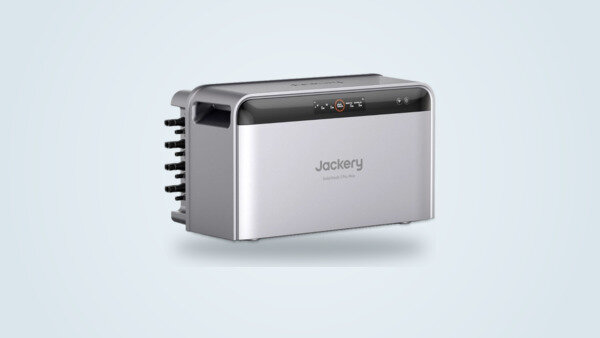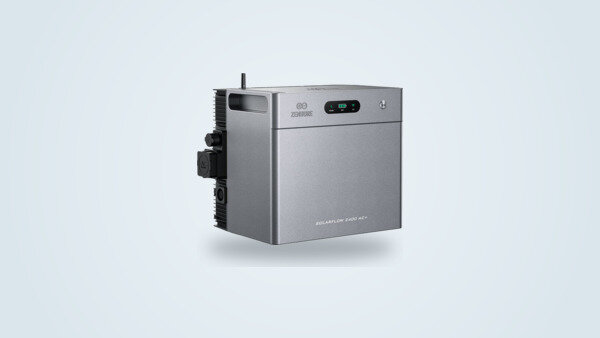
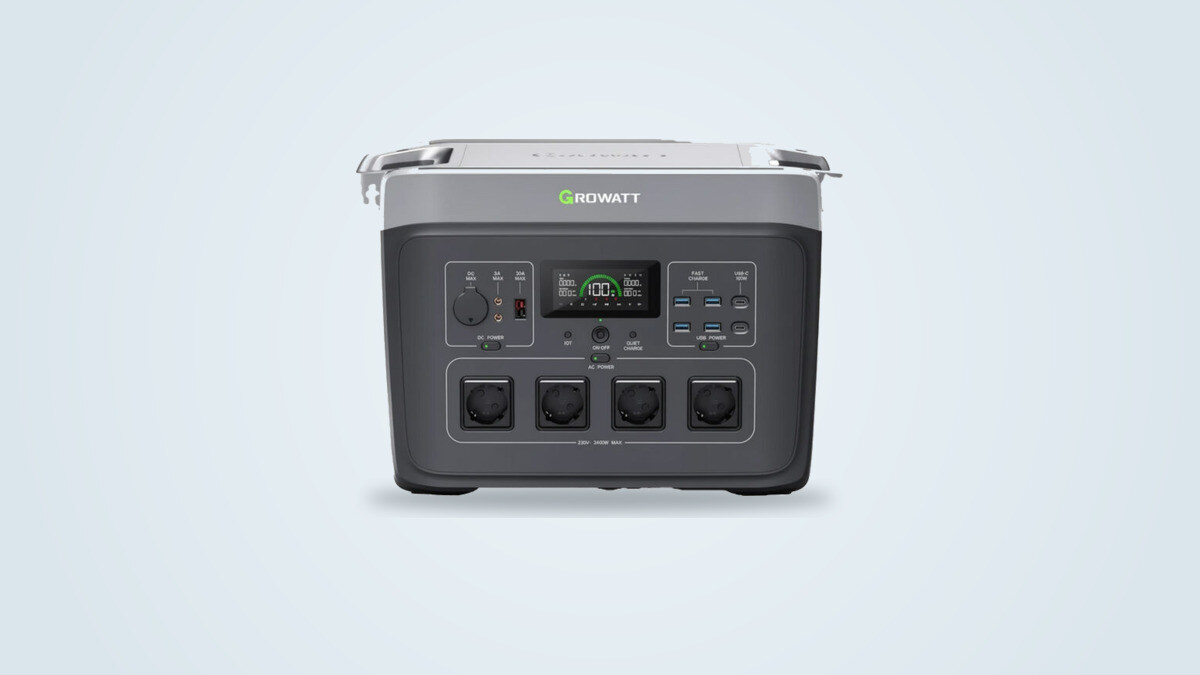
On paper: a well-equipped, versatile station
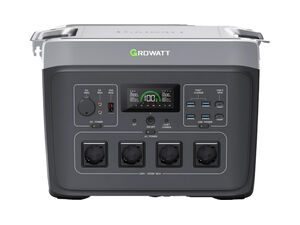
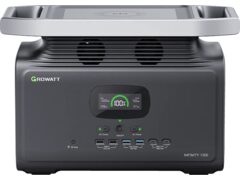
The Growatt Infinity 2000 Pro carries a 2048 Wh LiFePO4 battery, rated for over 4000 cycles to 80% capacity. It delivers 2400 W continuous across its four AC outlets, with a possible surge to 4800 W, and its capacity extends up to 6144 Wh thanks to two additional batteries. Full recharge in about 1h36, solar input up to 1200 W, fifteen outputs in total, a full LCD display, app control: on paper, this station ticks every box expected of a well-designed versatile model, equally suited to RV use and home backup. The box even includes everything needed to get started without extra accessories: an AC charging cable, a car-outlet cable, a solar charging cable (MC4 to XT60) and a DC5521 output cable. A detachable transport cart is also available as a separate accessory to help move the unit's 50.7 lb (23 kg), with a dedicated connection system that lets the main unit and its expansion batteries stack onto the same cart.
The rest of this review draws on Growatt's official technical documentation, including the user manual, to check what these figures actually mean day to day, beyond the marketing pitch alone.
What the 6144 Wh expansion actually changes
Growatt highlights the option of adding up to two extra 2048 Wh batteries, bringing total capacity to 6144 Wh, three times the single unit's capacity. That is a generous expansion ratio next to rivals that often cap out at twice their base capacity with a single add-on battery. But the Infinity 2000 Pro's official user manual is explicit about a point the marketing material does not spell out: once connected, each expansion battery does not operate independently. The manual states that all connected units charge and discharge equally, and that switching off the main unit shuts down the whole system. A technical note on combined charging modes goes further, stating explicitly that the expansion battery does not use an independent charging function once linked to the main unit.
There is nothing unusual about this setup in itself: plenty of expandable stations work on the same single-system principle. But it is worth knowing before buying, especially if the idea of independent charging and discharging, battery by battery, was part of the appeal. On the procedure side, the manufacturer recommends switching off both units before connecting them, then confirming the link via the dedicated icon on the main unit's LCD screen; unplugging an expansion battery mid-charge or mid-discharge is explicitly discouraged, at the risk of damaging the unit or connected loads.
Cold start at -22 °F (-30 °C): what the figure hides
Growatt advertises a cold start down to -22 °F (-30 °C), a figure presented as a strong winter selling point. The official technical documentation clarifies what this figure actually covers: between -22 °F and -4 °F (-30 to -20 °C), the station can trigger automatic battery heating, but only if a power source, AC or solar, is already connected. The table published by the manufacturer lists a heating time of 83 minutes from -22 °F (-30 °C) before reaching the 41 °F (5 °C) needed for normal operation, and 65 minutes from -4 °F (-20 °C), which is also the stated minimum discharge temperature for the unit. Below 32 °F (0 °C), normal charging outside the heating mode is itself no longer possible. The takeaway: -22 °F (-30 °C) is not an immediately usable temperature, it is the lowest point at which the unit can still start warming itself up, provided it is already plugged into a power source.
Watt+ mode: 3400 W, but not for every appliance
Watt+ technology is the most visible power claim on the product page: it promises to raise output capacity to 3400 W, against 2400 W continuous. The way it actually works, as documented by the manufacturer itself, is more nuanced than a straightforward power boost. Watt+ is off by default and only switches on from the myGro app. It is explicitly recommended for resistive loads such as heating appliances, and Growatt advises against using it with non-resistive appliances such as a refrigerator, or with appliances that are voltage-sensitive or fitted with voltage protection. The mode does not work in pass-through, and the manufacturer recommends plugging in only one appliance at a time while it is active: running several loads at once with Watt+ enabled can disrupt the normal operation of the other AC outlets.
Another useful detail to understand the mechanism: the unit's actual maximum output stays at 2400 W, even in Watt+ mode. What the mode changes is the ability to power an appliance whose rated wattage climbs up to 3400 W, give or take 10%, not the electrical power actually available to that appliance. It is the same principle used on other stations in Growatt's lineup, which already reserve this kind of boost mode for resistive appliances.
EPS function: a backup supply, not a professional UPS
The EPS (emergency power supply) function automatically switches to battery power during an outage, provided the station is already connected to power and an appliance is plugged into its AC outlets. The manufacturer states, in its own documentation, that this is a non-professional UPS function that does not support 0 ms switching, and explicitly recommends testing compatibility before connecting equipment that genuinely needs an uninterrupted supply. A desktop computer or a home router generally cope well with it; a server or critical medical equipment would warrant a prior check, as the manufacturer itself suggests.
A second detail rarely covered in the usual marketing pitch: the EPS function is sized for appliances rated at 1800 W or less, below the unit's 2400 W rated output. Plugging in several appliances whose combined draw exceeds this threshold during an outage risks triggering an overload alarm at the exact moment the protection matters most. Finally, automatic AC output resumption once power returns is switched off by default and must be enabled manually in the myGro app: without that setting turned on, a manual restart may be needed after a lengthy outage.
Charging: AC power, solar, and the combinations available
AC charging accepts up to 1800 W under normal operation (100 to 120 V for the US edition), for a full charge quoted at around 1h36. A bypass mode described by the manufacturer occasionally raises the AC input ceiling under certain usage conditions. On solar input, the station accepts up to 1200 W (12 to 60 V), via the MC4-to-XT60 cable included in the box, compatible with setups of up to six 200 W panels or eight 100 W panels wired in parallel (an extra cable is sold separately for the eight-panel setup). Charging is also possible via a car-outlet (XT60) connection as a complement.
Combining AC and solar raises input to 2300 W, and up to 3000 W once an expansion battery is connected to the full system. A quiet-charging button limits input power to reduce fan noise, at the cost of a longer charge time, but Growatt does not publish an exact wattage threshold or a precise noise measurement for this mode in its public documentation, so the trade-off cannot be quantified exactly. Another detail spelled out by the manufacturer: beyond 95% charge, current drops off mechanically as battery voltage rises, which stretches out the final stretch of a charge compared with a linear progression; a normal behavior meant to preserve battery life, not a defect.
Ports and control: a complete line-up, with one shared limit
With 15 outputs spread across four pure sine-wave AC outlets (2400 W total, 4800 W surge), two 100 W USB-C ports (200 W total), four 18 W USB-A ports (72 W total), a car outlet, two DC5521 ports and a 396 W Anderson port, the line-up is very complete for a station in this class. One detail worth knowing before planning any specific use: the car outlet and the two DC5521 ports share a common current budget of 10 A, roughly 132 W, as stated by the manufacturer. Running the car outlet at full power alongside both DC5521 ports at the same time would exceed that shared budget, even though each port's individual rating looks higher on paper.
On the control side, the myGro app, over Bluetooth then WiFi, shows the real-time charge state, activates Watt+ mode, sets automatic standby timers for each port (the screen turns off after 2 minutes of inactivity by default, the whole unit after 1 hour), and lets a second account share access. A more original feature for this type of station: Smart PV compatibility with Growatt's own residential solar inverters, via the ShinePhone app, which lets surplus solar production from an existing installation be redirected into the station without extra professional installation work, a genuine plus for a household already running a Growatt inverter.
| Output | Power |
|---|---|
| AC outlets (x4) | 2400 W total, 4800 W surge |
| USB-C (x2) | 100 W each, 200 W total |
| USB-A (x4) | 18 W each, 72 W total |
| Anderson | 396 W |
| Car outlet + DC5521 (x2) | 10 A shared, roughly 132 W |
Build, endurance and the data that is missing
The LiFePO4 battery is rated for over 4000 cycles to 80% capacity, backed by a 5-year manufacturer warranty, now a fairly standard level at this price point. The protection system described by the manufacturer is particularly thorough: overheating, undervoltage, over-discharge, overcharge, output overload, short circuit and overvoltage are all handled individually, with more than twenty distinct error codes listed in the manual, including separate protection for the USB-A, USB-C, car-outlet and Anderson ports. That is a sign of serious engineering, though it says nothing about real-world reliability over time.
The product is too recent to have any independent field track record: no teardown or cell identification could be found so far, and no independent efficiency or noise measurement has been published by a third-party lab. One isolated case of difficulty obtaining a replacement unit through customer support turned up in the course of this research; a single case is not enough to say whether it reflects an isolated incident or a wider issue. No recall or documented safety incident has been identified for this model at the time of writing. Worth noting for long-term storage: the manufacturer recommends keeping the unit charged between 30% and 80%, and topping it up to 80% roughly every three months to preserve the battery; the internal battery is not removable, and the unit carries no ingress-protection rating against water or dust, so it should be kept away from the weather. On the compliance side, the unit carries the certifications expected for this type of product on the US market: ETL listing, FCC certification, California's Proposition 65 (CA65) warning, and UN38.3 for lithium-cell transport, the last of which does not permit carrying it in aircraft cabins or checked baggage beyond the regulatory 100 Wh threshold, vastly exceeded by the main battery's 2048 Wh.
Availability: sold direct by the manufacturer, limited third-party coverage
In the US, the Growatt Infinity 2000 Pro is sold directly through Growatt's own online store, where the base unit was listed at $799 at the time of writing, alongside bundles that add solar panels. The unit also turns up on at least one major general marketplace. Unlike the network of specialist solar-equipment resellers that carries this model across Europe, Growatt's US sales channel for this station centers on its own direct-to-consumer store, which makes the manufacturer's own listing the most reliable reference for current pricing and stock.
Worth checking before buying: the warranty process runs through Growatt's own customer service regardless of where the unit is purchased, offering repair or exchange for a unit of equivalent value during the covered period; the warranty is not transferable to a second owner. Because independent US retail coverage for this exact model still looks thin beyond the manufacturer's own store, confirming current stock and any reseller-specific return policy before ordering is a reasonable precaution.
Against the Infinity 1300 and the direct competition
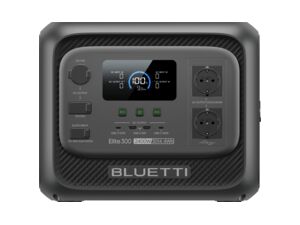
Next to its smaller sibling the Infinity 1300 (1382 Wh, 1800 W with a 3600 W surge, not expandable based on available information), the Infinity 2000 Pro stands out mainly through its expansion path up to 6144 Wh and its higher output. Against the Bluetti Elite 300 (3014 Wh, 2400 W with a 4800 W surge), the Infinity 2000 Pro offers comparable output for a more modest base capacity, with the advantage of being able to grow that capacity in steps rather than having to commit upfront to a larger, pricier format. This step-by-step expansion logic, rather than a fixed capacity chosen once and for all, remains the Infinity 2000 Pro's strongest argument against rivals with a similar fixed capacity, once the reservation about the expansion batteries' lack of independence is kept in mind.
| Criterion | Infinity 2000 Pro | Infinity 1300 | Bluetti Elite 300 |
|---|---|---|---|
| Capacity | 2048 Wh | 1382 Wh | 3014 Wh |
| Power | 2400 W (4800 W surge) | 1800 W (3600 W surge) | 2400 W (4800 W surge) |
| Expansion | up to 6144 Wh | not stated | not stated |
Who it suits, and who it suits less
It suits anyone after a versatile station that can grow over time: mixed RV and home-backup use, with the option to add capacity in 2048 Wh steps rather than buying a bigger station outright. Its very complete port selection and fast recharging also make it a good pick for anyone who needs to top the station up quickly between uses, and a household already running a Growatt solar inverter gets a genuine bonus from the Smart PV integration.
It suits less anyone after a genuinely uninterruptible supply for critical equipment, since the EPS function has limits the manufacturer itself documents, anyone counting on truly independent battery-by-battery expansion, or anyone who would rather shop a wide field of retailers than rely mainly on the manufacturer's own store.