A charger from a French industrial name since 1964
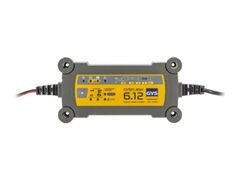
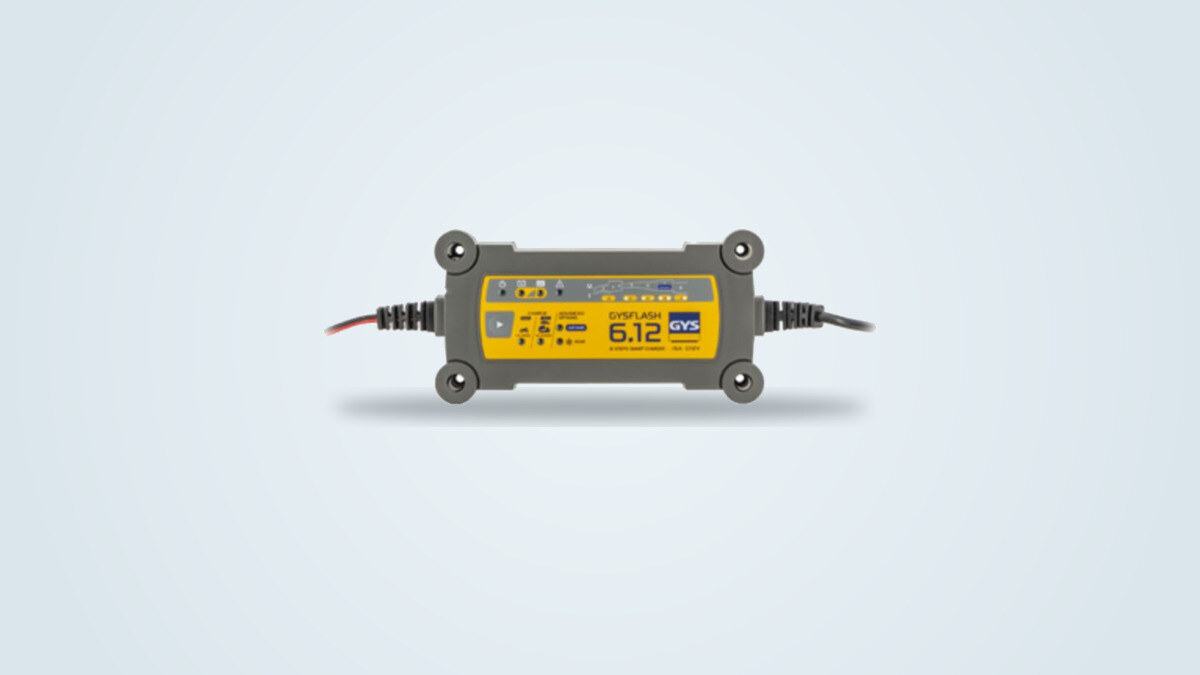
Founded in 1964, GYS is a French industrial group with more than 900 employees, known for its welding equipment and body repair tools, with a GYSFLASH charger range spanning around a dozen models. The GYSFLASH 6.12 is one of the most versatile: a smart 12V, 6A charger and maintainer built for everyday upkeep of lead-acid batteries in cars, motorcycles, vans or boats. Availability in the US market is currently limited, so check stock before planning around this specific model.
Every lead-acid technology, up to 125Ah
The GYSFLASH 6.12 is compatible with every common lead-acid technology: liquid/VRLA, AGM, SLA, Gel and EFB. It covers batteries from 1.2 to 125Ah when charging, and up to 170Ah in simple maintenance mode, enough for a light motorcycle as well as a large car or van battery. The one chemistry missing from the list is lithium, which remains the preserve of other models in the range.
An 8-stage program, with desulfation and regeneration
Its automatic 8-stage charging curve includes an initial diagnostic, a desulfation phase and then a Refresh stage that regenerates the cells to extend battery life, before switching to trickle charging once the battery is full. This staged approach charges roughly twice as fast as a standard single-curve 6A charger, while going easier on the battery over time.
SOS Recovery, for restarting a charge from 2V
Its SOS Recovery function can restart charging on batteries that have dropped very low, down to 2V, where most standard chargers detect the battery as absent and simply refuse to start. As with any recovery function, this is no universal guarantee: excessive sulfation or a dead cell remain physical limits no charger can lift. But the attempt costs nothing and can save a lawn mower or motorcycle battery forgotten through an entire winter.
AGM mode, cold weather and CAN BUS compatibility
AGM mode adapts the charge for the more demanding Start and Stop batteries as well as for temperatures below 41 °F (5 °C), keeping it effective year-round even in an unheated garage. CAN BUS compatibility, built in with no extra cable or accessory needed, lets the unit plug directly into the 12V socket on some equipped motorcycles, without ever disconnecting the battery.
IP65, resume after a power outage, and quick connections
The compact housing is rated IP65, protected against short circuits, reverse polarity and overload. It can be left connected indefinitely, for weeks or months, to keep a rarely-used vehicle topped up without ever damaging it: after a power outage, it resumes charging exactly where it left off, instead of starting over. Supplied with clamps and quick-connect M6 ring terminals, it takes seconds to fit, and its 2-year warranty reflects the manufacturer's confidence in the unit's durability.
No lithium, no fast charging: the two limits to know
At 6A, the GYSFLASH 6.12 remains a maintenance charger rather than a fast one: for a quick top-up on a large RV battery before a trip, look further up the range, to the 8.12 or 12.12. It also does not charge lithium LiFePO4 batteries: for that chemistry, GYS offers the GYSFLASH 1.12 PL or 18.12 PL within the same range, both compatible with lead-acid and lithium but limited in output.
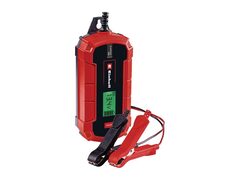
Against the CTEK MXS 5.0, the Noco Genius5 and the Einhell CE-BC 4M
How does the GYSFLASH 6.12 compare to other smart maintainer chargers on the market? Several of these have also seen stock gaps in the US, so treat the figures below as a guide rather than a live price check.
| Criterion | GYSFLASH 6.12 | CTEK MXS 5.0 | Noco Genius5 | Einhell CE-BC 4M |
|---|---|---|---|---|
| Charging current | 0.6 / 6A | 0.8 / 5A | 5A | 4A |
| Compatibility | Lead-acid (VRLA, AGM, Gel, EFB) | Lead-acid | Lead-acid and lithium | Lead-acid |
| Battery capacity | 1.2 to 125Ah | 1.2 to 110Ah | Up to 120Ah | Not specified |
| Waterproofing | IP65 | IP65 | Not specified | IP65 |
| Observed price | ≈ $103 | ≈ $113 | ≈ $70 | ≈ $45 |
The GYSFLASH 6.12 stands out with a slightly wider charging range (125Ah) than the MXS 5.0 and French manufacturing, with the same IP65 rating as the CTEK. It is not lithium-compatible, unlike the Noco Genius5, which also comes in at a much lower price and is reliably in stock: for a LiFePO4 battery, GYS offers the GYSFLASH 1.12 PL or 18.12 PL within the same range. Against the far cheaper but more basic Einhell CE-BC 4M (4A, a sparser feature set), the GYSFLASH 6.12 offers a more thorough charge (8 stages, desulfation, Refresh), though neither the Einhell nor the CTEK has been consistently available in this market either.
Who the GYSFLASH 6.12 is for
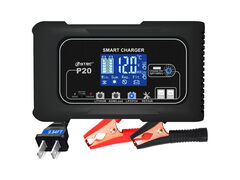
On paper, this charger is aimed at anyone with one or more lead-acid batteries in a car, motorcycle or van, up to 125Ah, who wants a reliable unit for winter storage without having to keep an eye on it. French manufacturing and the 2-year warranty are reassuring for an investment meant to last. Given the current availability gap in the US, the HTRC P20 is a more readily available alternative that also covers lithium at a noticeably higher current, and the Noco Genius5 is a reliably-stocked lead-and-lithium option in a similar price range to what the GYSFLASH would normally cost.