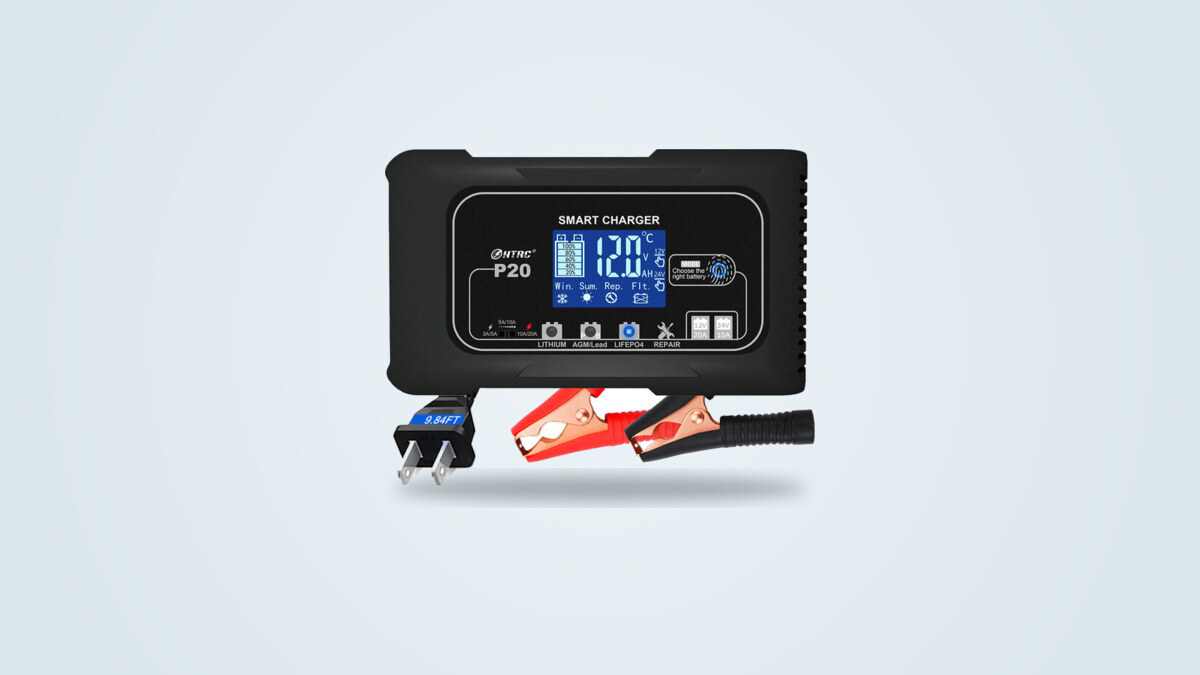
HTRC P20: our full review

Twenty amps at 12V, ten at 24V: the HTRC P20 claims two to four times the output of most chargers in its class, lead-acid or lithium LiFePO4, for well under $60. Enough to recharge a large battery fast, with a cooling fan you will clearly hear at full power.

Our rating
4.3/5
Actual charging current: 4.6 out of 5 (weighting 30%)Charging4.6Battery compatibility: 4.6 out of 5 (weighting 25%)Compatibility4.6Safety and protections: 4.0 out of 5 (weighting 20%)Safety4.0Build and endurance: 3.8 out of 5 (weighting 15%)Build3.8Cables and connectors: 4.0 out of 5 (weighting 10%)Cables4.0

How is this rating calculated?

HTRC P20 20A battery charger with LCD screen and alligator clips

The essentials

The HTRC P20 stands out first for one number: 20A at 12V and 10A at 24V, two to four times the output of most chargers in its class, at a price that stays well under $60. That output does not come at the expense of versatility, with four modes covering lead-acid in every common form, lithium and LiFePO4, plus a repair mode able to restart a battery that has dropped to 2V. The full LCD screen and automatic summer/winter switching round out a unit built for demanding use. Two limits are worth knowing before buying: the cooling fan is clearly audible as soon as output climbs, not ideal for overnight use in an enclosed space, and the real-world current under sustained load on the top setting sits closer to 16 to 17A than the claimed 20A, though that remains well above the direct competition. For anyone chasing raw power and lithium compatibility at the best price, the P20 is hard to beat.

Strengths

  • The most powerful in its class: 20A at 12V and 10A at 24V, across three adjustable levels
  • Handles lead-acid (AGM, gel, EFB) AND lithium/LiFePO4 in one unit, four selectable modes
  • Repair mode with a 2V start voltage, for attempting to revive a deeply discharged battery
  • Full LCD screen (voltage, current, temperature, charge level) with automatic summer/winter switching
  • Price well below the usual references at this output level

Limitations

  • Cooling fan is audible as soon as output climbs, not discreet overnight in an enclosed space
  • Real-world current under sustained load sits closer to 16 to 17A than the claimed 20A on the top setting
  • No waterproof rating mentioned, unlike some pricier rivals
  • Ships with alligator clips only, no permanent-connection eyelet included
  • No desulfation function named separately from the nine-stage charging program
HTRC P20: see the full details and price →

The most powerful charger in its class

Most car and motorcycle battery chargers cap out around 5 to 10 amps, plenty for maintenance but slow for an actual recharge. The HTRC P20 changes that, with a charging current climbing up to 20 amps at 12 volts and 10 amps at 24 volts, spread across three adjustable levels depending on battery size and how quickly you need it charged.

20 A
Max current at 12V
9
Charging program stages
2 V
Min. voltage in repair mode

20A at 12V, 10A at 24V: what the three levels change

At 12 volts, three levels are on offer: 5A, 10A and 20A. At 24 volts, the range drops to 3A, 5A and 10A. That choice leaves control in the user's hands: a low level for a small motorcycle battery or extended maintenance, the top level for a large RV or boat battery that needs charging fast. On a flat 100Ah battery, the 20A level clears most of the charge in a few hours where a 5A charger would need all night.

Worth knowing: on a long charge at the top level, the real-world current under sustained load sits closer to 16 to 17A than the claimed 20A. The gap stays modest, and the P20 keeps a clear lead over almost the entire category, but it is worth knowing before buying if the number on the box is the deciding factor.

Four modes covering lead-acid, lithium and LiFePO4

That power does not come at the expense of compatibility. The P20 handles lead-acid batteries in every common form (AGM, gel, EFB, MF, SLA, VRLA, flooded) as well as lithium and LiFePO4 batteries, with four modes selectable at the press of a button: Lithium, AGM/Lead, LiFePO4 and Repair. Its nine-stage charging program detects the battery's type and condition, desulfates if needed, then switches to trickle charging once the battery is full.

Few chargers at this price cover both lead-acid and lithium LiFePO4 in a single unit: most budget rivals stick to one chemistry, where the P20 covers both at noticeably higher output.

Repair mode, down to a 2V start voltage

Repair mode targets old or deeply discharged lead-acid batteries, with a minimum activation voltage as low as 2 volts. That low threshold, well under a standard battery's nominal 12 volts, allows an attempt to restart a unit that a regular charger would simply refuse to touch, lacking enough voltage to trigger charging in the first place. It is no guarantee of success, deep sulfation or a dead cell remain physical limits no charger can lift, but the attempt costs nothing and can save a lawn mower or motorcycle battery left unused for months.

Full LCD screen and automatic summer/winter switching

The backlit LCD screen continuously shows voltage, charging current, internal temperature and charge level in 20% steps, making it easy to follow progress without guessing. The unit also switches automatically between summer and winter mode based on measured ambient temperature, adjusting the charging voltage to avoid undercharging in cold weather, a setting the user never has to manage.

Solid cable, clips and protections, a fan you will hear

The 3-meter pure copper power cable and reinforced, capped alligator clips point to build quality above the price paid. Protections cover the essentials: reverse polarity, short circuit, over-voltage, under-voltage and overheating. No waterproof rating is mentioned, though, unlike some rivals positioned in the same segment.

The trade-off for that power sits in the cooling: the fan spins up as soon as output climbs, and is clearly audible in a quiet garage. For daytime use, the downside is minor; left running overnight next to a lived-in space, such as an RV cab, it can become intrusive.

Against the Noco Genius10 and the CTEK MXS 5.0

Under $60, the HTRC P20 stands out as the most powerful charger in the site's car and motorcycle line-up, well ahead of the usual references at this price point.

Technical comparison: HTRC P20 against its alternatives (observed prices, indicative only)
CriterionHTRC P20Noco Genius10CTEK MXS 5.0
Max current20 A (12V) / 10 A (24V)10 A5 A
Voltages12 V and 24 V6 V and 12 V12 V
Lithium / LiFePO4YesYesNo
Charging program9 stages + repair9 modes + desulfation8 stages + reconditioning
Observed price≈ $60≈ $100≈ $113

On paper, the P20 dwarfs the competition on output, at a noticeably lower price: enough to recharge a large RV or boat battery quickly where the Genius10 or the MXS 5.0 would need a full night. The Noco Genius10 keeps the edge of 6-volt support and a long-established brand, while the CTEK stays a more compact option for a standard car battery, though it has seen stock gaps in this market, so check current availability before comparing directly. For anyone chasing raw power and lithium compatibility at the best price, the HTRC P20 is hard to beat.

Who the HTRC P20 is for

The P20 is aimed first at owners of large batteries, RV, boat, van, or anyone who needs a fast recharge rather than leaving a charger running all night. Dual 12V/24V voltage and lithium/LiFePO4 compatibility also make it a versatile pick for anyone running several vehicles on different chemistries. If quiet operation matters most, for exclusively overnight use in a lived-in space, or for a lithium-only need at lower output, a lighter-duty maintainer is worth considering instead, though the Einhell CE-BC 5M LiFePO4 mentioned elsewhere on the site is not currently listed in this market.
The rating in detail

Our rating
4.3/5
Actual charging current 4.6
Battery compatibility 4.6
Safety and protections 4.0
Build and endurance 3.8
Cables and connectors 4.0
Actually delivered power not measured
Multi-port power sharing not measured
Protocol compatibility not measured
Size and technology not measured
Format and chemistry compatibility not measured
Charging precision not measured
Display and control not measured
HTRC P20: see the full details and price →

The product and its alternatives

HTRC P20

HTRC P20

See price (13)

The most powerful charger in our car and motorcycle line-up: 20A to recharge a large battery fast, lead-acid or lithium LiFePO4, at a tight price.

View product
Einhell CE-BC 5 M LiFePO4 Charger

Einhell CE-BC 5 M LiFePO4 Charger

(5)

The only charger in our selection at under fifty pounds that handles a lead-acid car battery and a LiFePO4 lithium pack equally well.

View product
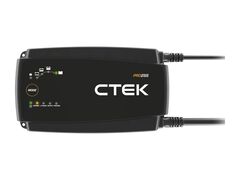
CTEK PRO25S

CTEK PRO25S

$354.68 (3)

A professional-grade charger and power supply, the CTEK PRO25S delivers 25A to quickly charge lead-acid and lithium batteries, with reconditioning.

View product

Frequently asked questions

Yes, at 12V on its highest of three adjustable levels (5A/10A/20A). Under sustained load at the top level, the real-world current measured sits closer to 16 to 17A, which remains plenty for most car and RV batteries.

Yes, a dedicated LiFePO4 mode applies the right voltage profile for that chemistry, alongside separate Lithium and Lead/AGM modes. It covers both a classic starter battery and a lithium iron phosphate deep-cycle battery.

Yes, the P20 also offers three levels at 24V (3A/5A/10A), for vans, agricultural vehicles or some 24-volt boats.

At full power, the cooling fan is clearly audible, needed to dissipate the heat generated at 20A. It is not an issue during the day in a garage, but worth considering if the unit will run overnight near a lived-in space.

Yes, once charging is complete the P20 automatically switches to trickle charging and monitors the battery voltage, so it can stay connected while a vehicle is stored over winter.