
Not available in the United States: what we found
Before anything else: the BK1600 Ultra does not appear to be sold or distributed in the United States. Indevolt's own site lists Germany, France, the Netherlands and the United Kingdom as its markets, with no US storefront, no US pricing, and no mention of American distribution. The listing carried on this site's own US catalog shows no stock and no purchase link, which matches what we found directly from the manufacturer.
This review still covers the product in full, because the underlying hardware and the facts about it do not change from one market to another, and because a US reader comparing options, researching the balcony-battery trend, or considering an import may still find the details useful. But we have not found, and will not invent, a US retail price, a US shipping timeline, or any US safety certification for this specific model.
What the advertised output power really means
On the European product, the BK1600 Ultra is marketed as a 3600 W system pretty much everywhere: on the product page, in the technical documentation, even in the expansion mode the manufacturer highlights. That figure is real, but it applies neither to the standalone unit nor to just any multi-unit setup: it depends on which pairing mode is used between units.
On its own, a single BK1600 Ultra delivers 1200 W continuous, with an 1800 W peak for 15 seconds. Pairing two units by cable, in what the manufacturer calls a centralised cluster (all power flows through the main unit before reaching the grid), raises the ceiling to 2300 W, not 2400 W as simple doubling would suggest: it is the main unit's own output port capacity that sets the limit. Reaching the advertised 3600 W requires switching to a coordinated cluster instead, where each of up to 3 units connects independently to the grid and synchronises over WiFi.
In practice, the standalone unit covers a fridge, a router and a few lights during an outage, but not a stovetop. That is a moot point for now for a US buyer given the lack of a purchase path, but it matters for understanding the real scope of the marketing claim.
Measured efficiency, ahead of its own bigger sibling
The BK1600 Ultra's round-trip efficiency reaches 82.2% under a constant 800 W load in Europe (solar panels disconnected). That beats the SolidFlex 2000, also not sold in the US and already reviewed on this site, at 80.1%, and sits well above a HomeWizard home battery (around 74% under the same conditions), while approaching the levels of a Zendure 2400 AC or a Marstek Venus A.
Against the 1636 Wh rated capacity, this efficiency works out to an estimated 1345 Wh returned under the same conditions. The manufacturer separately advertises a solar-to-battery conversion efficiency of up to 98%, a figure that measures something different: conversion in one direction only, not the full charge-and-discharge cycle measured above.
On noise, the manufacturer claims a level under 30 dB. Under active cooling, the average noise level reaches around 33 dB, slightly above that claim, though it remains unobtrusive.
Capacity and expansion: a promise kept, on the European product
The BK1600 Ultra packs 1636 Wh of LiFePO4 cells in a single unit in Europe. Up to two further units pair wirelessly to bring total capacity to 4.9 kWh (4908 Wh), a figure that works out to exactly three times the single-unit capacity.
This is worth spelling out: unlike the SolidFlex 2000, whose advertised expansion ceiling (22 kWh per group) turned out to be nearly double the confirmed real ceiling (10.8 kWh), the BK1600 Ultra's 4.9 kWh figure is identical throughout the manufacturer's documentation. It is a more modest expansion in absolute terms than its own sibling, but with no grey area attached, for a European buyer.
Against the Growatt NOAH 2000 (2048 Wh, expandable to 8192 Wh per its own spec sheet) and the SolidFlex 2000 (1792 Wh, 10.8 kWh genuinely confirmed), both also absent from the US market, the BK1600 Ultra remains the smallest capacity of the three, in line with its entry-level European positioning.
Two built-in MPPT trackers: a genuine edge, on paper
The BK1600 Ultra packs 2 MPPT trackers rated at 600 W each, for a maximum solar input of 1200 W on the standalone European unit. This figure is confirmed throughout: the product page and the manufacturer's technical documentation converge on 1200 W.
That is half the SolidFlex 2000's 4 trackers and 2400 W. But it is a genuine advantage over the Growatt NOAH 2000 (also not sold in the US), whose DC-coupled design needs a separate micro-inverter to convert current to AC: the BK1600 Ultra packs its own bidirectional inverter and needs no extra box. None of these three products has a confirmed US sales channel, which reflects how little this specific plug-in balcony-battery category has taken hold domestically so far.
For anyone in Europe who already owns a solar inverter, the BK1600 Ultra remains compatible via AC coupling, a flexibility that avoids having to choose between the two approaches at purchase time.
The EPS switchover: what it actually covers
The manufacturer's spec sheet states that the off-grid backup output switches over in under 10 milliseconds during an outage, fast enough that a computer or a router will not reboot. This is the one real technical difference between the BK1600 Ultra and the standard BK1600, which lacks this automatic switchover entirely.
That switchover feeds a dedicated backup output, limited to the power of whichever configuration is installed (1200 to 3600 W per the earlier section), not a whole house circuit: appliances that need protecting must be plugged directly into that output, or into a circuit an installer connects to it. All of this applies to the European product; there is no US equivalent installation to compare it with.
The app and tariff control, and the meter it does not include
The Indevolt app offers a European-tariff-oriented feature set: normal operation, time-based scheduling, self-consumption priority, zero-export with or without backup bypass, and dynamic electricity tariff tracking. The manufacturer states compatibility with several third-party meters (Shelly Pro 3EM, Shelly 3EM, HomeWizard P1), but unlike the SolidFlex 2000, which ships with its own branded meter, no meter comes bundled with the BK1600 Ultra: a Shelly or Solarman P1 reader needs to be added separately in Europe, at roughly 39 to 99 € depending on the model, with no US pricing available for these accessories since neither the battery nor the meters are sold domestically for this product.
App ergonomics could be more intuitive on first use, even though the automatic functions need no manual intervention once set up. A local API access is aimed at advanced users, with a Home Assistant integration common to the wider Indevolt ecosystem.
Why this product, and this whole category, is not really a US story yet
The plug-in balcony-battery category that the BK1600 Ultra belongs to is a specifically European phenomenon, driven by a wave of national rules (Germany's VDE-AR-N 4105, and similar 800 W self-install thresholds recently adopted in France, Spain and Italy) that let a household plug a small solar-plus-battery system into a standard wall outlet with little or no utility paperwork. The United States has no direct equivalent: interconnecting any grid-tied generation or storage device normally requires utility notification and compliance with IEEE 1547, handled state by state and utility by utility, with no federal "under 800 W, no paperwork" exemption comparable to the European rules that apply to this same product in its home markets.
That regulatory gap, more than anything about the hardware itself, is likely a major reason Indevolt has not brought the BK1600 Ultra to the US: a product built around plugging into a wall outlet without a utility interconnection study does not map cleanly onto how US utilities currently handle grid-tied storage. We found no evidence of a UL listing, no NEC 690 compliance documentation, and no state-level net-metering or interconnection approval for this model, and we are not going to guess at requirements that have not been confirmed for this specific product.
For a US reader who still wants a plug-in battery for backup power without a utility interconnection study, the closest domestically available options today are portable power stations with a pass-through UPS or backup-circuit function, a different product category from the AC-coupled, MPPT-integrated balcony batteries reviewed here.
Build quality, a young brand, and practical limitations
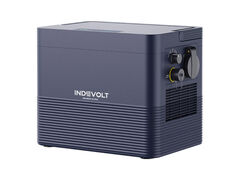
The enclosure follows the Indevolt range's visual language: anthracite grey casing, a control dial and mains socket at the rear, an active-cooling vent on the front. Rated IP54, it operates from -4 °F (-20 °C) to 113 °F (45 °C). The unit weighs 35.3 lb (16 kg) and measures roughly 11.8 x 8.5 x 9.8 in (300 x 215 x 250 mm), noticeably easier to move and install single-handed than the SolidFlex 2000 at 47.4 lb (21.5 kg).
Indevolt remains a young brand: the BK1600 Ultra has been on sale in Europe since September 2025, roughly two months ahead of the SolidFlex 2000. No product recall or documented safety incident has been found for this model to date, in any market. The European manufacturer warranty runs for 10 years, targeting 6000 cycles to 80% remaining capacity, applied to a conventional LiFePO4 chemistry with a long track record, rather than the newer semi-solid cells used in the SolidFlex 2000.
That is a genuinely positive result, taken for what it is: the absence of a negative signal after a serious search, not a guarantee of long-term reliability for a still-recent, not-yet-US-market product.
Against the SolidFlex 2000 and the Growatt NOAH 2000, all absent from the US market
On paper, the SolidFlex 2000 leads on nearly every raw European spec: more capacity (1792 against 1636 Wh), twice the MPPT (4 against 2, 2400 against 1200 W), a bigger confirmed expansion (10.8 against 4.9 kWh), and a bundled communicating meter. Yet the BK1600 Ultra earns an equal rating on this site (4.0) for two specific reasons: a higher measured round-trip efficiency (82.2% against 80.1%), and no gap at all between what the manufacturer states and its own technical figures on the expansion ceiling, where the SolidFlex 2000 advertises 22 kWh against a genuinely confirmed ceiling of 10.8 kWh. None of this is actionable for a US buyer today, since none of the three products discussed here, including the Growatt NOAH 2000, has a confirmed US retail channel.
| Criterion | BK1600 Ultra | SolidFlex 2000 | Growatt NOAH 2000 |
|---|---|---|---|
| Capacity | 1636 Wh | 1792 Wh | 2048 Wh |
| Confirmed maximum expansion | 4.9 kWh (3 units) | 10.8 kWh (manufacturer's own UK site) | 8192 Wh (manufacturer spec sheet) |
| Backup output, standalone unit | 1200 W (1800 W peak) | 1000 W | Not applicable (no EPS function) |
| Built-in MPPT | Yes, 2 x 600 W (1200 W) | Yes, 4 x 600 W (2400 W) | No, separate micro-inverter required |
| Communicating meter included | No (39 to 99 € as an option in the EU) | Yes, as standard | Not disclosed |
| Weight | 35.3 lb (16 kg) | 47.4 lb (21.5 kg) | Not disclosed |
| EU observed price | 499 € | 799 € | Priced separately, without built-in MPPT |
The Growatt NOAH 2000 claims a measured efficiency of around 89% across the full chain at full power, but under a different protocol from the one used here: the two figures do not compare directly. Against both Indevolt units, it remains held back by the lack of a built-in bidirectional inverter, requiring a separate micro-inverter that neither Indevolt unit needs.
Bottom line for a US reader
If you live in Germany, France, Spain, Italy or the UK, the BK1600 Ultra is a genuinely competent entry-level balcony battery: a real built-in inverter and MPPT, an honestly documented expansion ceiling, and a fair asking price for what it does. If you live in the United States, none of that is currently actionable: there is no confirmed way to buy this specific model domestically, no US pricing, and no evidence of the safety certification that would typically be required to sell a grid-interactive battery here.
The most useful takeaway for a US audience may simply be the trend itself: plug-in balcony solar storage has become a mainstream category in parts of Europe over the past two years, built on regulatory exemptions the US does not currently offer. Whether that changes here will depend on utility and state-level rules evolving, not on any single product like this one.