Not available in the United States: what we found
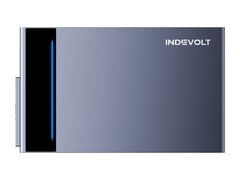
Before anything else: the SolidFlex 2000 does not appear to be sold or distributed in the United States. Indevolt's own site lists Germany, France, the Netherlands and the United Kingdom as its markets, with no US storefront, no US pricing, and no mention of American distribution. The listing carried on this site's own US catalog shows no stock and no purchase link, which matches what we found directly from the manufacturer.
This review still covers the product in full, because the underlying hardware and the facts about it do not change from one market to another, and because a US reader comparing options, researching the balcony-battery trend, or considering an import may still find the details useful. But we have not found, and will not invent, a US retail price, a US shipping timeline, or any US safety certification for this specific model.
What the 2400 W power rating really means
On the European product, the SolidFlex 2000 is marketed everywhere as a 2400 W system: on the product page, on the manufacturer's site, even in the "Highlight" field of its own listing. That figure is real, but it describes the most heavily expanded configuration, not the standalone unit. The manufacturer's own spec sheet actually breaks this down into three tiers.
Without any expansion, backup output tops out at 1000 W and AC charging power at 896 W. Adding a single SFA1800 battery raises backup output to 2000 W and charging to 1792 W. It takes two SFA1800 units, or a single SFA3600, to finally reach the advertised 2400 W in both directions.
In practice, the standalone unit covers a fridge, a router and a few lights, but not a stovetop or a space heater. That is a moot point for now for a US buyer given the lack of a purchase path, but it matters for understanding the real scope of the marketing claim.
The measured efficiency, and what remains unknown
The SolidFlex 2000's round-trip efficiency reaches 80.1% under a constant 800 W load in Europe. That is a respectable figure for this segment, but no second independent measurement confirms it to date, and behavior below a few hundred watts remains unknown.
Against the 1792 Wh rated capacity, this efficiency works out to an estimated 1435 Wh returned under the same conditions. Enclosure temperature peaked at 103 °F (39.4 °C) after a continuous 800 W discharge, pointing to effective passive cooling with no worrying temperature rise.
This places the SolidFlex 2000 in the upper-middle of the segment as measured in Europe, without quite matching the best-performing references already reviewed on this site. The lack of a second independent source is an honest caveat to keep in mind, not a proven flaw.
Four built-in MPPT trackers: a genuine edge, on paper
This is the SolidFlex 2000's strongest argument on the European market, and it holds up under scrutiny: the standalone unit packs 4 MPPT trackers rated at 600 W each, for a total of 2400 W of solar input directly usable with no micro-inverter or third-party inverter to add. That figure applies to the standalone unit, not to an already-expanded system.
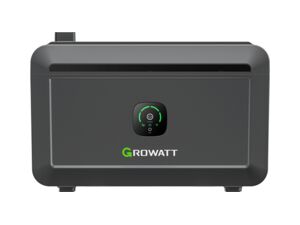
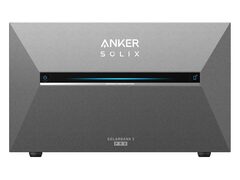
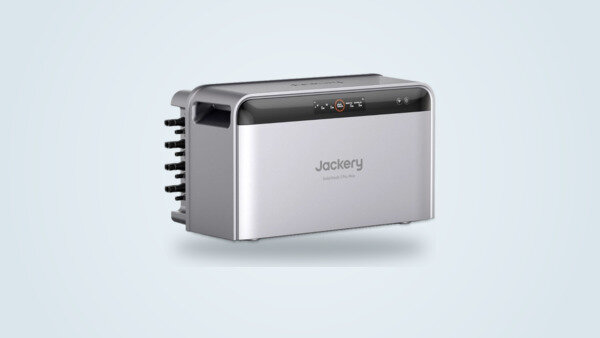
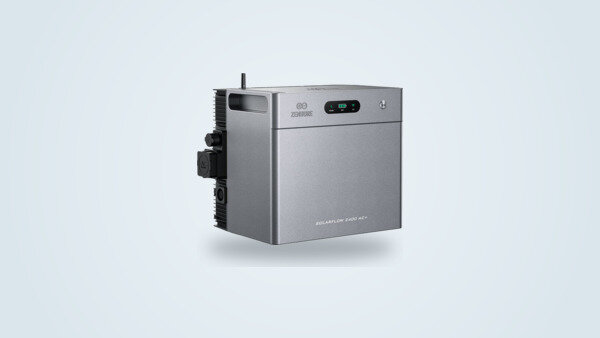
This sets the SolidFlex 2000 apart from two direct European rivals: the Growatt NOAH 2000, which needs a separate micro-inverter, and the Zendure SolarFlow 3000 Mix AC+, which also depends on a third-party inverter. Neither of these competitors is confirmed to be sold in the US either, which reflects how little this specific plug-in balcony-battery category has taken hold domestically so far.
For anyone who already owns a solar inverter in Europe, the SolidFlex 2000 remains compatible via AC coupling. In the three-group expanded configuration, total solar input climbs to 7200 W, a figure that assumes buying all three complete units.
Expansion: the gap between the marketing claim and the manufacturer's own UK site
This is the most serious reservation about the product on its own European merits. Indevolt advertises an expansion ceiling of 22 kWh per group and up to 66 kWh by stacking three groups. But the manufacturer's own UK site tells a different story for this same model: it lists a noticeably lower figure, 10.8 kWh per group (the base unit plus a maximum of five SFA1800 batteries) and 32.4 kWh for three groups, an internal contradiction with the 22 kWh Indevolt highlights elsewhere in its own communication.
This gap would matter to any buyer planning an ambitious expansion, wherever they are. For a US reader, it is one more reason for caution: even setting aside the availability question, the headline expansion figure overstates what the manufacturer's own UK site confirms.
| Module | Capacity | Observed price (EU) | Advertised cycles |
|---|---|---|---|
| SFA1800 | 1792 Wh | 499 € | 8,000 |
| SFA3600 | 3584 Wh | 849 € | 10,000 |
Expansion cost also weighs into the picture: on Indevolt's European store, a single SFA3600 lists at 849 €, more than the base unit's own European price, just to double native capacity. No US price exists for either module, since neither is sold domestically.
The app, tariff control and the included meter
The Indevolt app offers a fairly complete range of modes for this segment: normal operation, time-based scheduling, self-consumption priority, zero-export with or without backup bypass, smart-plug control, and dynamic electricity tariff tracking, aimed at European tariff structures. A communicating meter branded Indevolt ships in the box, which means zero-export can be activated right after installation with no mandatory extra purchase, unlike some competitors where that accessory is left for the buyer to source separately.
For fully local control with no dependency on Indevolt's cloud, the system also supports a separately sold Shelly Pro 3EM meter (about $155 based on US retail listings for the meter itself, which is sold in the US independently of this battery). That is not a required purchase, but an option for anyone who wants to be completely independent of a network or third-party service. A Home Assistant integration is also available for advanced users.
The interface includes real-time flow graphs, and support runs through an official Discord server. Two genuine points of friction stand out even so: an initial WiFi pairing process that sometimes needed several attempts, and a state-of-charge drift between multiple stacked units in multi-battery setups, which calls for a full recalibration charge roughly every 15 days to stay accurate.
The backup switchover: what it actually covers
The manufacturer's spec sheet states that the off-grid output switches over in under 10 milliseconds during an outage, fast enough that a computer or a router will not reboot.
That switchover feeds a dedicated backup output, limited to the power of whichever configuration is installed (1000 to 2400 W per the previous section), not the whole house circuit: appliances that need protecting must be plugged directly into that output, or into a circuit an installer connects to it. A prolonged outage is limited above all by the battery capacity available, not by how fast the switchover itself happens.
Why this product, and this whole category, is not really a US story yet
The plug-in balcony-battery category that the SolidFlex 2000 belongs to is a specifically European phenomenon, driven by a wave of national rules (Germany's VDE-AR-N 4105, and similar 800 W self-install thresholds recently adopted in France, Spain and Italy) that let a household plug a small solar-plus-battery system into a standard wall outlet with little or no utility paperwork. The United States has no direct equivalent: interconnecting any grid-tied generation or storage device normally requires utility notification and compliance with IEEE 1547, handled state by state and utility by utility, with no federal "under 800 W, no paperwork" exemption comparable to the European rules that apply to this same product in its home markets.
That regulatory gap, more than anything about the hardware itself, is likely a major reason Indevolt has not brought the SolidFlex 2000 to the US: a product built around plugging into a wall outlet without a utility interconnection study does not map cleanly onto how US utilities currently handle grid-tied storage. We found no evidence of a UL listing, no NEC 690 compliance documentation, and no state-level net-metering or interconnection approval for this model, and we are not going to guess at requirements that have not been confirmed for this specific product.
For a US reader who still wants a plug-in battery for backup power without a utility interconnection study, the closest domestically available options today are portable power stations with a pass-through UPS or backup-circuit function, a different product category from the AC-coupled, MPPT-integrated balcony batteries reviewed here.
Build quality, a young brand, and practical limitations
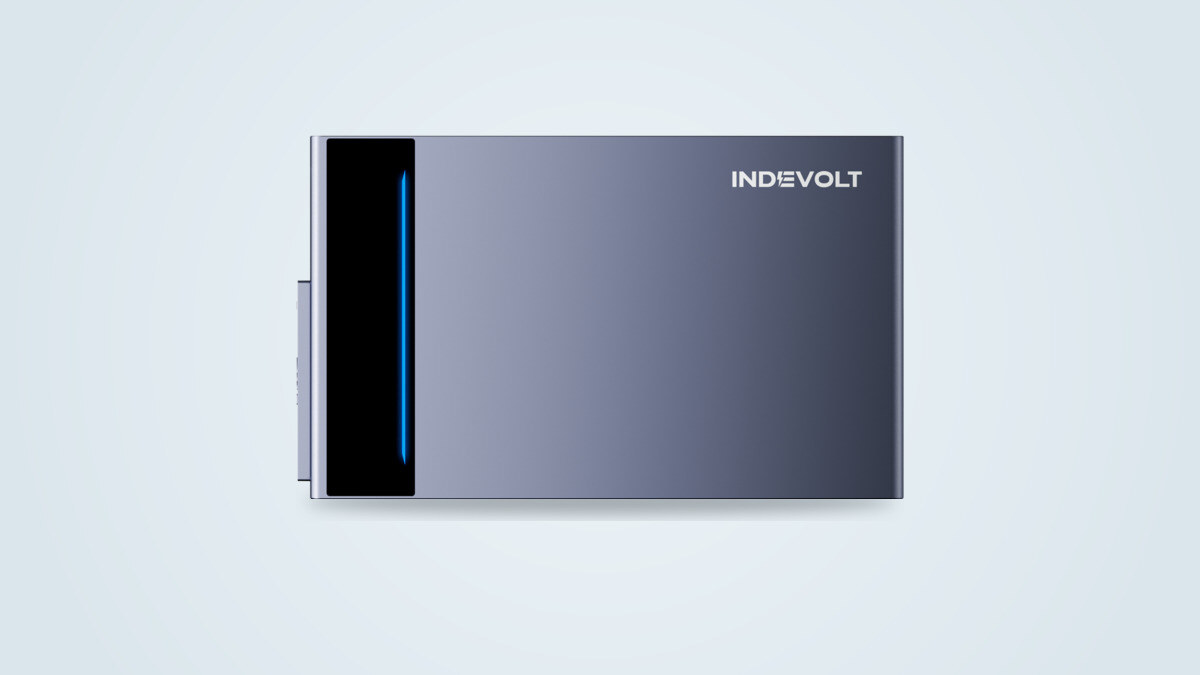
The enclosure appears sturdy, with generously rated cabling and adjustable feet for leveling. The base unit weighs 47.4 lb (21.5 kg) and measures roughly 16.7 x 7.7 x 10.2 in (425 x 195 x 260 mm), sized for a balcony rail, a wall mount, or a garage floor rather than for portable use. Manufacturer support is reachable through an official Discord server, with software fixes rolled out there after a problem is reported.
Two genuine reservations temper that picture, on top of the availability question. First, Indevolt remains a young brand: the SolidFlex 2000 has only been on sale in Europe since November 2025, leaving little track record on long-term reliability. Second, a few installation details could be better: the MC4 cables needed to connect panels are not included, and the initial WiFi pairing process sometimes took more than one attempt.
No product recall or documented safety incident has been found for this model to date, in any market. That is a genuinely positive result, taken for what it is: the absence of a negative signal after a serious search, not a guarantee of long-term reliability for a still-recent, not-yet-US-market product.
Bottom line for a US reader
If you live in Germany, France, Spain or the UK (with the caveats noted above for battery-equipped systems in the UK specifically), the SolidFlex 2000 is a genuinely interesting balcony battery: real built-in MPPT, a novel cell chemistry, and a fair asking price once the expansion caveats are understood. If you live in the United States, none of that is currently actionable: there is no confirmed way to buy this specific model domestically, no US pricing, and no evidence of the safety certification that would typically be required to sell a grid-interactive battery here.
The most useful takeaway for a US audience may simply be the trend itself: plug-in balcony solar storage has become a mainstream category in parts of Europe over the past two years, built on regulatory exemptions the US does not currently offer. Whether that changes here will depend on utility and state-level rules evolving, not on any single product like this one.