90W, three ports and a display: the promise of a compact shape
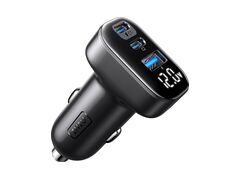
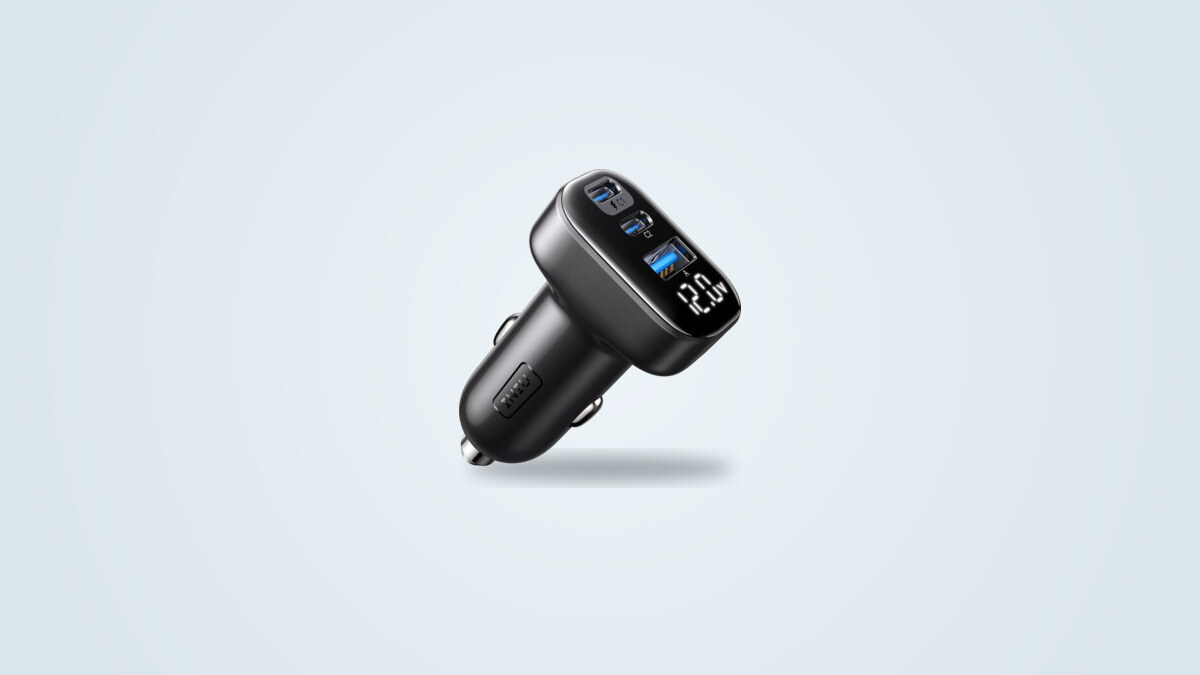
With two independent USB-C ports rated at 45W each, an extra USB-A port, and a built-in voltage display, the INIU 90W car charger targets a clear audience: drivers who want to charge several devices at full speed without carrying multiple adapters, in a shell that fits almost entirely inside the 12V socket. It undercuts the direct rivals of similar power in this comparison on price.
The shell plugs into the vehicle's cigarette lighter socket and splits its power between two USB-C ports, marked C1 and C2 on the faceplate (C1 carries a priority marker), and one USB-A port. The rest of this review details what each of these figures actually means once several devices are plugged in at the same time.
45W advertised, 48W at peak: what a USB-C port really delivers
Each USB-C port relies on a Power Delivery 3.0 controller that offers, alongside the usual fixed steps, a PPS (Programmable Power Supply) profile reaching up to 11V. On this PPS profile, the port's capacity slightly exceeds the advertised rating, with a ceiling close to 48 to 49W where the spec sheet states 45W, a rare gap in this direction for this type of product, where the advertised figure usually overstates reality rather than the other way round.
The important nuance concerns the fixed PD profile, without PPS: this one stops at 12V/3A, or 36W. A cable or device that does not negotiate PPS, or that needs a higher voltage step (15V or 20V, absent from this port's table), is therefore limited to that 36W rather than the advertised 45W. A 65W hybrid tablet negotiated a fixed 12V profile on this port, drawing a stable power close to 32W over about twenty minutes, consistent with that 36W ceiling rather than the advertised 45W.
This 45W ceiling per port should not be read as a universal guarantee: it states the maximum power the port can supply to a device able to negotiate it correctly, not the automatic outcome for any cable or device plugged in.
2x45W plus 18W: a power split not always spelled out
Adding up each port's maximum gives 108W: 45W for each USB-C port plus 18W for the USB-A port. The shell is nonetheless rated at only 90W total, an 18W gap that points to a dynamic power split once several ports are in use at the same time, a common mechanism on this type of product whenever the sum of the ports exceeds the advertised total.
Unlike the Baseus 65W or the Anker 75W, which each publish an exact split with two ports active, the INIU 90W does not detail any official table for its two or three port combinations at once: the spec sheet only states 45W maximum per port in dual use, without clarifying what happens once the third, USB-A port joins in. That is the main blind spot of this charger on this axis.
In practice, charging two smartphones at once on the two USB-C ports runs with no noticeable slowdown, and a combined draw of around 56W split between two devices only caused mild warming of the shell, with no sign of aggressive thermal throttling. The third, USB-A port works more as a backup for a third device (earbuds, an older phone) than as a fast-charging port in its own right: its 18W stays modest next to the two symmetrical 45W USB-C ports, a cleaner split than the 45W/18W asymmetry of the Baseus 65W or the 45W/30W of the Anker 75W.
PD, QC and beyond: wide compatibility on the USB-A port
Both USB-C ports rely on Power Delivery 3.0 rounded out by the PPS mode detailed above, plus Quick Charge 3.0 for devices that do not natively negotiate PD. The USB-A port goes noticeably further than most rivals in this comparison: besides QC 2.0 and 3.0, it recognizes AFC (Samsung), FCP and SCP (Huawei and Honor), Apple's proprietary 2.4A fast charging, and the older Programmable Efficiency standard. Only VOOC (Oppo) and VFCP (Vivo and iQoo) remain out of reach, two proprietary standards with little presence on the US market.
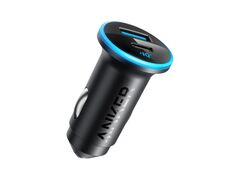
This wide USB-A coverage sets the INIU 90W apart from the Anker 323 52W, limited to PowerIQ 3.0 without SCP or Samsung's Super Fast Charging 2.0. It matches the Baseus 65W, which also covers AFC, FCP and SCP on both its ports.
One thing this charger shares with most car chargers on the market: no cable is included in the box. A good quality USB-C to USB-C cable, able to carry the PD and PPS steps involved, remains necessary to get close to the advertised 45W on the USB-C ports.
0.9 oz for 90W: a rare power-to-weight ratio
The shell weighs 0.9 oz (26 g) and measures 1.4 x 0.9 x 2.4 in (3.5 x 2.3 x 6 cm), a shape that stays almost entirely within the socket's outline once plugged in. Relative to its 90W total output, that weight gives a ratio well above the Anker 323 52.5W (0.8 oz / 23 g) and far above the Anker 75W (2.7 oz / 77 g).
No GaN claim comes with this charger, unlike some rivals that highlight this technology to justify their compact size: the INIU 90W does not claim anything on this point, which avoids any unfulfilled promise but also leaves the shell without a marketing angle that its real lightness could otherwise have supported.
The voltage display: useful, but not a wattmeter
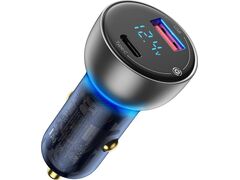
The built-in display constantly shows the vehicle's battery voltage, a useful indicator for spotting a weak battery before it leads to a breakdown, especially heading into winter or after the car has sat unused for a while. None of the Anker chargers in this comparison offer this feature, and only the Baseus 65W shares it.
The clearest limit of this display concerns its usefulness once a device is plugged in: unlike the Baseus 65W, whose display switches to each port's voltage and current while charging, the INIU 90W's display stays focused on the vehicle's battery voltage and never shows the actual power delivered to a connected device. A power readout in watts, rather than a plain voltmeter, would have made charging easier to follow at a glance.
Build and warranty: 3 years, but a brand-wide policy
The shell uses a UL94 V-0 fire-retardant housing, a standard feature on this type of product to limit flame spread in case of an internal fault. INIU advertises a 3-year warranty on this charger, the longest in this comparison: against the 30-day manufacturer warranty of the closest official Baseus lineup, or the 18 months of the Anker 323 52W, the gap is clear.
On the brand's track record, the Consumer Product Safety Commission opened a recall in 2025 on an entirely different INIU product: a 10,000mAh power bank sold between 2021 and 2022, pulled after several cases of overheating and fire that caused minor burns. That recall concerns a lithium-ion battery cell, a failure mode that does not apply to this car charger, which contains no storage cell and simply converts the vehicle's voltage. It remains worth knowing about the wider brand lineup, though.
On this specific model, the product's newness does not yet allow for extended, multi-year use: no recurring failure or repeated manufacturing defect shows up at this stage, a note of caution rather than an identified flaw.
Safety: standard protection, no incident specific to this model
The charger includes the 6-layer protection common on this type of product: against overvoltage, overcurrent, overheating and short circuits, with independent management on each port. A combined draw of around 56W between two devices only caused mild warming of the shell, with no shutdown or audible degradation.
Two caveats: no IP rating against dust or water is advertised, a gap common to nearly all car chargers of this shape and a minor one for in-cabin use. And unlike the Baseus 65W, whose CE and FCC markings appear directly on the circuit board, no equivalent information is available for the INIU 90W beyond what appears on the packaging and product page.
12 to 24V compatible: cars, trucks and vans
The INIU 90W accepts a 12 to 24V input range, making it compatible with standard cars and motorcycles as well as trucks, vans and camper conversions running on 24V. That wide range answers a real need: a single charger for an entire fleet of personal or professional vehicles, without checking compatibility every time the vehicle changes.
Coming back to the power nuance covered earlier, it hinges mostly on the negotiated charging profile (fixed PD or PPS) rather than on the vehicle's input voltage itself: a port that negotiates PPS can reach full power on either 12V or 24V, as long as the connected device supports it. A higher input voltage, such as on a 24V network, may in turn give the internal converter more headroom to offer a higher fixed step without relying on PPS, which would explain why the product documentation ties the ports' full potential to 24V: the difference would sit at the converter level, not in an artificial limit imposed on 12V.
Against the Baseus 65W, the Anker 75W, the Anker 323 and the Ugreen 130W
How does the INIU 90W compare with the other car chargers already reviewed on this site?
| Criterion | INIU 90W | Baseus 65W | Anker 75W | Anker 323 52W | Ugreen 130W |
|---|---|---|---|---|---|
| Total power | 90W | 65W | 75W | 52.5W | 130W |
| Ports | 2xUSB-C 45W + USB-A 18W | USB-C + USB-A | USB-C cable + USB-C | USB-C 30W + USB-A 22.5W | 2xUSB-C + USB-A |
| Voltage display | Yes | Yes | No | No | No |
| Weight | 0.9 oz (26g) | ~1.0 oz (28 to 29g) | 2.7 oz (77g) | 0.8 oz (23g) | Not disclosed |
| Advertised warranty | 3 years | 30 days | Not disclosed here | 18 months | Not disclosed here |
| Price as observed | $18.99 | Not disclosed here | Not disclosed here | Not disclosed here | Not disclosed here |
The INIU 90W combines the highest total power after the Ugreen 130W, one of the lowest weights in this comparison, a voltage display shared only with the Baseus 65W, and the longest warranty of the group. Its relative weakness against the Ugreen 130W lies in the advertised power of the main port (45W versus 100W), but the Ugreen only holds its full power for a few minutes before dropping noticeably, which softens that gap for everyday use.
Who this charger suits, and who should look elsewhere
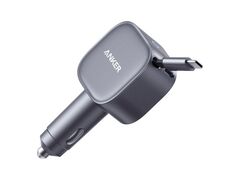
The INIU 90W suits drivers who want to charge two recent smartphones at full speed at the same time, plus a third device as backup, in a shell that barely sticks out of the socket. Its 3-year warranty also makes it a reassuring pick for anyone planning to keep it for several years without a second thought. For occasional single-device use on a tighter budget, the Anker 323 52W stays an even lighter option. For a cable that is always built into the shell, the Anker 75W avoids carrying a separate one. For a demanding laptop in regular use, none of the rivals compared here, INIU included, guarantee reliable charging above 36W per port without a PPS negotiation: it is worth checking the exact device compatibility before buying.