What the advertised 100W is really worth
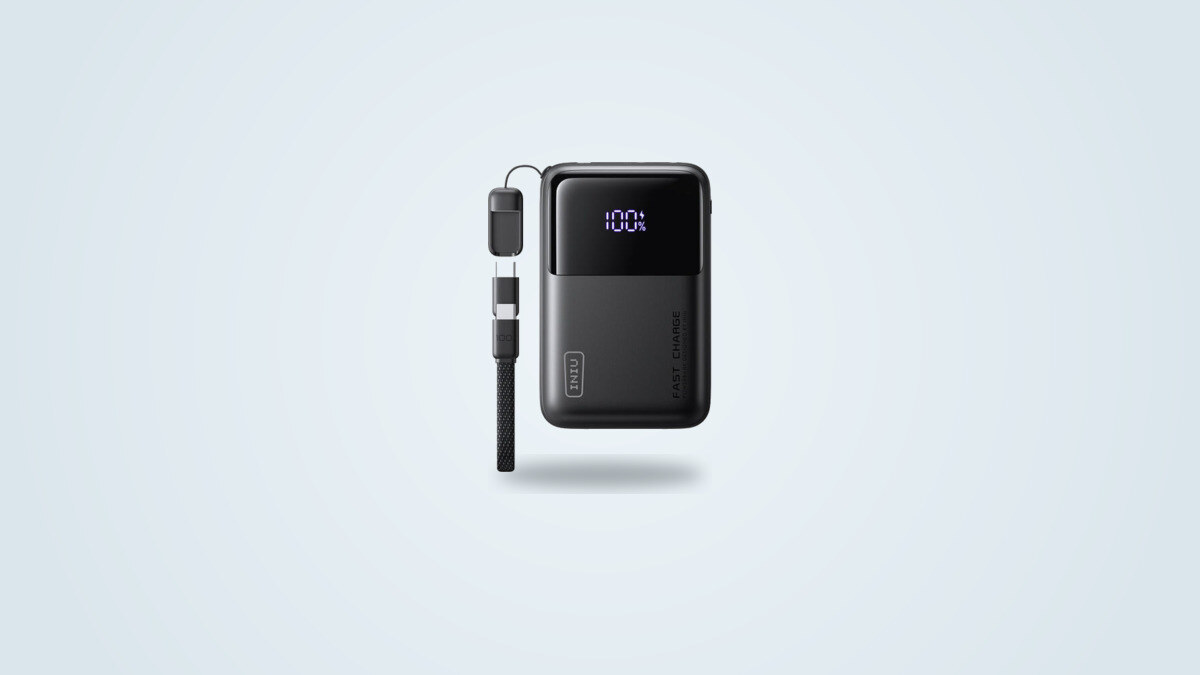
The INIU P63 advertises 100W over USB-C, and that figure holds up when a single device is plugged into the main port: a laptop, a handheld console or a recent smartphone negotiates the USB PD 3.0 protocol without issue and gets its full power. The second USB-C port tops out at 45W, and the USB-A port at 18W. Add the three figures together and the spec sheet implies 163W. That is not what actually happens once more than one device is plugged in at the same time.
When both USB-C ports run together, the total pool caps at 110W split between the two, already less than the 145W a quick read of the spec sheet would suggest. Once the third port (USB-A) joins in, the total pool drops to 80W shared across all three outputs, and the second USB-C port, rated at 45W, delivers no more than 15W in that exact configuration. This limit appears on no spec sheet and only shows up in use, by plugging in a laptop, a phone and a third device at the same time.
91Wh in real terms: what it actually recharges, and the real recharge time
The advertised 25,000mAh works out to roughly 91Wh once converted at the cells' nominal voltage, the figure that actually matters for what the battery can recharge. That much energy covers roughly 4 to 5 full phone recharges, one and a half charges of a 13-inch iPad Pro, or one full charge of a 14-inch laptop depending on the workload running at the time. On a handheld console such as the Steam Deck, one full charge of the console uses about 69% of the P63's capacity, which allows for a little over one full console charge per full cycle of the power bank.
As for recharging the P63 itself, the main port accepts up to 65W of input, and INIU advertises a full recharge in 84 minutes with a charger of that wattage or more. That figure assumes favorable conditions from start to finish; in everyday use, a full recharge is closer to 1h40, and can approach two hours depending on the charger used. Part of the gap comes down to the ordinary tapering of any lithium battery near the end of a charge, when current has to drop to protect the cells: the last few minutes are among the slowest, whichever charger is used.
The 100W promise, and its real conditions
The 100W over USB-C only matters for devices able to actually draw it. A 14-inch MacBook Pro regains roughly 70% of its charge in about 30 minutes with the supplied cable, a speed very close to that of an equivalent wall charger. A newer MacBook Air, on the other hand, whose own charger typically tops out around 65 to 70W, never pushes the port to its maximum: the main port's extra headroom does nothing for this kind of lighter machine. The 100W is therefore fully useful only with laptops or consoles able to ask for it, typically the more demanding 14 or 16-inch models.
On the phone side, the P63 correctly negotiates the main fast-charging protocols specific to each brand: a recent Samsung flagship reaches about 75% charge in 30 minutes via Super Fast Charging 2.0, and a recent iPhone passes 75 to 80% in the same window. These speeds hold as long as no other port is in use at the same time: single-device use is what delivers the best figures.
Real-world battery life and performance
Day to day, the P63 holds its charge across several days of mixed use (phone, tablet, camera) with no noticeable capacity loss over a five-week stretch of varied use, in one specific case. Pass-through charging, which lets the bank recharge itself while powering a connected device, genuinely works: in one specific case, input reaches about 60W at the same time output delivers about 35W to a laptop, with no break in the transfer.
For photo and video work, the available capacity can recharge a camera or drone battery several times over in a single day. For remote work, a full charge covers roughly fifteen hours of wireless web browsing on a 13-inch laptop on top of its own battery, an order of magnitude consistent with the 91Wh on tap.
The main friction point: weight and thickness
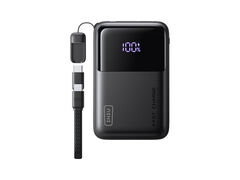
13.8oz (391g) on the scale in theory, between 13.6oz (386g) and roughly 14.1oz (400g) across individual units in practice, for a shell measuring 4.3 x 2.7 x 1.4 inches (109 x 69 x 36mm). That is the logical trade-off for 91Wh on board, but the weight is clearly noticeable in a pants pocket: the P63 travels better in a bag or a roomy jacket pocket. The 1.4-inch (36mm) thickness, more than the length or width, is what gives it that dense, compact-block feel, quite different from a simple wall charger.
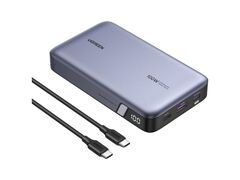
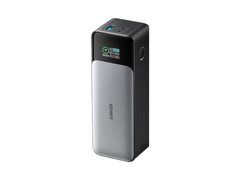
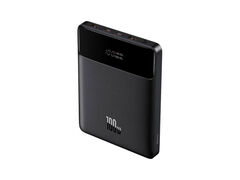
| Model | INIU P63 | Ugreen Nexode 100W | Anker 737 (PowerCore 24K) | Baseus Blade 100W |
|---|---|---|---|---|
| Capacity | 25,000mAh / 91Wh | 20,000mAh / 72Wh | 24,000mAh / 86Wh | 20,000mAh / 74Wh |
| Weight | 13.8 oz (391 g) | ≈ 14.8 oz (420 g) | ≈ 1.39 lb (630 g) | ≈ 1.12 lb (506 g) |
The comparison with direct rivals of the same power class works in the P63's favor: the Anker 737 weighs about 1.39lb (630g) for 24,000mAh, and the Baseus Blade 100W about 1.12lb (506g) for 20,000mAh. The P63 offers more capacity than both for 25 to 40% less weight, making it, on this measure alone, the lightest in its class at the same main-port power.
Screen and detachable cable: an imperfect secondary feature
The LCD screen shows the remaining charge in 1% steps, precise enough to track the level through the day. It is, however, limited to that single figure, with no voltage or current readout during charging, and it becomes hard to read in direct sunlight or even bright outdoor light, forcing the unit to be tilted to check the level. The glossy display panel also picks up fingerprints easily.
The supplied detachable USB-C cable doubles as a wrist strap: it clips onto the side of the unit so it never gets lost, a touch that saves carrying a separate cable. The trade-off is its length, about 12 inches (30cm), designed for that strap function rather than for comfortably reaching a device set down away from the bank. No trickle-charge mode is offered on the input port, an option that could have mattered for anyone leaving the P63 permanently plugged into the wall as backup.
A particular use case: handheld gaming
The Steam Deck and the ROG Ally are among the uses where the P63 makes the most of its format: the main port powers these consoles at full speed during play, without slowing the session down, adding several hours of runtime on the road. A full console charge uses about 69% of the P63's capacity, leaving enough headroom to also top up a phone during the same outing.
The Nintendo Switch benefits from the same principle. In all three cases, the console's own screen remains the practical limit: gaming continuously while charging draws more power than on standby, which cuts into the number of full charges available from a single P63 charge.
Against the INIU lineup and the competition
Within INIU's own lineup, the P63 sits between the P62, more compact and capped at 65W on its main port (20,000mAh), and the P64, aimed at the most power-hungry laptops with 140W of output. The P63 adds 20W of input power over the P62 (65W versus 45W), for a self-recharge time that stays close despite an extra 5,000mAh.
| Criterion | INIU P63 | Ugreen Nexode 100W | Anker 737 (PowerCore 24K) | Baseus Blade 100W |
|---|---|---|---|---|
| Main port | 100W | 100W | 140W (2 ports combined) | 100W |
| Cable | Detachable USB-C, wrist strap | USB-C included | USB-C included | 2 built-in USB-C cables |
| Warranty | 3 years | 18 months | 18 months | 18 months |
At equal main-port power, the P63 offers the best capacity-to-weight ratio of the group: more mAh than the Ugreen Nexode 100W and the Baseus Blade 100W, for less weight than all three others. The Anker 737 keeps the edge if its two ports are combined for 140W total, but at a weight more than 60% higher.
Reliability, warranty and after-sales support
INIU backs the P63 with a 3-year warranty, well above the 12 to 18 months typical for this kind of product. No recurring fault specific to the P63 shows up beyond the points already raised above (screen, cable, power sharing): the shell and the TinyCell/HyperStack cells appear to hold up over several weeks of intensive use.
Who the INIU P63 is for, and who it is not for
The P63 suits anyone who wants a single power bank able to keep up with a laptop, a phone and a handheld console, without juggling several chargers for a trip or a day out. Its capacity-to-weight ratio, the best in this comparison against rivals of the same power class, makes it a logical choice for regular travel or flying, its capacity staying under the 100Wh threshold.
It suits less anyone after the lightest possible pack for occasional phone-only use: a smaller, cheaper battery is enough in that case, avoiding the need to carry 13.8oz (391g) of capacity that will never be fully used. The three-device simultaneous behavior, with its power drop on the second USB-C port, is also worth knowing before relying on it for continuous three-device use.