What the advertised 10,000 mAh are really worth
The number that sells this battery is the 10,000 mAh printed on the box. Like any power bank, that figure doesn't measure energy but a quantity of charge, and it needs to be multiplied by a voltage to get watt-hours. Intenso counts the XS10000's LiPo cell at 3.7 V, which gives the 37 Wh the manufacturer states on its own spec sheet.
Between the 37 Wh stored in the pack and the energy that actually comes out through the USB port, there is always a loss: the converter that steps the voltage up from 3.7 V to the 5 V of the USB output is never perfect, and part of the energy is dissipated as heat along the way. That is true of every power bank of this kind, without exception. For the Intenso XS10000, no independent measurement specific to this model was found to quantify that loss precisely, whether as the actual Wh delivered or as an efficiency percentage. That is a reservation worth keeping in mind, not a proven flaw: nothing points to an unusually high loss either, simply the absence of a reliable published figure on the subject.
Absent a restitution measurement, an order of magnitude is still useful. Most current smartphones carry a battery of roughly 15 to 20 Wh. Even allowing for the usual conversion loss on this kind of device, the pack's 37 Wh comfortably cover two full charges, matching the claim already made on the product page. For heavier use (a tablet, a camera, several charges back to back on a large phone), the margin shrinks quickly.
A 15 W budget to share between the two outputs
Intenso sets this ceiling itself in its spec sheet: the combined output of the USB-C port and the USB-A port caps at 5 V for 3.1 A in total, or about 15 W. That is not 15 W per port, it is 15 W to share between the two as soon as both are in use at the same time. Plugging in a second device doesn't add anything: it draws its share from a budget that doesn't change.
Used alone, a single device can receive close to the full 15 W if its own cable and charger allow it, which is enough to power a smartphone at a decent pace. It is as soon as two devices draw power at once that the limit shows, each one then mechanically receiving less than it would alone.
This 15 W ceiling places the Intenso XS10000 firmly in backup-charging territory, not fast-charging territory. No fast-charging protocol (Power Delivery, Quick Charge or a proprietary equivalent) is advertised by the manufacturer, despite the USB-C port: that port brings bidirectionality (input and output on the same socket), not a voltage step above 5 V.
Recharging the battery itself: 12 W, no fast charging
On the input side, the Intenso XS10000 accepts up to 5 V at 2.4 A, or 12 W, through its USB-C port or its micro-USB input. Both paths deliver the same power: going through USB-C doesn't recharge it any faster than an older micro-USB cable, it only brings the convenience of a reversible connector.
With 37 Wh to fill at a theoretical maximum of 12 W, a full charge mechanically takes several hours, even ignoring the usual conversion losses during charging. No full-recharge time was found for this specific model in a reliable source: the manufacturer doesn't publish one, and no independent measurement specific to the XS10000 was located. As a theoretical reference point only, 37 Wh divided by 12 W gives a little over three hours under the unrealistic assumption of perfect charging efficiency; the real time is necessarily longer.
There is no fast-charging mode to switch on, no higher voltage step, no setting to tick in an app: the XS10000 recharges the way a power bank would have a decade ago, which fits its price point but remains a real friction point for anyone used to a full charge in about an hour on other devices.
Connectivity: the essentials, but only two output ports
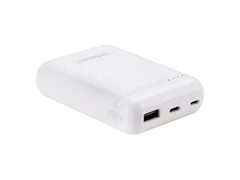
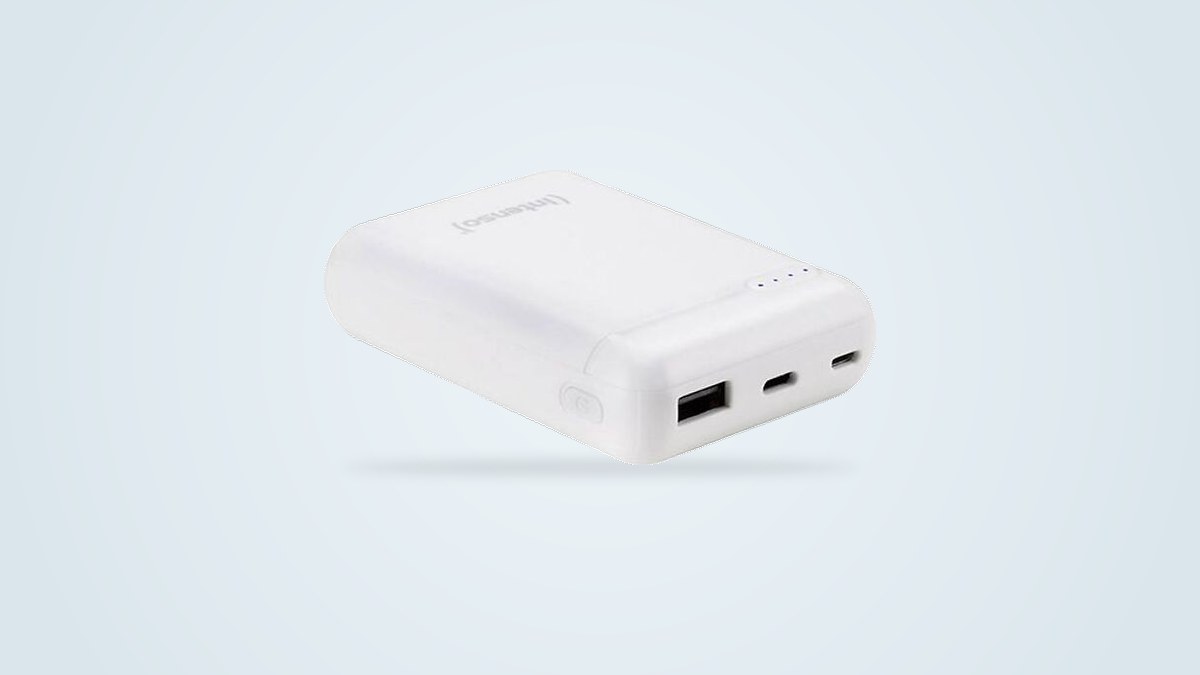
Three sockets sit on the edge of the case: a USB-C port, a USB-A port, and a micro-USB input. The USB-C port is the only genuinely bidirectional one: it both recharges the battery and powers a device, so there's no need to remember which side to plug what into. The USB-A port only works as an output, and the micro-USB input only works as an input, a useful fallback for anyone who still owns older cables.
| Port | Direction | Power |
|---|---|---|
| USB-C | Input and output | Shared within the 15 W output total, up to 12 W on input |
| USB-A | Output only | Shared within the 15 W total |
| Micro-USB | Input only | Up to 12 W |
A USB-A to USB-C cable is included in the box, so there's no need to buy one from day one. It's a small detail, but one that several direct competitors at this price don't include.
The remaining charge is shown on four LEDs, in 25% steps. That's enough to know whether there's still headroom or whether it's time to recharge, but it never gives an exact percentage: between two lit LEDs, the difference can represent up to a quarter of the total capacity. A numeric display, found on newer or pricier models, isn't offered here.
Size and weight: a compact build for 10,000 mAh
6.4 oz (182 g) on the scale, in a case measuring about 3.5 x 2.5 x 0.9 in (90 x 63 x 24 mm): a size that slips easily into a jacket pocket or a small bag without weighing it down. For a 10,000 mAh capacity, that's a compact build, even though no independent comparative weigh-in against its direct rivals was found to turn that into a ranked figure.
The case comes in five colors (white, black, blue, pink and petrol), strictly identical on the technical side: only the shade changes, no version gets more power or more ports than another. Choosing a color is a matter of taste, not function.
The finish stays simple: matte plastic, a power button, a printed logo. Nothing eye-catching in the photos available, but nothing that suggests cheap assembly either. The rounded shape makes it easy to hold, a detail that matters for something taken out and put away several times a day.
XS10000 or S10000: two Intenso models not to confuse
Intenso's catalog also includes an "S10000", a very similar name with the same 10,000 mAh capacity, but it is a different product, with a design difference that matters. The S10000 has a charging cable permanently built into the case, whereas the XS10000 uses a removable cable, supplied separately in the box.
This difference isn't cosmetic. A built-in cable means there's nothing extra to carry, but it can't be replaced if it wears out or breaks: on this kind of design, the built-in cable is regularly mentioned as a weak point over time. On the XS10000, a damaged cable can be replaced for a few dollars without making the battery unusable.
Intenso's XS lineup also includes an XS5000 (5,000 mAh) and an XS20000 (20,000 mAh), which share the same overall design (removable cable, bidirectional USB-C port) at different capacities. So the number in the XS lineup does track capacity; it's the prefix that changes everything between "XS10000" and "S10000". Checking the exact model name on the product page or the packaging avoids an easy mix-up between the two.
Build quality, warranty and long-term reliability
Intenso is a general-purpose German brand, long established in audio, storage and power banks, positioned more toward the budget and mid-range than the very top end. The XS10000 fits that positioning well: simple, with no superfluous feature, sold at a price well below the best-equipped references on the market.
The manufacturer's warranty is two years, longer than the one-year term common on budget electronics in the US market. The case includes the protections now standard for this kind of product: against overcharging, deep discharge, overvoltage and short circuits.
No recall or safety notice targeting this model was found during research. That isn't absolute proof of a trouble-free record, but it is a positive sign in a segment where several recalls have genuinely affected power banks from other brands in recent years, sometimes over overheating risks. The XS10000 has remained on sale with no visible technical revision since its launch in October 2019, which makes it a mature product today rather than a recent newcomer: staying on the market for close to seven years with no recall found is the kind of indirect signal that matters, even though it doesn't replace an actual reliability measurement.
Up against other 10,000 mAh power banks
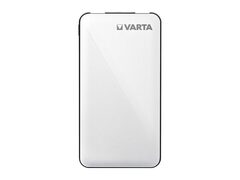
In the segment of 10,000 mAh power banks selling for around $15 to $25, three references regularly come up in direct comparison with the Intenso XS10000: the Xiaomi Redmi 10000, the Anker PowerCore 10000 and the Varta Energy 5000, the last of which only has half the capacity despite a name that could suggest otherwise.
| Criterion | Intenso XS10000 | Xiaomi Redmi 10000 | Anker PowerCore 10000 | Varta Energy 5000 |
|---|---|---|---|---|
| Capacity | 10,000 mAh | 10,000 mAh | 10,000 mAh | 5,000 mAh |
| Outputs | USB-C (in/out) + USB-A | 2 USB-A + USB-C | 1 USB-A | 2 USB-A + USB-C |
| Total power | 15 W | 18 W | 12 W | 15 W |
| Cable included | USB-A to USB-C | USB-A to USB-C | USB-A to micro-USB | Yes |
| Observed price | ≈ $18.96 | ≈ $17.60 | ≈ $25.73 | ≈ $17.60 |
Against the Xiaomi Redmi 10000, the gap is mostly about ports: an extra USB-A port on the Xiaomi side, versus the Intenso's genuinely bidirectional USB-C port, which simplifies day-to-day charging with a single cable type. The advertised total power is slightly higher on the Xiaomi, a difference that remains marginal in practice.
Against the Anker PowerCore 10000, the difference is clearer on connectivity: a single USB-A output port, and micro-USB-only recharging, versus the Intenso's two output ports and USB-C recharging. The brand's reputation for reliability in this segment remains a strong argument, even without a figure specific to this exact model.
Against the Varta Energy 5000, the comparison is short-lived: at half the capacity for a comparable price, it doesn't play in the same usage category, except for anyone genuinely after the smallest possible size at the cost of shorter runtime.
Who it suits, and who it doesn't
The Intenso XS10000 suits anyone after a simple backup battery to slip into a bag or a pocket without a second thought, for topping up a smartphone at the end of the day or while traveling. The compact size, the bidirectional USB-C port and the included cable make it a hassle-free purchase: take it out, plug it in, it works. For occasional backup charging, that is exactly what it promises, no more and no less.
It also suits anyone who values a tight budget and an established brand over an impressive spec sheet. At a price generally between $15 and $23 depending on the retailer, it remains one of the cheapest options at this capacity from a known brand, with a two-year warranty and several years on the market with no safety notice found.
It suits less anyone charging hungrier devices (a tablet, a camera, a handheld console) or several devices at once: the 15 W budget shared between the two outputs shows up quickly. It also doesn't suit anyone expecting fast charging on their smartphone: without Power Delivery or Quick Charge, the USB-C port here only serves connector reversibility, not speed. Finally, anyone who travels a lot and prefers to know their charge level to the exact percentage should look at a model with a numeric display, since the XS10000's 4-LED gauge only gives readings in 25% steps.
For anyone after significantly more capacity without really raising the budget, the market now offers power banks of 20,000 mAh and beyond at sometimes similar prices: that is worth comparing before buying, depending on whether compactness, the XS10000's main strength, or raw capacity matters more to you.