What the claimed 100% discharge really changes versus lead-acid
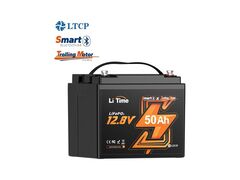
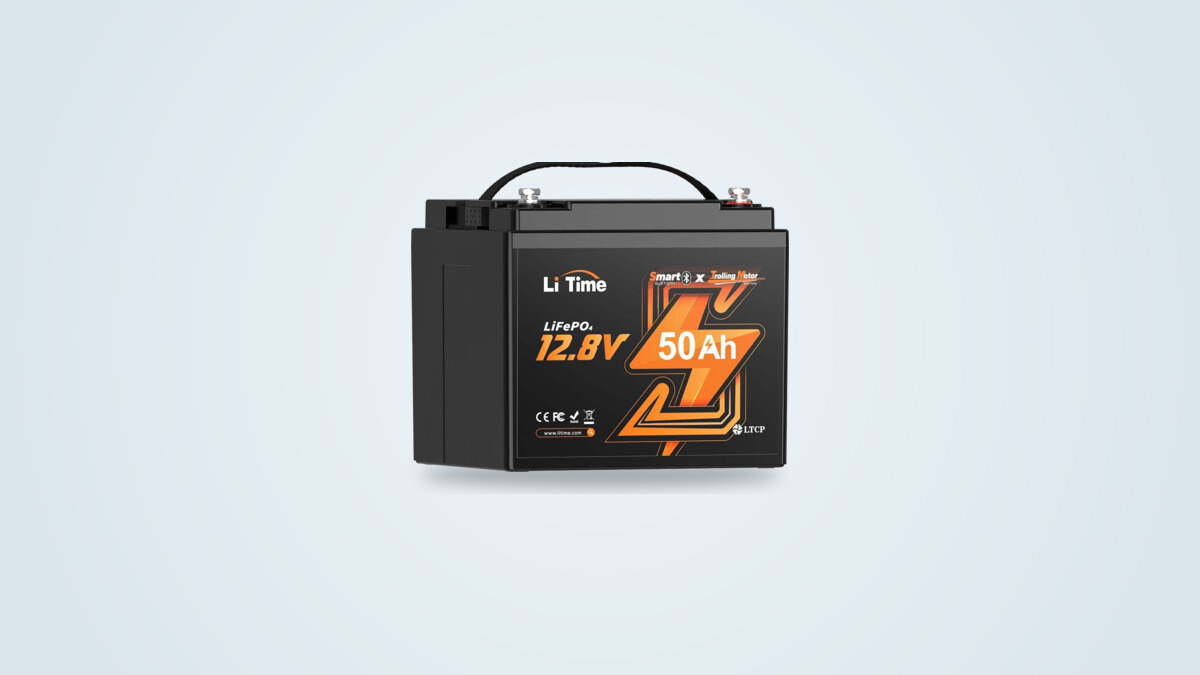
The LiTime 12V 50Ah is rated at 640 Wh (12.8V nominal for 50 Ah) with a claimed 100% depth of discharge, a trait specific to LiFePO4 chemistry. A lead-acid battery should never be drained past 50% without noticeably shortening its lifespan, so matching the same usable energy as these 640 Wh would require a lead-acid battery with a substantially higher nominal capacity to begin with.
A reference 12V 50Ah AGM lead-acid battery typically weighs between 31 and 35 lb (14 to 16 kg). At 11.1 lb (5.05 kg), the LiTime weighs less than a third of that, built-in carry handle included. The real-world gap is even wider than this simple weight ratio suggests, since a lead-acid battery matched for usable energy (and therefore oversized to compensate for its 50% discharge limit) would weigh substantially more still.
| Criterion | AGM lead-acid 50Ah (reference) | LiTime 12V 50Ah (this product) |
|---|---|---|
| Nominal capacity | 50 Ah (640 Wh) | 50 Ah (640 Wh) |
| Recommended discharge | 50% maximum | 100% claimed |
| Actual usable energy | About 320 Wh | 640 Wh |
| Weight | 31 to 35 lb (14 to 16 kg) | 11.1 lb (5.05 kg) |
The manufacturer also claims 4000 cycles at 100% depth of discharge, 6000 cycles at 80%, and up to 15000 cycles at 60%, against a few hundred cycles for a lead-acid battery regularly drained halfway. No independent measurement specific to this exact 50Ah model could be cross-checked to confirm the actual delivery of the claimed 640 Wh over time: it's a manufacturer figure, not a third-party verified one, and it remains a confidence gap rather than an established flaw.
Bluetooth and app: a real diagnostic tool, not a gimmick
The built-in Bluetooth 5.0 connects with a simple scan of the QR code printed on the case, skipping the usual manual pairing dance. The LiTime app then shows voltage, current and charge level in real time, including across several batteries wired in series or parallel. That's a genuine step up from lead-acid, where only a multimeter tells you where a battery actually stands.
The battery works fine on its own without a phone nearby: the BMS handles its protections continuously, and the app is only an optional monitoring layer, not a requirement to function. Two real limits are worth flagging. First, the very first connection (or reconnecting after a low-voltage cutoff) requires waking the battery up with a brief charge before Bluetooth activates, a detail missing from the quick-start material in the box. Second, the claimed range sits around 33 ft (10 m), worth keeping in mind for an install inside a closed engine bay or a crawl space far from the helm.
BMS and protections: thorough on paper, finicky with some third-party chargers
The BMS is rated for 50A of continuous current and guards against overcharge, deep discharge, overcurrent, overheating and short-circuits, with an internal resistance claimed at 40 mΩ or below. When something goes wrong, the cutoff is automatic, and the battery restarts on its own roughly 30 seconds after conditions return to normal, with no manual intervention needed.
One technical point is worth flagging for anyone planning to pair this battery with a charger or solar controller from another brand rather than a LiTime unit: on this BMS generation, full-charge detection relies partly on a high-voltage threshold rather than a complete digital handshake with the charging device. Facing a third-party charger or controller not built around that exact protocol, this can show up as charging that stops short or a cutoff that triggers earlier than expected. Using a charger designed around this kind of BMS, whether from LiTime or another brand known to be LiFePO4-compatible, limits that risk. Nothing points to this specifically affecting the 50Ah Bluetooth model reviewed here rather than another capacity in the lineup, but the underlying design choice applies to this BMS generation as a whole.
Cold-weather performance: automatic cutoffs and restart
Charging is automatically cut below 32 °F (0 °C) and resumes on its own above 41 °F (5 °C). Discharging stays available down to -4 °F (-20 °C), with a claimed storage range of 14 °F to 122 °F (-10 °C to 50 °C). That's a wide window for mobile use, and notably more forgiving than a classic NMC lithium chemistry, which handles a cold charge very poorly.
For a boat or RV used through shoulder-season weather, this automatic cutoff heads off lithium's main cold-weather risk (metallic lithium plating on the electrode during a too-cold charge, which permanently degrades the cell) without any input from the owner. The trade-off is that a charge attempted on a chilly morning simply won't start until the temperature climbs back above the threshold.
The warranty clause that traps the exact use it's sold for
The advertised warranty runs 5 years, a solid figure for this price bracket. But the manufacturer's warranty policy states that cell coverage only applies if the battery is recharged at least once every 3 months. It's a clause that gets little airtime in marketing copy, yet it directly affects the very use this product is sold for: boats, RVs, off-grid solar kits, all of them frequently left idle for months at a stretch.
In practice, a boat or RV laid up for 4, 5 or 6 months without being reconnected or recharged can, strictly by the letter of the contract, fall outside cell warranty coverage, for exactly the kind of use the manufacturer markets it for. The fix is simple but needs planning ahead: disconnect the battery fully from every load before laying it up, and schedule a recharge reminder every 2 to 3 months rather than relying on the chemistry's own low self-discharge.
Reliability and buyer feedback
Buyer feedback on this model skews heavily positive, most often citing good build quality, reliable operation and a product that matches expectations; opinions are more split on value for money against the equally crowded field of other Chinese-made alternatives at this price point. A handful of isolated failure cases exist, including one involving an off-label use (an electric mobility application the manufacturer never intended), with a refund granted without much back-and-forth once the fault was clearly established.
The brand's customer service shows more mixed feedback on some European markets than on its main sales channel, with support exchanges sometimes taking longer to land on a replacement or refund. That nuance doesn't undermine the base-level protection (the BMS and its electrical safeguards keep working regardless), but it's worth knowing before ever needing to rely on it.
Expandable to 10.24 kWh in 4S4P: real headroom, not a marketing footnote
The manufacturer claims expandability up to a 4S4P configuration (4 batteries in series, repeated across 4 parallel strings), or 16 units forming a 48V/200Ah system, for a combined 10.24 kWh and a claimed 20.48 kW of power. That ceiling isn't just a theoretical spec: it turns this everyday battery into the building block of a far more ambitious home or marine system, while staying just as usable one unit at a time for a simple lead-acid swap.
To stay reliable, a series/parallel build like this calls for batteries from the same batch, brought to a matching charge level before they're wired together, a precaution that applies to any LiFePO4 chemistry combined this way and not just to this brand. For a more modest setup (a boat or RV), a single unit swapped in for a lead-acid battery remains the simplest and most common use case.
LiTime ComFlex: the higher tier the same manufacturer already sells
The same manufacturer also sells a newer, pricier ComFlex line that adds wired CAN/RS485 communication compatible with Victron inverters and monitoring systems, on top of Bluetooth. That range targets buyers already running a Victron setup, or anyone wanting remote monitoring that doesn't depend solely on Bluetooth range.
The LiTime 12V 50Ah Bluetooth reviewed here stays the standalone, more affordable version of the brand: it needs no third-party hardware to function and is fully controlled through its own app. Anyone already running a Victron system should check ComFlex's compatibility and pricing before deciding; for a straightforward lead-acid swap with no existing ecosystem to match, this standard version covers the need without paying for extras that go unused.
Practical installation: M8 terminals, size and weight
The case measures 7.7 x 6.5 x 6.8 in (195 x 166 x 172 mm) and weighs 11.1 lb (5.05 kg), with a built-in carry handle that makes it easy to move despite the compact footprint. The terminals are M8 screws, a common format but one that needs the right lugs: lugs salvaged from an old lead-acid battery aren't always the right diameter, worth checking before ordering rather than after the battery arrives.
The IP65 rating protects against dust and water splashed from any direction, which covers use in an open boat locker exposed to spray or under an RV floor exposed to light leaks. It isn't an immersion rating, though: a battery left submerged for any length of time isn't covered by this level of protection.
Who it's for, and who should look elsewhere
This battery is best suited to anyone replacing a 50 to 70 Ah lead-acid battery on an electric or trolling motor boat (20 to 70 lb thrust), an RV, or a small off-grid solar setup, on a modest budget and without wanting installation headaches. The Bluetooth link and compact size also make it a solid first step into lithium for anyone who has never left lead-acid behind.
It suits less well anyone already running a Victron system (the same manufacturer's ComFlex line fits that use more natively), anyone needing a continuous discharge current well above 50A, or anyone planning a multi-month lay-up with no chance of an interim recharge, unless they're willing to accept what that does to the cell warranty. Checking the compatibility of an already-owned charger or solar controller before buying is also worth doing if the plan is to avoid buying new charging hardware.