A bare 18650 cell built for very high current
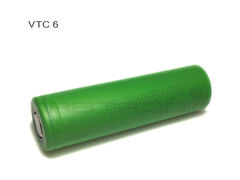
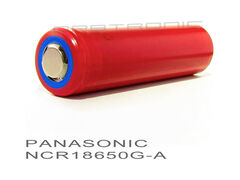
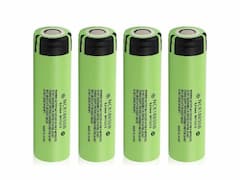
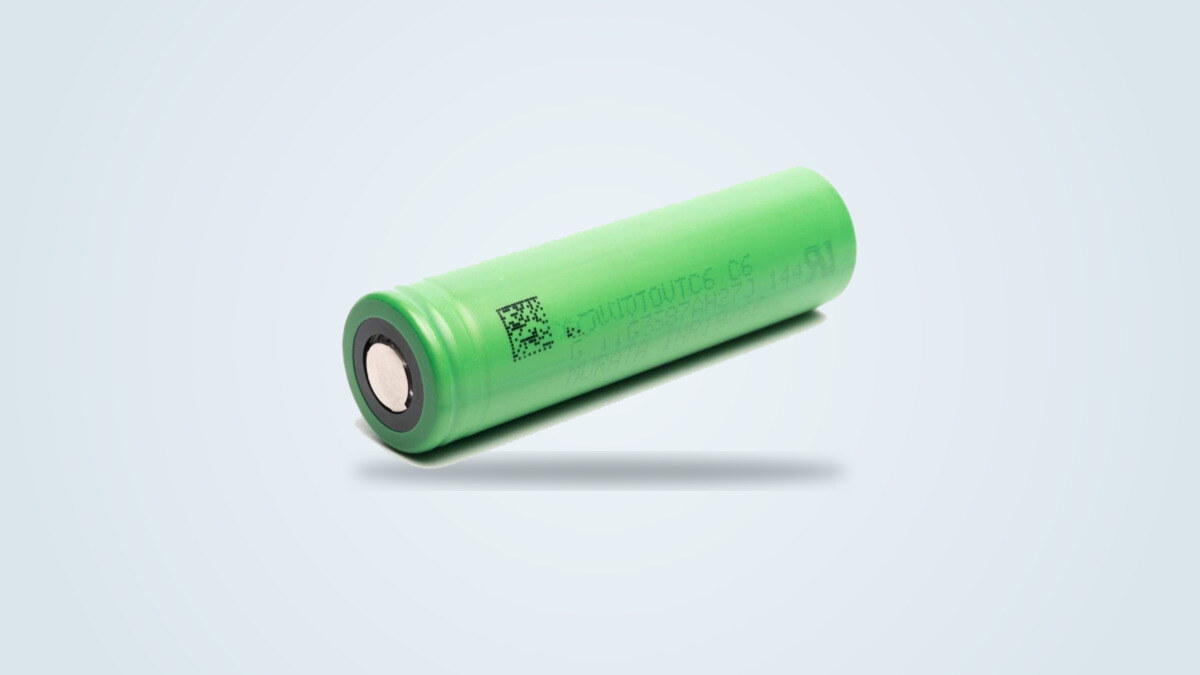
The Murata VTC6 (full designation US18650VTC6) is a bare cylindrical lithium-ion cell in the standard 18650 format (0.72 in / 18.35 mm diameter, 2.57 in / 65.2 mm long), sold without any consumer casing around it. Like the Panasonic NCR18650B and NCR18650GA already in our lineup, it serves as a building block for rebuildable vape mods, very powerful flashlights and packs assembled by knowledgeable hobbyists, never directly in a consumer device designed for AA or AAA batteries.
Within this family of 18650 cells, its specialty is current: 15A of continuous discharge set by the manufacturer, up to 30A at peak, for a guaranteed minimum capacity of 3000 mAh (3120 mAh typical) and a weight of about 1.64 oz (46.6 g). It is, to date, the most drain-oriented cell in our 18650 lineup, ahead of the NCR18650GA (10A) and far ahead of the NCR18650B (about 4.9A).
Sony yesterday, Murata today: the same cell under two names
Murata Manufacturing bought out Sony's cylindrical battery division, the one that made the VTC lineup, in September 2017. The VTC6 sold today under the Murata brand is therefore, down to the letter, the same cell as the Sony VTC6 released a few years earlier: same internal design, same datasheet, only the brand printed on the green wrapper changed. This is not a new generation or a spec revision, simply the continuity of the same production line under a new owner.
This transition explains why an online search for this reference brings back a roughly equal number of results under both names: shops, vaping and flashlight forums, technical comparisons, everything keeps referring to "Sony VTC6" and "Murata VTC6" interchangeably, sometimes on the very same page. Both names refer to the same product: neither is older or more reliable than the other, and there is no reason to prefer a "Sony" batch over a "Murata" one or vice versa. A serious retailer may well keep using the older name out of habit, even on a cell manufactured well after the buyout.
VTC6 or VTC6A: two cells not to confuse
This cell's name lends itself to frequent confusion with the VTC6A, a different reference that appeared later. Both list a very similar capacity, around 3000 mAh, which does not help tell them apart at a glance. The difference lies in the current: the original VTC6, the one covered here, is set by the manufacturer at 15A of continuous discharge, while the VTC6A claims a markedly higher continuous current, generally quoted between 20 and 25A, for a capacity just as close to 3000 mAh.
The cell covered in this review is indeed the plain VTC6: the associated product page lists a capacity of 3000 mAh minimum (3120 mAh typical) and a continuous discharge current of 15A, up to 30A at peak, exactly the profile of the original VTC6 and not that of the VTC6A. Before buying, if the continuous discharge current advertised by a seller exceeds 15A for a cell sold under this name, it is very probably the VTC6A rather than the cell covered in this review: the two are not interchangeable in a use case that would push either cell to its maximum current.
A modest capacity on paper, but remarkably stable
Murata rates the VTC6 at a guaranteed minimum capacity of 3000 mAh and a typical capacity of 3120 mAh, measured at a slow discharge rate (0.2C) down to a 2.0V cut-off voltage. That is noticeably less than the 3450 mAh typical of the NCR18650GA or the 3400 mAh of the NCR18650B: on paper, the VTC6 is not the cell to pick for maximizing the runtime of a pack or a moderate-current flashlight.
The important nuance lies in how stable this capacity is across the current drawn: on this cell, the available capacity varies very little with the discharge rate, including at currents far more sustained than the simple 0.2C rated regime. That is a notable difference in behavior compared with cells that advertise an attractive rated capacity but see it shrink noticeably as they approach their maximum current. One point worth keeping in mind regardless: the 2.0V cut-off used for the 3120 mAh figure is more permissive than the 2.5V threshold generally recommended for everyday use, which means the capacity actually usable before reaching this safety floor is slightly lower than the figure printed on the datasheet.
15A continuous, 30A at peak: the highest-drain of the three
This is the area where the Murata VTC6 stands out most clearly from its Panasonic cousins. The manufacturer sets its continuous discharge current at 15A, against 10A for the NCR18650GA and about 4.9A for the NCR18650B, that is 50% more than the better of the two Panasonic cells. At peak, the VTC6 can reach up to 30A, a figure tied to a 176 °F (80 °C) safety threshold detailed in the next section.
On the charging side, Murata sets a standard charge current of 3A (1C) and a maximum charge current of 5A, for an end-of-charge voltage of 4.20V, values consistent with those of the other high-drain 18650 cells in our lineup. A charger able to deliver this current without exceeding this voltage remains essential to get the most out of the cell without degrading it prematurely.
Why the 30A peak figure is not a continuous rating
The datasheet figure of "30A at peak, cut-off at 176 °F (80 °C)" is easy to misread: it does not describe a current the cell can absorb indefinitely, but a short-duration tolerance before its temperature reaches a threshold the manufacturer considers risky. On very brief pulses, the cell tolerates noticeably more than 30A: on the order of 30 to 40A for more than 44 seconds, 55A for more than 19 seconds, and up to 80A for more than 6 seconds before cutting off. These figures make clear that this is a time-limited tolerance window, not a cruising regime.
The difference shows up clearly under sustained load rather than a pulse: held at its rated continuous regime of 15A, a VTC6's temperature stays just under the 176 °F (80 °C) set by the manufacturer. Run continuously, however, at a rate of 20 or 30A, that is, the top of the "peak" range treated as a cruising regime rather than a brief pulse, the temperature climbs to about 196 °F (91 °C), beyond that same 176 °F (80 °C) threshold. The practical lesson is simple: the 15A figure is the one to respect for sustained use, while the 30A figure should only ever be asked to absorb brief spikes (a start-up current draw, a short vaping burst), never a continuous flow.
300 rated cycles: endurance behind the Panasonic cells
Murata rates the VTC6 at about 300 charge and discharge cycles at 0.5C before a noticeable capacity drop (down to 80% of the initial value), a figure noticeably lower than the roughly 500 cycles Panasonic rates for the NCR18650GA and the NCR18650B. This is not a manufacturing flaw: cells built for very high continuous current generally trade off a bit of cycle endurance for their current handling, a fairly standard engineering compromise in this segment rather than a real shortcoming specific to the VTC6.
As with any lithium-ion 18650 cell, a partial discharge (for example between 20 and 80% charge rather than a full cycle every time) noticeably extends this lifespan. This matters even more here, since the VTC6 is often run at sustained currents, which are more stressful for the cell over time: managing discharge depth day to day has a more visible effect on this cell than on a low-drain, lightly used capacity-focused cell.
Sub-ohm vaping, mechanical mods, very powerful flashlights: the VTC6's territory
The unprotected Flat Top format (2.57 x 0.72 in / 65.2 x 18.35 mm) is identical to that of the NCR18650B and NCR18650GA, just as compatible with the vast majority of cell holders, flashlights and home-built packs on the market. What truly sets the VTC6 apart is the range of uses its 15A continuous current opens up: rebuildable sub-ohm vape mods at very low resistance (below 0.15 ohm), unregulated mechanical mods, tactical flashlights rated at several thousand lumens, and DIY packs or light electric bikes that draw a sustained rather than occasional current. On this specific ground, it covers uses the NCR18650GA (10A) cannot serve without a risk of excessive heat.
This specialization has its logical trade-off: for moderate-current use (a regular flashlight, a model remote control, a pack sharing current across several cells), the VTC6's extra current brings nothing concrete, and its lower capacity compared with the NCR18650GA or NCR18650B then becomes a plain disadvantage with nothing to offset it. As with any 18650 cell, its 3.6 to 3.7V voltage also remains entirely incompatible with a device designed for a 1.2 to 1.5V battery, without a dedicated converter circuit.
Build quality and counterfeiting: an even bigger target than its cousins
The VTC6's reputation, inherited directly from its past under the Sony brand, makes it one of the most counterfeited 18650 cells on the market, at least as much as the NCR18650GA and NCR18650B already covered in this same lineup. The best-documented counterfeiting method for this format remains rewrapping: a second genuine wrapper, or a very faithful copy of the green Murata wrapper, hides a lower-quality cell with a real capacity well below what is claimed.
Several signs help limit the risk, beyond choosing a serious seller. Weight first: a genuine cell weighs about 1.64 oz (46.6 g), plus or minus 0.05 oz (1.5 g); a clear shortfall is suspicious. The wrapper next: a genuine wrapper is well glued, with a clean seam and a slightly glossy finish, while a counterfeit often shows a rough seam, visible glue and a green that is either too dull or too bright. The top-cap is a third clue, specific to each manufacturer and hard to reproduce faithfully. Finally, the advertised capacity: beyond about 3500 mAh for an 18650 format, the claim exceeds what current lithium-ion chemistry allows in that volume, and almost always gives away an outright counterfeit, exactly as with the NCR18650B and NCR18650GA.
On the handling side, the precautions remain those for any bare, unprotected 18650 cell: a charger dedicated to 3.7V lithium-ion cells, never a NiMH charger, and avoiding any short circuit, overcharge or loose storage without an insulated case. The high current this cell can deliver makes a counterfeit riskier here than on a pure-capacity model run at a low rate: a lower-quality cell mistakenly pushed towards 15A, in the belief it is a genuine VTC6, heats up and degrades far faster than a fake cell drawing 1 or 2A in a regular flashlight.
Against the Panasonic NCR18650B and NCR18650GA, and even more extreme cells
The table below lays out the technical gaps between the three high-drain 18650 cells already covered on best-batteries.com, alongside two references frequently cited in the same online comparisons, the Samsung 30Q and the Molicel P26A, which do not have a dedicated product page in our catalog at this time.
| Criterion | Murata VTC6 | Panasonic NCR18650GA | Panasonic NCR18650B | Samsung 30Q | Molicel P26A |
|---|---|---|---|---|---|
| Capacity | 3000 mAh (3120 mAh typical) | 3450 mAh | 3400 mAh | 3000 mAh (2950 mAh minimum) | 2600 mAh |
| Max continuous discharge | 15A (up to 30A at peak) | 10A | ~4.9A | 15A | 25A (up to 35A at peak) |
| Rated cycles | 300 | ~500 | ~500 | not stated | not stated |
| Terminal | Unprotected Flat Top | Unprotected Flat Top | Unprotected Flat Top | Unprotected Flat Top | Unprotected Flat Top |
| Ideal use | Extreme sub-ohm vaping, mechanical mods, very powerful flashlights | Powerful flashlight, moderate sub-ohm vaping, high-current DIY pack | Packs and flashlights at moderate current | Balanced vaping and DIY | Mechanical mods, extreme drain |
| Observed price | $6.99 | $6.99 | $9.41 | $6.99 | $5.99 |
In short, the Murata VTC6 is the most drain-oriented cell of the two Panasonic references already covered, with a continuous current 50% higher than the NCR18650GA, at the cost of lower capacity and cycle endurance. Against the Samsung 30Q, whose rated continuous current is identical (15A) for a comparable capacity, the VTC6 keeps the edge on peak current (30A against values generally closer to 20A for the 30Q according to manufacturer sheets) and, above all, a longer-standing reputation and track record. The Molicel P26A remains reserved for even more extreme use, with a continuous current of 25A, at the cost of a noticeably lower capacity (2600 mAh).
Who the Murata VTC6 is for, and who should look elsewhere
The Murata VTC6 is primarily aimed at anyone who genuinely needs more than 10A continuous: very-low-resistance sub-ohm vaping, unregulated mechanical mods, very powerful tactical flashlights, or high-current DIY packs. On this specific ground, it is the most capable of the three high-drain 18650 references already in our lineup, with a capacity that holds up to its promise even under heavy load, and a reputation built on more than a decade of use under the Sony name and then Murata's.
For moderate-current use (a regular flashlight, a remote control, a pack sharing current across several cells), the NCR18650B or the NCR18650GA remain more sensible choices: higher capacity, higher cycle endurance, for a current need the VTC6 is not uniquely positioned to satisfy anyway. In every case, buying from a serious source remains the single most important precaution on this format, which is particularly exposed to counterfeiting, and respecting the 15A figure as a continuous ceiling rather than a floor is what determines the cell's real longevity.