What the manufacturer's spec sheet actually confirms
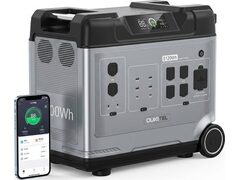
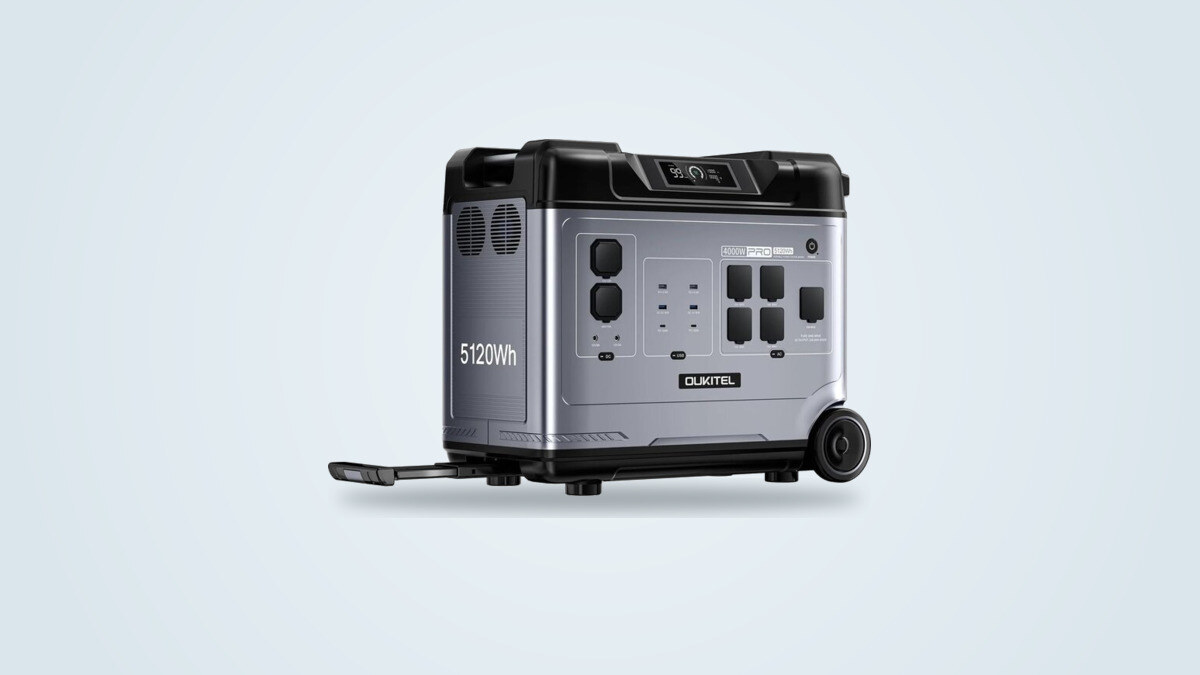
The Oukitel P5000 Pro is rated at 5120 Wh in a LiFePO4 pack, with 4000 W of continuous output and an 8000 W startup surge. These figures, used as the reference throughout this review, come from the manufacturer's current technical sheet for this unit. Weight reaches 116.8 lb (53 kg) for a footprint of 21.7 x 11.8 x 19.2 in (550 x 299 x 487 mm), mounted on wheels with a telescoping handle.
LiFePO4 chemistry is a sound choice for a unit this size: it withstands more full cycles than a conventional lithium battery before losing capacity, which supports a claimed lifespan beyond ten years under regular use. The manufacturer's official list price sits well above what this model is actually sold for once ongoing promotions are factored in, a gap worth keeping in mind before comparing this unit to a rival shown at full price.
Oukitel is a Chinese brand first known for rugged smartphones, which more recently expanded its lineup into portable power stations. This limited track record on the energy side partly explains why the available documentation, as this review will show, is still richer in marketing promises than in independent verification.
Filed under "expandable" stations, not expandable according to its own spec sheet
The site files the Oukitel P5000 Pro under its very high-capacity, expandable stations category. On this exact point, the manufacturer's spec sheet says the opposite outright: this station's capacity cannot be expanded by an add-on battery that docks onto it. What Oukitel offers instead is pairing with separate units from its own lineup, up to three P2001 Plus units (2048 Wh each) or one P1000 Plus (1024 Wh), used alongside the main unit rather than integrated into it.
The distinction matters to a buyer: pairing separate units means buying, hauling and wiring several complete stations, each with its own housing, its own screen and its own weight, rather than adding a single battery block inside the same enclosure. It is a difference in kind, not just degree, from what some direct rivals offer.
| Criterion | Oukitel P5000 Pro | Fossibot F3600 Pro |
|---|---|---|
| Base capacity | 5120 Wh | 3840 Wh |
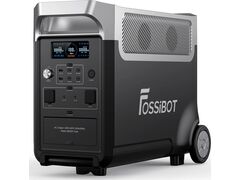
| Official expansion | None: pairing of separate units only | Dedicated module (FB3840) that docks onto the main unit |
| Combined capacity with expansion | Not applicable | 6530 Wh out of a claimed 7680 Wh |
The Fossibot F3600 Pro, named for comparison on Oukitel's own product page, does have a real expansion module that performs as advertised once combined: 6530 Wh delivered out of a claimed 7680 Wh for the pair. Nothing equivalent exists today for the P5000 Pro: its already very large starting capacity (5120 Wh, already ahead of the Fossibot's 3840 Wh alone) has to stand on its own, with no straightforward path to grow it further.
Genuinely fast AC charging for this capacity
This is one area where the figures stay consistent across every piece of communication: AC charging reaches 80% of capacity in 1h30, at a maximum input of 3200 W. A full charge takes about 1h48 (1.8 h), and combining AC input with solar pushes the total accepted input up to 4200 W, bringing that same 80% mark down to just 1h10.
This performance level remains a manufacturer figure, but it has the merit of being stable: the 1h30-to-80% number shows up identically on the official spec sheet and in every summary made of it elsewhere, with no contradiction found. For a 5.12 kWh capacity, that is a high charge rate, on par with the catalogue's best references at this capacity, though no independent stopwatch test has confirmed this figure to date.
6000, 7200 or 8000 W of surge: the advertised figure has changed more than once
Surge power is one of the most heavily promoted arguments for this model, but the exact figure has not stayed fixed over time. The earliest commercial listings for the P5000 Pro advertised a 6000 W surge. The launch video dedicated to the unit carries 7200 W in its own title. The current spec sheet, used as the reference throughout this review, now states 8000 W.
This kind of shift is not inherently suspicious: a spec sheet can genuinely be revised after a component change or an internal re-assessment. But it does mean the 8000 W figure should be treated as a current, stated claim rather than a fixed characteristic the unit has carried since launch. No load test has otherwise been found confirming, on an actual unit, that this surge is truly reached and for how long it can be sustained.
Efficiency and noise: the two data points missing for this version
Two pieces of information that matter a great deal in daily use remain unverified by any independent source for the Oukitel P5000 Pro: how much capacity is actually deliverable once conversion losses are accounted for, and how loud the cooling fans get under charge or discharge. No stated protocol and no reliable figure has been found for either point on this exact version, despite a search spanning several markets.
This absence of data is not proof of a hidden flaw: it is simply an area the available documentation does not yet cover for this specific model. A buyer who needs to know the real efficiency or noise level with certainty before purchase will, for now, find only general promises about active cooling and conversion efficiency, without the figure that would make them verifiable.
4000 W continuous: enough to run a house, with conditions
With 4000 W continuous and a UPS switchover claimed under 10 ms, this unit is clearly aimed at backing up an entire house: fridge, freezer, well pump, router and large appliances can run at once without the combined startup draw being much of a worry, since the advertised surge is meant to absorb the harshest inrush currents (induction cooktop, compressor, angle grinder). A sub-10ms switchover is imperceptible to most electronics, but it remains a manufacturer figure: as with the surge rating, no independent check of this delay has been found.
For professional job-site use or an outdoor event, the same logic applies: the 5120 Wh reserve and the five AC outlets let several stations run in parallel over a long stretch, without the noise or exhaust of a gas generator. This is a use case where the station frequently substitutes for a gas generator, with a clear comfort gain (relative quiet at rest, no fuel to manage), at the cost of a finite runtime where a generator can simply be refueled indefinitely.
Solar, a single MPPT channel, and ports: well equipped without being exceptional
The solar input accepts up to 1000 W, across a 12 to 120 V range and a maximum current of 15 A, through a single XT60 connector wired to a single MPPT controller. This single-MPPT limitation means the entire panel array has to be wired as one coherent string or parallel set: there is no way to point part of an array due south and another east-west to smooth production across the day, a flexibility some direct rivals of comparable capacity offer through two independent MPPT inputs.
On general connectivity, the unit offers around fifteen outputs: five AC outlets, two 100 W USB-C Power Delivery ports, four USB-A ports (two rated 12 W, two Quick Charge 3.0 at 18 W), plus 12V outputs including a car-style outlet. Control runs through an onboard LCD screen and a mobile app over Wi-Fi or Bluetooth. This lineup covers most needs for the class without standing out on any single point: 100 W USB-C is now an expected standard at this price tier, not a differentiating advantage.
A brand still young on power stations
Oukitel remains notably less established in power stations than the sector's long-standing players, having launched its energy lineup after already being known elsewhere, in rugged smartphones built for outdoor use. This recent entry into the energy segment is not by itself a proven flaw: no product recall or safety notice specific to the power station lineup has been identified to date. The harshest criticism found regarding the brand's customer support concerns almost exclusively its smartphone business, an entirely separate product and service, which cannot be attributed to the power station lineup without caution.
One honest reservation remains: without several years of field history on this exact model, the claimed 5000 cycles and ten-year lifespan rest, for now, on the manufacturer's word alone. FCC certification, along with RoHS and UN38.3 compliance for lithium-cell shipping, confirms baseline regulatory compliance, not a long-term reliability record.
116.8 lb on wheels: the logical trade-off of this much capacity
At 116.8 lb (53 kg), this is not a unit you lift by hand: the wheels and telescoping handle are essential, not comfort options. On hard, flat ground (garage, patio, workshop), moving it alone stays manageable. As soon as the terrain gets uneven (grass, gravel, packed dirt), the effort required rises noticeably, a trade-off common to every station in this capacity class rather than a flaw specific to this model.
This weight and footprint (21.7 x 11.8 x 19.2 in / 550 x 299 x 487 mm) naturally point toward a fairly fixed installation: home backup set up near the breaker panel, a central position on a job site, or a dedicated spot in a large RV or camper van. A unit moved around daily from one spot to another is not what this station's format is built for.
Against the lineup's direct rivals
At 5120 Wh, the Oukitel P5000 Pro clearly exceeds the capacity of the Fossibot F3600 Pro (3840 Wh), named as a direct rival on its own product page, and offers a higher continuous output (4000 W versus 3600 W). The Fossibot still holds two advantages the P5000 Pro cannot claim today: a real capacity expansion beyond the base unit, and a real-world continuous output of 3640 W, above its own 3600 W claim, where the P5000 Pro has not been through any comparable check of its own advertised 4000 W.
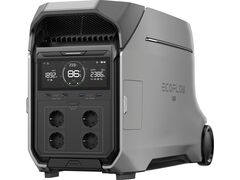
Against the more established names in the very-high-capacity segment, the P5000 Pro plays a different card: an aggressive capacity-to-price ratio, with the street price commonly seen bringing the cost per Wh well under the segment average, at the cost of a shorter brand history and gaps in independent verification that the sector's established references have, by contrast, largely closed over successive product generations.
Who the P5000 Pro suits, and who it does not
The Oukitel P5000 Pro suits a buyer who needs a very large, fixed energy reserve, whether for full home backup, a professional job site or an off-grid setup, and who is willing to rely on a spec sheet that is internally consistent but still lightly verified independently, in exchange for a price well below the more established brands at a comparable capacity.
It is a weaker fit for anyone looking for genuine expandability to grow their reserve over time without buying a whole new station, anyone who favors a brand with a long, proven reliability record for this exact kind of product, or anyone who needs to move their unit around frequently rather than install it once and leave it in place.