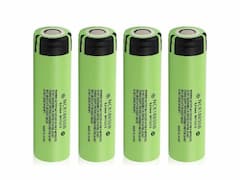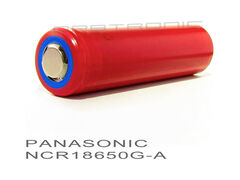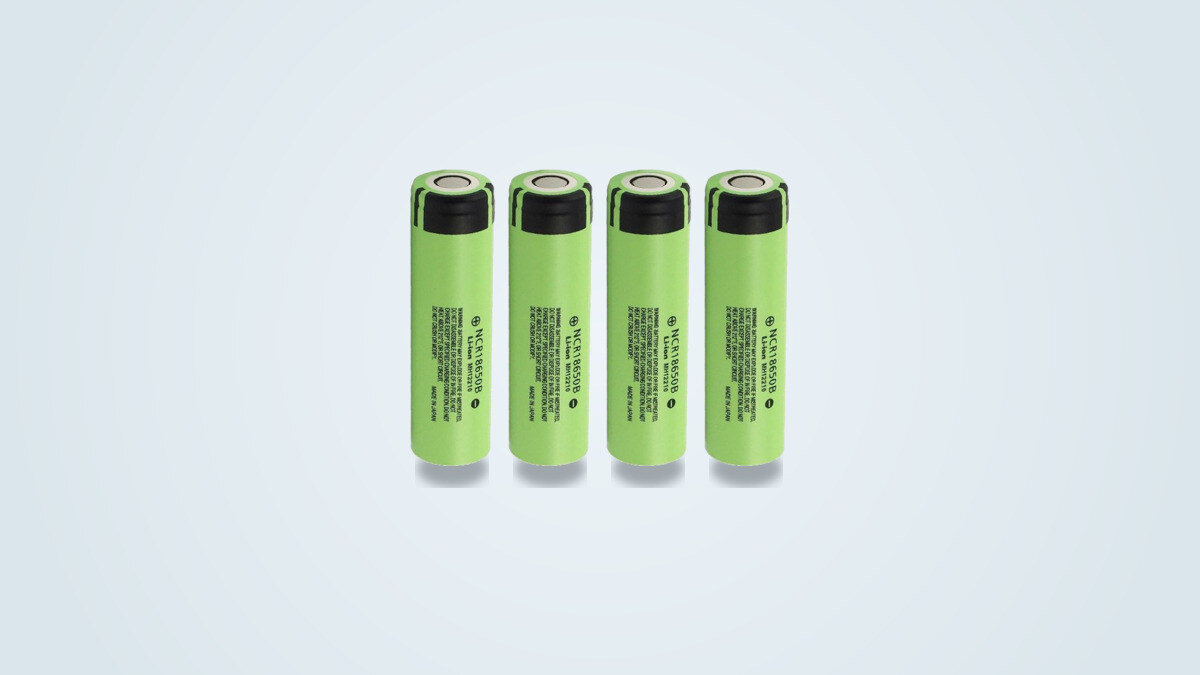
A bare 18650 cell, not a consumer battery
The Panasonic NCR18650B is not a battery you keep in a kitchen drawer: it is a bare cylindrical lithium-ion cell in the 18650 format (0.7in / 18mm in diameter, 2.6in / 65mm long, about 1.6oz / 45g), sold with no consumer casing around it. It does not go straight into a remote control or a game controller: it serves as the building block for powerful flashlights and headlamps, for rebuilt battery packs (light e-bikes and e-scooters, cordless tools), and for power banks assembled by informed enthusiasts. Compared with a consumer AA or AAA battery, the difference in kind is total: a nominal voltage of 3.6 to 3.7V instead of 1.2 to 1.5V, no built-in electronic protection on this version, and handling requirements that assume the user knows what they are doing.
This review reuses the same rating grid as the rest of the site's Batteries section (real capacity, endurance, behavior under demanding use, versatility, build and safety), but each axis is read here through the lens of a component cell rather than a direct-use consumer battery. That is what the following sections cover.
What the rated 3400mAh is actually worth
Panasonic rates the NCR18650B at a typical 3400mAh, with a guaranteed minimum of 3250mAh. At a slow discharge rate, around 0.2C (0.65A), real capacity comes in just above 3300mAh, a figure consistent with the cell's benchmark reputation and confirmed repeatedly on this exact model over the years. That level of fidelity to the maker's claim is rare in the 18650 format, where many lesser-known cells disappoint noticeably once pushed outside the most favorable test window.
The nuance shows up closer to the cell's maximum continuous discharge current, around 4.9A: at that rate, available capacity drops to roughly 3100 to 3200mAh, sometimes just under the guaranteed 3250mAh minimum. Nothing abnormal there, every lithium-ion cell loses some apparent capacity as the drawn current rises, but in practice it means the 3400mAh figure applies to low or medium-intensity use (a flashlight, a pack sharing the load across cells), not to a load close to the cell's own ceiling.
500 rated cycles: an honest figure, if you avoid full discharges
Panasonic rates the cell at around 500 charge and discharge cycles at full depth before noticeable degradation, a figure in line with high-capacity Li-ion 18650 cells of this generation (the best consumer NiMH cells last far more cycles, but at a much lower energy density, a different trade-off rather than a direct edge). What is notable here is that the figure checks out precisely under the harshest conditions: at full depth of discharge (0 to 100% every cycle), capacity falls to around 2250mAh, roughly 68% of the initial figure, after 500 full cycles. The maker's claim is not inflated, which is not always the case with this kind of spec sheet.
The good news is the room this leaves the user: a partial discharge, for example staying between 20% and 80% charge rather than always running to the limits, extends this lifespan considerably, potentially by a factor of several dozen. That is a useful point for anyone building a DIY pack or an e-bike battery: going easy on the cell day to day genuinely changes the outcome, far more than on an ordinary AA battery. On the storage side, self-discharge on a lithium-ion cell stays low, without matching the specific strength of NiMH cells engineered purely for that one criterion.
Heat and behavior under heavy load
Unlike an AA battery drawing a few hundred milliamps, an 18650 cell destined for a powerful flashlight or a DIY pack can see several amps flow continuously, and that is where the NCR18650B shows its limits: its maximum continuous discharge current sits around 4.9A. Below that threshold, in the vast majority of flashlights and packs sharing current across several cells, it stays stable and does not heat up abnormally. Pushed beyond it, in a low-resistance rebuildable mod for instance, heating becomes noticeable and voltage sags faster than expected.
This is not a manufacturing flaw, it is a design choice: the NCR18650B prioritizes capacity, not current. For high-amperage use (sub-ohm vaping, very demanding cordless tools), a cell specifically built for high drain, such as the Panasonic NCR18650GA (10A) or the Murata VTC6 (15A), handles the load without that drawback, at the cost of slightly or considerably lower capacity. In a DIY pack combining several NCR18650B cells in parallel, ensuring proper ventilation and staying under the per-cell limit remains the best precaution.
Flat Top or Button Top: check compatibility before buying
The version offered here is an unprotected Flat Top measuring 2.6 x 0.7in (65 x 18mm), the most compact format and the one most widely accepted by cell holders, flashlights and home-built packs. That is a genuine versatility strength: most devices designed around the 18650 format accept it without reservation. Some high-end flashlights, on the other hand, require a protected Button Top cell, slightly longer, with a built-in circuit guarding against overcharge and deep discharge: without that exact format, the device sometimes refuses to work, or worse, works without the expected protection.
This versatility has a structural limit worth keeping in mind: an 18650 cell like this one is not a universal battery substitute. Its 3.6 to 3.7V has nothing to do with the 1.2 to 1.5V of an AA or AAA battery, and fitting one in place of the other without a dedicated converter would damage the device or the cell. The NCR18650B is intended exclusively for devices designed around the 18650 format (flashlights, packs, light e-bikes and e-scooters), never as a direct replacement for an everyday consumer battery.
Build and safety: authenticity comes first
This is the key point to know before buying an NCR18650B, whichever seller you use: this format ranks among the most counterfeited in the lithium-ion cell market. The mechanism is well understood: recycled cells, sometimes pulled from dismantled laptop packs, or cells with genuinely lower capacity, get relabeled and resold under well-regarded names like the NCR18650B, often at a price that looks like a bargain.
Three concrete checks help limit the risk. Weight first: a genuine cell of this format typically weighs 1.6oz (45g) or more, with strong consistency from one cell to the next within a batch; a noticeably lower weight, under 1.4oz (40g), is a warning sign. The traceability code next: genuine cells carry a marking printed on the metal can itself, visible under the outer plastic wrap, often missing on copies. Finally, the rated capacity: beyond roughly 3500mAh for an 18650 format, the claim exceeds what current lithium-ion chemistry allows in that volume, and almost always signals an outright fake.
Beyond the question of authenticity, this remains a bare, unprotected lithium component: it does not forgive a short circuit, repeated deep discharge, or loose storage in a pocket without an insulating case. Handled with a suitable charger, used as intended and bought from a reputable source, it carries no particular risk beyond those already inherent, and real, to any bare lithium-ion cell.
The US market comes with one more consideration. Lithium-ion cells like this one are classified as hazardous material for transport in the United States (DOT/PHMSA regulations), which means dedicated packaging, UN38.3 test documentation from the supplier, and stricter shipping conditions than in Europe. Air travelers should also know that loose spare lithium cells must go in carry-on baggage, never in checked luggage, under standard aviation safety rules. Availability reflects this stricter landscape: at the time of writing, this NCR18650B listing had no active US retail partner, while the higher-drain NCR18650GA remained available through a specialized battery retailer.
Against the NCR18650GA and high-drain cells
The Panasonic NCR18650B shares its category with 18650 cells built for different purposes. Against the Panasonic NCR18650GA, the gap is mainly about current: the GA handles 10A continuous against roughly 4.9A for the B, for near-identical capacity (3450mAh versus 3400mAh). Beyond these two Panasonic cells, even more drain-focused options exist, such as the Murata VTC6 (15A, up to 30A peak, for 3000mAh) or the Molicel P26A (35A, for 2600mAh): their lower capacity only makes sense if the device genuinely draws more current than the NCR18650B can supply without heating.
| Criterion | Panasonic NCR18650B | Panasonic NCR18650GA |
|---|---|---|
| Rated capacity | 3400mAh | 3450mAh |
| Max continuous discharge | ~4.9A (not built for high drain) | 10A |
| Terminal | Unprotected Flat Top | Unprotected Flat Top |
| Ideal use | Packs and flashlights at moderate current | Very powerful flashlight, moderate vaping |
| Price observed | $9.41 (out of stock) | $6.99 |
The NCR18650B keeps the edge in simplicity and track record for any moderate-current use (flashlights, packs, light e-bikes): it is the historic benchmark of the format. As soon as a device calls for more than 2 to 3A continuous, the NCR18650GA, or failing that a high-drain cell, becomes the better-suited choice.