What the advertised 20000mAh actually cover
RAVPower advertises 20000mAh for this power bank, and goes further than most brands at this price point by stating the cell's exact voltage on its own spec sheet: 3.65V. That gives a stored energy figure of 73Wh (20000mAh x 3.65V). Many competitors only ever quote mAh, a unit that on its own cannot say how much energy a battery actually holds: two "20000mAh" power banks can store a different amount of energy depending on their cell voltage.
This 73Wh figure is the energy stored in the cell, not the energy that actually reaches a connected device. Between the two sits the conversion electronics, which turn the cell's voltage into 5V, 9V, 12V or 20V depending on the port and the device, losing some energy as heat at every step. No independent measurement of this loss exists for this specific reference: publishing a real-world output figure would mean making it up, which this review will not do. What can be confirmed is that 73Wh sits comfortably under the 100Wh threshold most airlines apply to batteries carried in the cabin. That threshold also explains why most power banks on the market today, across brands, cluster around 20000mAh: beyond that, the actual stored energy more easily crosses the 100Wh line once real cell voltage is factored in, which would complicate air travel.
70W in theory, far less once several ports are working
The 70W figure printed on the box is only available on a single USB-C port used on its own. As soon as a second port is used, the manufacturer's own spec sheet sets noticeably lower ceilings, down to just 18W when both USB-A ports work together.
In practice, plugging in a laptop on one USB-C port while charging a phone on the other USB-C port drops the power available to the laptop well below the 70W shown on the box: the manufacturer's own spec sheet caps that exact scenario at 65W shared between the two ports. This is not specific to this reference: almost every multi-port power bank on the market shares a limited total output between its active outputs once more than one is in use. RAVPower's real merit here is publishing its exact tiers rather than leaving buyers to guess. The real criticism is not power sharing itself, a physical constraint common to the whole category, but the gap between the "70W" printed in large type on the box and the reality of using several devices at once, a nuance the packaging never spells out. For a realistic use case, such as a laptop on one port and a phone on another, it is safer to think in shared tens of watts than in an isolated 70W peak.
Four ports, a real edge in a category that often stops at three
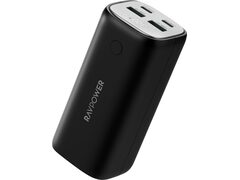
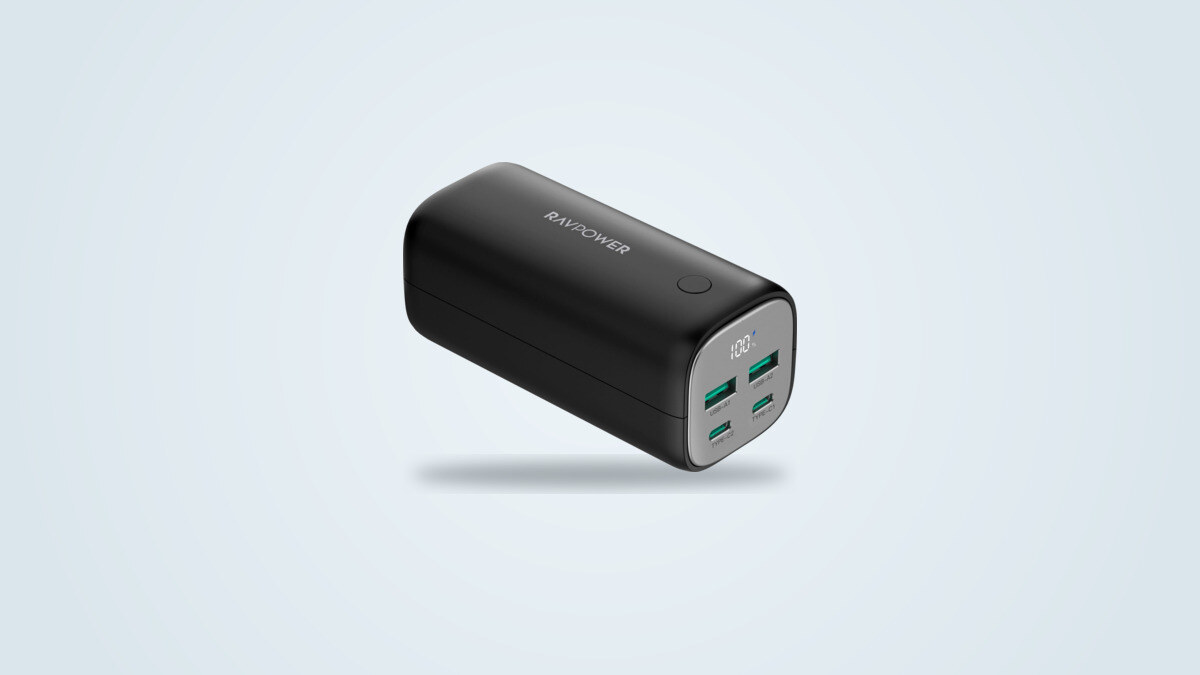
The port cluster has four active ports: two USB-C (Type-C1 and Type-C2) and two USB-A (USB-A1 and USB-A2), plus an LED display showing the remaining charge percentage and a charging icon, and a single button to turn it on. A USB-C to USB-C cable is included in the box; no wall charger is.
- Type-C1 and Type-C2: input and output, up to 70W each when used alone
- USB-A1 and USB-A2: output only, up to 18W each with fast charging
- LED display: remaining charge percentage and an activity icon
- Single button: turns on the display and the outputs
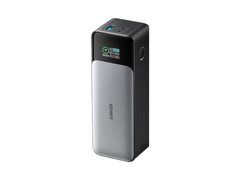
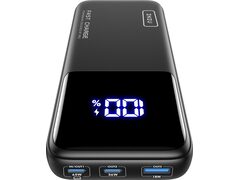
Four active ports remain a genuine differentiator at this price point: several direct rivals, including the Anker 737 and the INIU 20000mAh 65W, stop at three outputs (two USB-C and one USB-A). An extra USB-A output does not change much for a laptop, but it matters as soon as several small devices need charging at once: a phone, headphones, a smartwatch and an e-reader can all charge at the same time without an adapter or splitter, a common scenario for a family or a business trip.
Recharging the power bank itself: the three-hour promise
RAVPower states a full 0 to 100% recharge in around three hours, when the power bank itself is fed by a 70W USB-C Power Delivery charger. This figure has not been independently confirmed for this exact reference. It remains plausible given the stated capacity: recharging 73Wh in three hours works out to an average of around 24W across the whole cycle, far below the 70W input peak, which fits the usual slowdown of the last stretch of a lithium-ion charge.
Since no charger is included, reaching that speed requires already owning a USB-C Power Delivery charger capable of at least 70W: a standard phone charger, limited to 20 or 30W, will noticeably stretch that time out.
A size that stays reasonable for 73Wh
At 0.79 lb (360g) for 7.09 x 1.97 x 1.89 in (180 x 50 x 48mm), this power bank works out to roughly 91 Wh per pound (200Wh per kilogram) once the casing and electronics are counted, a solid ratio for a Li-ion cell housed in a polycarbonate shell. As an internal point of comparison, the brand's own 30000mAh model, a different unit with a different screen and shape, weighs close to 1.19 lb (540g): the 20000mAh version covered here stays in a far more portable format, closer to a large phone battery than a brick.
The shell follows the brand's usual look: black casing, matte finish, logo embossed on the top face. The single button and the display sit on the same face as the ports, so the remaining charge can be read without turning the power bank over in hand. No pouch or carrying case is included.
Same name, three very different power banks
Searching for this power bank online runs into a common trap: RAVPower has used the product name "PD Pioneer 20000mAh" for at least three different configurations, with output levels and port counts that have nothing to do with each other.
The confusion continues even within a single reference: several regional retailers list an RP-PB208 unit at 48W or 50W that otherwise looks identical to the 70W version sold on the brand's official website and covered in this review. There is no way to confirm whether that gap reflects an actual regional hardware variant or simply a listing error, which is more likely for a brand whose retailer network has fragmented since 2021. Where in doubt, the output figure used throughout this review is the one RAVPower itself publishes for the RP-PB208 Pro reference: 70W. A fourth variant, badged RP-PB208 Ultra, has more recently appeared at some Gulf-region retailers with a stated peak of 100W while keeping the "70W" label for its usual two-way charging: yet another name in the range not to confuse with the model covered here.
2021: the ban that changed the brand's trajectory
In 2018, Sunvalley Group, the company that owns RAVPower as well as the TaoTronics, VAVA, HooToo, Anjou and USpicy brands, changed hands: the Chinese industrial group Guangdong SACA Precision Manufacturing took control for around 1.5 billion yuan. Three years later, in the spring and summer of 2021, the brand faced a far more visible turning point for American buyers: Amazon banned RAVPower's seller accounts, alongside those of Aukey, Mpow, VAVA, TaoTronics and Choetech, in a sweep that ultimately affected more than 600 China-linked brands and over 3000 seller accounts. The stated reason was customer review manipulation, through financial incentives and vouchers exchanged for positive comments.
This ban did not mean the end of the company. RAVPower kept developing new products after 2021, including the reference covered in this review, which the brand itself promoted in early 2024. What changed for good is the sales channel: stripped of its long-standing Amazon storefront across much of the world, the brand fell back on its direct-to-consumer website and on regional retailers, a shift that still has not fully played out even on the brand's own home market.
Where can you actually buy it in 2026: a tour of six markets
The brand has not vanished from every market in the same way. Here is the situation found market by market for this exact reference.
| Market | Situation |
|---|---|
| France | No active listing found at major general retailers; the brand's dedicated French-language site is now abandoned. |
| United Kingdom | The brand keeps a general storefront for other references; this exact power bank could not be found there. |
| Germany | A brand storefront also exists for other RAVPower products; this specific reference does not appear there. |
| Italy | No active listing found at major general retailers. |
| Spain | No active listing found at major general retailers. |
| United States | The manufacturer's own website lists the reference, but shows it as out of stock while still displaying a delivery window. |
The only active sales found for this exact reference are at regional retailers in the Gulf and in Turkey, outside the six markets this site covers. Ordering from any of these six markets therefore means an import, with the delays, possible customs charges and warranty uncertainty that come with it.
Warranty and after-sales support: the real risk
Several retailer listings for this reference advertise an 18-month warranty. That duration is neither confirmed nor contradicted by a warranty page specific to this model on the manufacturer's website, which instead points to a general policy covering the whole catalogue.
The brand's warranty support has been inconsistent since 2021: some failures after around a year of use go uncovered, while others are handled without difficulty. That contrast fits a brand that scaled back its service network rather than removing it entirely after its partial retreat from major platforms. What can be confirmed is the lack of any local after-sales network identified across the five European markets this site covers: a buyer running into a problem should expect to deal directly with the manufacturer's online support rather than a local contact. Anyone who still chooses this reference should keep proof of purchase and favor a payment method with buyer protection, given the lack of a simple local recourse in case of a dispute.
Up against the Anker 737 and the INIU 65W
Two alternatives stand out for an equivalent need, namely large capacity and enough power for a laptop: the Anker 737 Power Bank and the INIU 20000mAh 65W.
| Criterion | RAVPower PD Pioneer 70W | Anker 737 Power Bank | INIU 20000mAh 65W |
|---|---|---|---|
| Capacity | 20000mAh (73Wh) | 24000mAh (86.4Wh) | 20000mAh |
| Peak output (1 port) | 70W | 140W | 65W |
| Ports | 2x USB-C + 2x USB-A | 2x USB-C + 1x USB-A | 2x USB-C + 1x USB-A |
| Display | LED (percentage) | OLED (detailed percentage) | LED (percentage) |
| 2026 availability | Very limited, even on the manufacturer's own site | Wide, at major retailers | Wide, at major retailers |
On paper, the RAVPower holds its own: it offers one more port than either rival, with peak output sitting between the two. The Anker 737 goes considerably further on power (140W versus 70W) and carries a more detailed OLED display; the INIU banks on a more compact size for similar power. Neither alternative carries RAVPower's history of a marketplace ban or its distribution troubles, which makes both noticeably easier to buy and to get warranty support for today. Pricing across the three references is broadly similar on paper, but for a buyer on the markets this site covers, only the availability comparison actually matters: a cheaper power bank that cannot be bought is not, in practice, an option.
Who it can still suit, and why most buyers should look elsewhere
Judged purely on its spec sheet, this power bank earns its place among capable, powerful power banks: four ports, 70W of peak output, a capacity rating that states the real cell voltage. It could suit a buyer who already finds it in stock at a regional retailer, or who brings one back from a market where it is still sold, and who accepts the warranty uncertainty that comes with it. That calculation mostly shifts for a buyer already based in a market where the brand is still distributed, or who already has an established relationship with a regional retailer: in that specific case, the technical specification remains a solid argument.
For the vast majority of American buyers, and for buyers on the French, Italian, Spanish, British and German markets, the question should not even come up in these terms: the product simply is not accessible through a normal buying channel, with a reachable warranty and after-sales support. Faced with a brand banned from a major platform for review manipulation, whose distribution has collapsed across most of the markets this site covers, and whose own official website shows this exact reference as out of stock, the sensible choice is to turn to an equally capable but genuinely available alternative, such as the Anker 737 or the INIU 20000mAh 65W.