Format: the 16BB's central argument
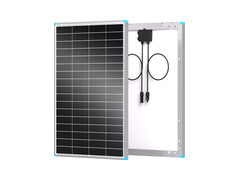
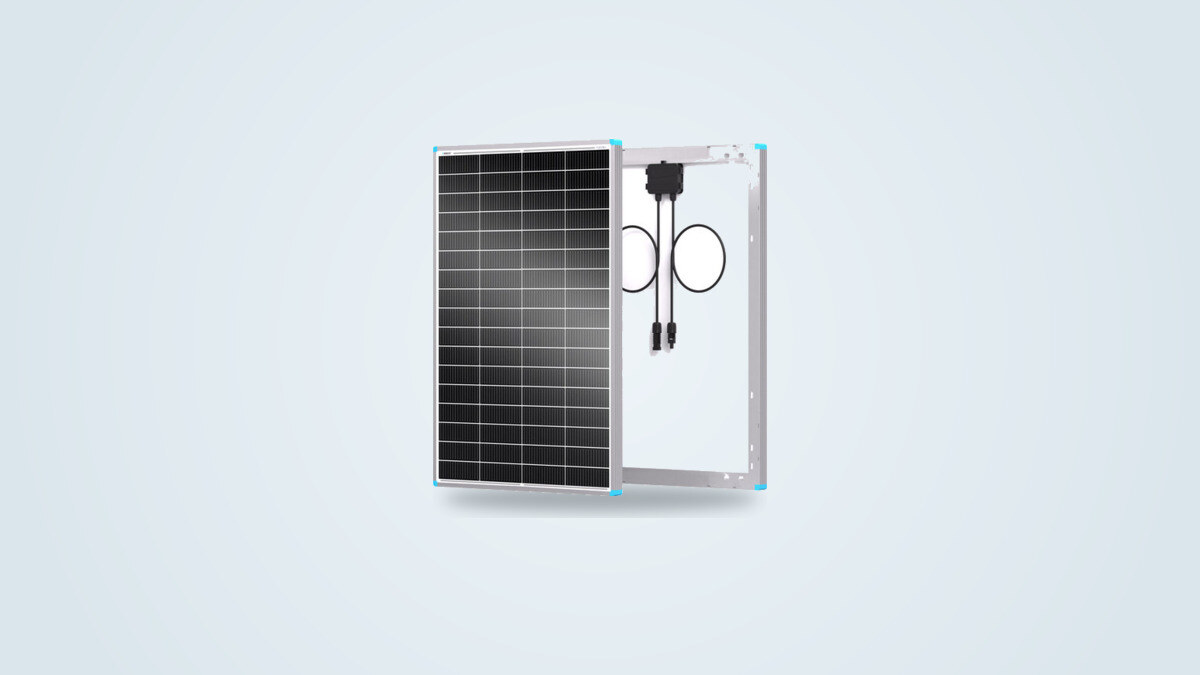
On a converted van roof, the constraint is almost never the budget but the space left between the roof vent, the rack and the antenna. The Renogy 16BB 175W measures 43.7 x 30.1 x 1.2 in (1110 x 764 x 30 mm) for 21.2 lb (9.6 kg), a footprint of around 9.15 sq ft (0.85 m²) for 175W installed.
Renogy quotes a footprint 7 to 10% smaller than other 175W panels on the market. Per square foot, that works out at around 19.1 watts, a ratio that compares favorably with conventional PERC panels of the same rating, typically between 18.2 and 18.6 watts per square foot on comparable references.
| Panel | Power | Footprint | W/sq ft |
|---|---|---|---|
| Renogy 16BB 175W | 175W | 9.15 sq ft | ≈ 19.1 |
| Renogy ShadowFlux 200W | 200W | 10.33 sq ft | ≈ 19.3 |
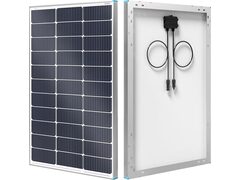
| Renogy 100W (PERC) | 100W | 5.38 sq ft | ≈ 18.6 |
| Competing rigid 100W panel | 100W | 5.49 sq ft | ≈ 18.2 |
The gap stays modest against the ShadowFlux, which makes sense since both share the same cell technology: the real difference lies in the latter's anti-shading cell-splitting, not raw density. Against conventional PERC panels, though, a gain of a few percent can be enough to fit one more module on an already crowded roof.
This watts-per-square-foot reasoning matters more than it looks for this kind of install. On a vehicle, available roof space is a fixed quantity, unlike the budget, which can flex. A panel that delivers a few extra watts on the same footprint is not just competing on price per watt against rivals, it is competing on the value of the square foot it frees up for something else (another roof vent, an antenna, a walkway on the roof). That trade-off, more than raw efficiency on its own, is usually what justifies choosing a dense format like this one over a cheaper generic PERC panel at the same rating.
N-type against PERC: what holds up beyond the marketing
The N-type cell is not a Renogy-only find: it is the generation succeeding PERC across the whole photovoltaic industry, adopted by most major cell makers over the past few years. Two advantages come up consistently in the sector's technical literature, regardless of which brand's panel they end up in.
The first concerns heat. A PERC cell is P-type, boron-doped: it suffers from light-induced degradation tied to boron-oxygen defects, which worsens with heat. The N-type cell, phosphorus-doped, does not show this mechanism and keeps its efficiency better as the module heats up, hardly an edge case on a vehicle roof where surface temperature regularly passes 140 °F (60 °C) in full summer. The second advantage concerns degradation over time: Renogy quotes a power loss capped at 1% in the first year and 0.4% a year after that for this range, a pace more favorable than the rate typically associated with a standard PERC cell.
That does not make the 16BB a one-off: several manufacturers now offer N-type ranges at prices close to top-tier PERC. Renogy's angle here is pairing that technology with a reduced footprint, not any technological exclusivity.
Projecting the quoted degradation rates over time makes the gap more tangible than an isolated percentage. At 1% loss in year one then 0.4% a year, this panel would keep around 96% of its original output after ten years. A generic PERC panel, with an annual degradation rate closer to 0.5 to 0.6% after the first year (a common range for that cell type), would sit closer to 92 to 93% over the same period. The gap, on the order of three to four points of output at ten years, remains an arithmetic projection from rates quoted by the respective manufacturers, not a measurement on a real unit: it gives a plausible order of magnitude, not an individual guarantee.
16 busbars: beyond the marketing figure
The second headline figure, 16 busbars against 5 to 9 on a conventional panel, answers a precise technical need rather than an inflated sales pitch. Busbars collect the current a cell produces and route it to the junction box. Increasing their number shortens the path electrons travel inside the cell, which cuts resistive losses, typically on the order of a few tenths of an efficiency point on this kind of comparison.
The other benefit, less visible but more concrete in daily use, concerns resistance to micro-cracks. On a cell with few busbars, a crack can isolate a large share of the active surface and disproportionately cut the whole module's output. With 16 collection points, current has alternative paths: the same crack then isolates a markedly smaller portion of the cell. On a vehicle roof exposed to repeated vibration and thermal cycling, that is more a longevity argument than an immediate performance gain.
No anti-shading cell-splitting, and no way to re-angle the panel
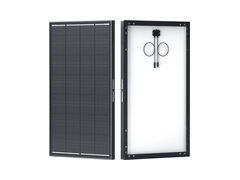
The Renogy 16BB 175W shares its cell technology with the same maker's ShadowFlux 200W, but not its electrical layout. The ShadowFlux splits its module into 28 independent zones to limit the impact of partial shade. This 16BB stays wired as classic series-connected cells: when part of the module falls into shadow, even a small part (a branch, an antenna mast), the current from the least productive cell limits the whole string's output. The resulting production loss is almost always out of proportion with the actual shaded area.
That is not a manufacturing flaw, it is the normal behavior of any conventional rigid panel of this kind, ShadowFlux aside. The explanation lies in how the cells are wired in series inside the module: a series circuit is limited by its weakest link, the least-lit cell dictates the current for the whole chain. A shaded patch covering a small fraction of the total surface can therefore cut output by far more than that same fraction, a disproportionate effect that is widely known in photovoltaics and common to every panel that does not split its cells into independent zones.
Still, it is worth knowing before buying: on a clear roof, the question does not arise. On a roof with a fixed antenna, a roof vent or a recurring nearby tree, the price gap with the ShadowFlux (roughly double) can be worth paying.
Second limit specific to any rigid panel mounted flat on a roof: once fitted, its angle no longer moves. Unlike a portable panel tilted toward the sun, the 16BB receives light at whatever incidence the roof geometry dictates, all year round. In high summer with the sun overhead, the gap with an optimal angle stays small. In winter or early morning, when the sun sits low on the horizon, the loss tied to a grazing angle can become significant, a physical effect that hits any fixed panel much the same regardless of brand.
MC4 wiring and controller compatibility
The panel uses MC4 connectors, the near-universal standard in the solar industry, quoted at IP67. Its open-circuit voltage of 24.48V and its voltage at maximum power point of 20.88V sit comfortably within the input range of almost every 12V MPPT controller on the market, which generally accept noticeably higher voltages to leave headroom for cold weather, when a panel's open-circuit voltage rises.
One point deserves attention for anyone with an existing setup: wiring this panel in series with existing PERC modules of a different voltage is not necessarily neutral. A series string gets the most out of modules with matching characteristics; mixing different optimum voltages can slightly cap the whole string at the weakest module's level. The safest option remains wiring this panel to its own MPPT input where the controller offers more than one, or checking with the controller's manufacturer how well it tolerates mixed modules on a single input.
Installation: what to plan for beyond the panel
The panel does not ship with mounting brackets: that is a separate purchase, common enough for this kind of product but worth budgeting and timing for if installation is planned soon after delivery. The rigid format also brings the usual constraints of the category, mechanical fixing into solid roof points rather than simple adhesive, and a cable entry into the vehicle that needs a careful weatherproof seal.
On weatherproofing, Renogy quotes IP67 for the MC4 connectors but only IP65 for the junction box, a tier down the protection scale. In practice, a junction box properly sealed on the back of a panel mounted flat on a roof stays fairly sheltered from direct water spray, but the gap between the two ratings is worth knowing rather than assuming identical. The quoted operating range, -40 °F to 185 °F (-40 °C to 85 °C), comfortably covers the conditions found on a vehicle roof across a winter and summer alike.
At 21.2 lb, the panel is easy enough for one person to handle, but is large enough (43.7 x 30.1 in) that a second pair of hands helps when positioning it on a sloped roof or in a light breeze.
Build quality, quoted degradation and warranty
Construction follows the sector's proven standards: low-iron tempered glass, a corrosion-resistant aluminum frame, a junction box and connectors rated for outdoor use. That is a far older and more time-proven architecture than a flexible panel, whose working life tends to run shorter at equal cell technology.
The volume of feedback available online for this panel shows no recurring manufacturing flaw (cracking, failed connectors, water ingress), a reassuring signal that does not replace several years of track record, this cell generation being still fairly new to the consumer market. The manufacturer's warranty covers 5 years on the product, a figure in line with the sector rather than above it: the newer cell technology does not come with a longer commitment here than older PERC panels typically carry.
This limited track record is not specific to Renogy: the whole consumer-facing N-type segment has fewer years of field history than PERC, which has been fitted for longer. That is not a reason to dismiss the technology, whose physical fundamentals are sound and already deployed at much larger scale across the industry, but an honest reservation worth stating rather than glossing over.
Pricing and where it sits in the catalog
The price observed in the US sits around $159, before sales tax, for the panel alone, excluding any kit or mounting accessories. Per watt, that undercuts the Renogy 100W PERC in the same catalog (around $129, a higher cost per watt) and comes in well below the ShadowFlux 200W (around $317), which mostly charges for its anti-shading cell-splitting rather than a higher efficiency.
In absolute terms, a generic PERC panel is often still cheaper at the same rating. But against another panel already using N-type cells, this price sits toward the lower end for that technology, making it a fairly inexpensive way into N-type's benefits without paying the anti-shading premium a clear roof has no use for.
At this price point, the real question is not simply 100W PERC versus 175W N-type, but what each remaining square foot of roof on the vehicle in question is actually worth. For a fresh install on untouched space, the cost-per-watt gap with a generic PERC panel remains the simplest yardstick. For topping up an already tight layout, the space saved outweighs price per watt in the trade-off.
Who this panel suits, and who it does not
The Renogy 16BB 175W suits first and foremost anyone fitting out a van, RV, boat or shed roof that is already partly taken up and wants to maximize installed power on the remaining space, without paying for anti-shading protection a clear area has no use for. It also suits anyone adding a panel to an existing setup on its own controller input.
It suits less well anyone needing a portable, foldable panel for nomadic use (a portable-format panel answers that need better), anyone dealing with recurring partial shade at the install point (the same maker's ShadowFlux targets exactly that case), or anyone chasing the lowest possible price per watt regardless of footprint, where a conventional PERC panel remains the more economical route.