The real threshold of the Rover 40A: the ceiling of the 100V/12-24V lineup, not a step toward 48V
The Renogy Rover 40A belongs to the same sub-line as the Rover 20A already in the catalog: the Li series, capped at 100V of solar input with automatic 12/24V detection, never reaching 36V or 48V. That is an important reference point before comparing the three Renogy sizes: moving from the 20A to the 40A doubles capacity on the same electronic platform (same screen, same charge profiles, same manual), while moving to the Rover 60A means switching platforms entirely (150V, automatic detection up to 48V). The Rover 40A is therefore not a midpoint on a continuous scale between the other two sizes: it is the ceiling of everything the 100V/12-24V platform can handle.
In practice, that means 40A of charge current and a maximum PV power of 520W on a 12V system and 1040W at 24V, twice as much as the Rover 20A at the same voltage. Enough to wire a noticeably larger panel array, two or three high-wattage panels rather than one or two, without changing system voltage or controller generation.
This 100V input ceiling deserves a safety margin when sizing the panel array: open-circuit voltage rises in cold weather and can creep toward the rated limit, a precaution common to every MPPT controller in this category rather than a flaw specific to the Rover 40A.
Advertised MPPT efficiency, and a genuinely low self-consumption
Renogy rates the Rover 40A at up to 99% tracking efficiency and 98% peak conversion efficiency, figures consistent with MPPT technology against a conventional PWM controller, capped at 70 to 80% tracking efficiency. Those figures correspond to ideal conditions: steady sunlight, lossless wiring and moderate temperature. Partial shading on part of the array or an undersized cable run reduces that efficiency in practice, a trait of the whole MPPT category rather than something specific to this model.
One figure that gets less attention deserves it: the controller's own self-consumption, meaning the energy it uses to run itself, separate from what it passes on to the battery. The Rover 40A rates this under 100mA at 12V and under 58mA at 24V, a parasitic draw of less than 1.5W continuously. On a standalone setup where every watt-hour matters, particularly on short or overcast days, this self-consumption stays negligible next to the output or the battery's capacity.
The voltage chosen for the panel array also directly affects the margin available to the MPPT algorithm. Wiring that stays well below the system's nominal voltage limits the controller's ability to hunt for the optimal power point; conversely, sitting right at the 100V limit with no margin risks an overvoltage cutoff on the input, especially in cold weather when open-circuit voltage climbs. Correct sizing therefore depends as much on the number of panels and how they are wired, in series or in parallel, as on the controller itself. Another structural limit, shared by most controllers of this size: the Rover 40A has a single MPPT tracker. On an installation with panels facing different directions, a single tracker cannot optimize each string independently; matching panels of the same orientation on the same string becomes necessary.
LCD screen, RS232 port and LOAD output: what you control without an app
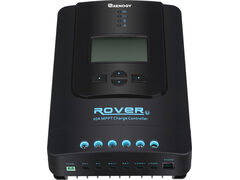
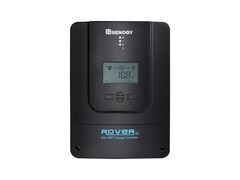
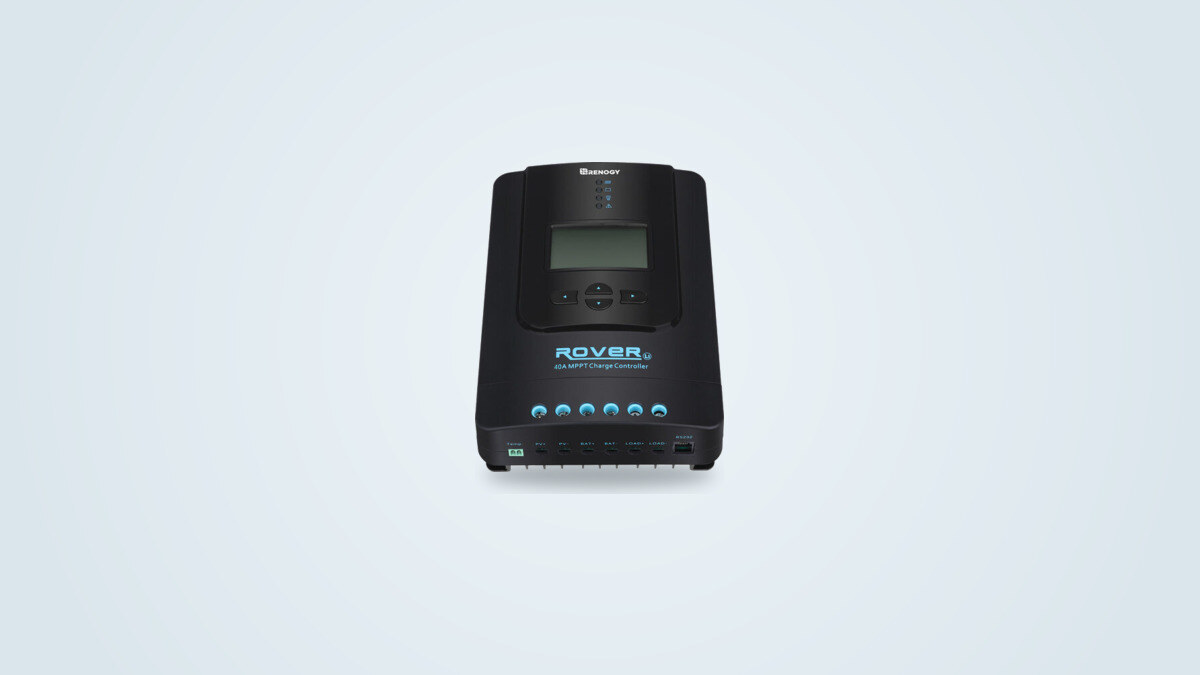
The built-in LCD screen shows battery voltage, charge current and instantaneous solar output directly, along with status icons (charging, alert, sunlight) and error codes when something goes wrong. Like the rest of the Rover lineup, it is not backlit: reading it becomes difficult at night or in dim light, worth keeping in mind for a unit installed in a poorly lit space. Four arrow buttons let you navigate the menus and pick the battery profile directly from the device, without a phone.
For remote monitoring, the Rover 40A has an RS232 port compatible with an optional Bluetooth module, BT-1 or BT-2, which links the controller to the Renogy DC Home app. That module is not included and is an added cost to budget for upfront if smartphone monitoring matters to you.
Less talked about than the screen or Bluetooth, a pair of LOAD terminals rounds out the terminal block, alongside the PV inputs and battery outputs. It delivers up to 20A at system voltage, below the 40A charge rating for the battery: it is meant to power a small direct load, typically lighting, with a direct, light-sensor-driven, or timed control mode depending on the menu setting. It does not replace an inverter or a dedicated output for a power-hungry device, but it saves adding a separate relay for a simple use case.
Battery compatibility: a real lithium preset, worth checking before trusting the default
The Rover 40A offers five charge profiles selectable directly from the screen or the app: sealed, gel, flooded lead-acid, a fully customizable User profile, and a dedicated Lithium profile. That is a concrete difference from a controller that would only offer a User profile for lithium: the Rover 40A's Lithium profile charges in three stages (bulk, boost, float), skipping the equalization stage reserved for lead-acid, and its default charge voltage is set to 14.4V with a default high-voltage cutoff of 16.0V. That cutoff automatically adjusts to the chosen charge voltage plus 2V if the user changes it, a safeguard that limits the risk of a poorly set overvoltage alarm after a manual adjustment.
For lead-acid batteries, sealed, gel or flooded, charging happens in four stages through the preconfigured profiles, with no particular setup needed. A remote temperature sensor ships with the controller: it compensates the charge voltage based on the battery's actual temperature rather than the casing's internal temperature alone, a real plus for an installation exposed to large seasonal swings.
Electronic protections and unattended operation
The controller includes the full set of electronic protections standard for this category: reverse polarity protection on both the panel and battery sides, overcharge protection through the multi-stage charge algorithm, low-voltage disconnect with a configurable reconnect threshold, short-circuit protection, and reverse current blocking at night to stop the battery draining back into the panels once the sun sets. An input overvoltage cutoff protects the electronics if panel voltage exceeds the rated limit, a scenario that stays possible in cold weather if sizing left no margin.
These protections run continuously, with no human input: a solar charge controller stays connected permanently, often for years without anyone touching it, which makes their reliability just as important as the advertised charging performance. No product recall has been identified for this model.
Build quality, IP32 casing and passive cooling
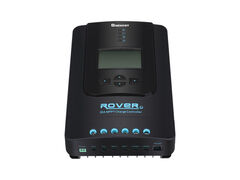
The die-cast aluminum housing doubles as a passive heat sink: there is no fan, which removes any operating noise but leaves all the cooling to the surface of the heat sink. At 4.41 lb (2.0 kg) and 9.37 x 7.09 x 3.03 in (238 x 180 x 77 mm), it sits well above the Rover 20A (3.1 lb / 1.4 kg) but far below the Rover 60A (9.5 lb / 4.3 kg), a size that lines up consistently with its charge current.
The protection rating stays at IP32, identical to the Rover 20A: the case tolerates dust and limited vertical splashing, but must be installed under shelter, never exposed directly to rain or sea spray. Its operating temperature range spans -31 °F to 113 °F (-35 °C to 45 °C), with storage tolerated from -31 °F to 167 °F (-35 °C to 75 °C) and a maximum relative humidity of 90% without condensation, figures that comfortably cover the conditions inside an RV or an unheated shed.
Wiring runs through screw terminals sized for cable gauges suitable for the rated 40A; careful tightening on these terminals remains the most common point to watch during installation, as with any controller of this power class. It is FCC Class B certified, and the manufacturer's warranty runs for 2 years, covering both parts and workmanship.
Against the Rover 20A, the Rover 60A and the Victron SmartSolar 100/20
Choosing between the three Renogy sizes is not simply a matter of a rising budget. The Rover 20A and the Rover 40A share the same 100V/12-24V electronic platform, the same screen, the same charge profiles and the same manual: moving from one to the other simply doubles capacity without changing ecosystem. The Rover 60A, on the other hand, switches platforms entirely: 150V of input, automatic detection up to 48V, but no one-tap Lithium preset. Planning a future move to 36V or 48V justifies going straight for the Rover 60A rather than buying a Rover 40A as a stepping stone, a cost that is not recovered when the system voltage eventually changes.
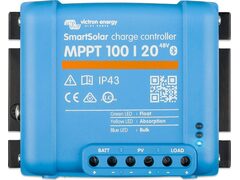
Against direct competition at the same maximum voltage, the most telling comparison pits the Rover 40A against the Victron SmartSolar 100/20, already in the catalog.
| Criterion | Renogy Rover 40A | Renogy Rover 20A | Victron SmartSolar 100/20 |
|---|---|---|---|
| Max PV voltage | 100 V | 100 V | 100 V |
| Charge current | 40 A | 20 A | 20 A |
| Max PV power (24V) | 1040 W | 520 W | 580 W |
| Built-in screen | LCD | LCD | No (app only) |
| Bluetooth | Optional (BT-1/BT-2) | Optional (BT-1) | Built in |
| Typical price | around $200 | around $88 | around $89 |
On this market, the Rover 20A and the Victron SmartSolar 100/20 are priced almost identically, both around $88 to $89, unlike markets where the gap between the two is much wider. The Victron SmartSolar 100/20 accepts a slightly higher PV power at 24V (580W against 520W for the Rover 20A, both still far below the Rover 40A's 1040W) and has Bluetooth built in, with no module to add. Against that, the Rover 40A more than doubles the price of either one but also more than doubles the charge current, and keeps a physical screen that Victron leaves entirely to the VictronConnect app. Victron's closest match in current, the SmartSolar 100/30, narrows that capacity gap somewhat but is priced noticeably higher than the Rover 40A while keeping the advantage of built-in Bluetooth.
Who the Rover 40A is for, and when to pick a different size
The Rover 40A suits a 12V or 24V setup that has grown: an RV or van with two or three high-wattage panels, a cabin or an off-grid site with a substantial array, or any project that will stay on 12V or 24V for good, never targeting 36V or 48V. Its charge capacity, double that of the Rover 20A at the same voltage, lets it absorb a noticeably larger panel array without moving to a different controller generation.
It is not worth it for a small setup with one or two panels: a Rover 20A, cheaper and just as reliable at that scale, covers that need without tying up budget unnecessarily. It is not the right pick either for a project that needs to migrate to 36V or 48V down the line: the Rover 60A, despite a less direct lithium setup, opens that door from day one. Finally, anyone who wants Bluetooth monitoring ready to go with no extra module will find more to like in the Victron SmartSolar 100/20 or 100/30, at the cost of a physical screen. Like any MPPT controller, the Rover 40A does not replace an inverter for 120V AC power, nor a dedicated BMS for a lithium battery with no built-in protection: it is limited to the charging function between the panels and the battery bank. For an already serious 12/24V setup, on a controlled budget and with the willingness to check the lithium profile setting personally, the Rover 40A remains a solid, well-sized choice.