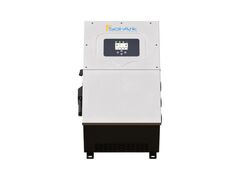

What the Sol-Ark 15K actually is
The Sol-Ark 15K is a residential hybrid inverter, built to run a grid-tied solar system alongside a 48V backup battery, lead-acid or lithium. It differs from the Sol-Ark 12K, the same maker's earlier generation limited to 9000W of continuous output and 63A of grid pass-through with no integrated switch, and from the Sol-Ark 8K, an older and less powerful model: the figures in this review apply exclusively to the current 15K-2P reference, also sold as the 15K-2P-N or Limitless 15K-LV depending on the retailer, all the same hardware platform.
Assembled in Allen, Texas, the enclosure combines the MPPT controller, the bidirectional inverter/charger and battery management in a single unit, with a color touchscreen built directly into the device. Up to 12 units can be paralleled, at native 120/240V split-phase or at 120/208V to approximate a three-phase output on larger installations.
97.5% peak, roughly 96.6% weighted average
The Sol-Ark 15K's maximum efficiency reaches 97.5%. Its CEC-weighted efficiency (California Energy Commission), the reference method that weighs conversion across the full power range rather than at a single ideal point, sits between 96.5% and 96.7% depending on the technical documents consulted. This weighted figure remains the most representative of real-world use, where the power drawn keeps varying throughout the day rather than staying fixed at the peak-efficiency point.
This level compares directly with a European residential hybrid inverter already reviewed on this site, which posts 96.5% European-weighted efficiency and a 97.1% peak: the two weighting methods, American and European, differ in their calculation protocol but land on the same order of magnitude. No round-trip efficiency figure specific to the inverter-battery pairing is available for the Sol-Ark 15K, a gap that applies to the whole category rather than to this model alone.
Lead-acid or lithium, one of the most open ecosystems around
The Sol-Ark 15K runs at a 48V nominal voltage and accepts either a lead-acid or a lithium battery, with charge and discharge current up to 275A. Rather than restricting closed-loop communication (CAN or RS485, the kind that shows the exact state of charge and automatically adjusts charging thresholds) to its own lineup, it opens it up to multiple third-party brands sharing the same 48V standard, including EG4, SOK, Pytes and Pylontech.
This openness goes beyond an inverter locked to a single manufacturer's own lineup, and comes close to a European competitor already compared on this site, which lists more than a dozen compatible brands and references once its full technical documentation is taken into account. It is a real hallmark of DIY and off-grid culture, where switching battery suppliers without changing the inverter remains a genuine option.
An integrated 200A switch: the whole house stays powered
The Sol-Ark 15K's real edge over many residential backup systems lies in its integrated 200A automatic transfer switch: wired directly to the main panel, it allows up to 200A of pass-through with no critical-loads subpanel to add. Most residential backup solutions only save a selection of circuits chosen at installation time; here, the entire house switches to battery power in 5 milliseconds as soon as the grid drops, a delay short enough that a computer or a home router does not even restart.
Neither the Kostal PLENTICORE plus 4.2 nor the Huawei SUN2000-3K-LB0 lists an integrated switch sized for the whole electrical panel at this power level: the Sol-Ark 15K is the only one of the three to give an explicit figure on this exact point. It runs on 120/240V split-phase, the standard residential setup here, rather than native three-phase: getting a 120/208V output closer to three-phase means pairing several units in parallel. It is precisely in that multi-unit configuration that a point of caution applies: on at least one installation combining three units in parallel, the input voltage on one MPPT tracker oscillates intermittently between open-circuit voltage and under 100V, a behavior that has remained unresolved in this specific case. This point only concerns multi-unit parallel setups, not the operation of a single unit in a standard residential configuration.
As with any inverter tied to the main electrical panel, final hookup and the utility interconnection filing require a licensed electrician, regardless of which retailer supplied the hardware. The 10-year warranty applies with no activation step required, unlike some competitors that only deliver part of that term as standard.
Touchscreen, app and generator auto-start: functional breadth that needs careful setup
Monitoring and configuration run through a built-in color touchscreen, the MySolArk app, and a web portal. Neither the app nor the portal controls the inverter remotely in the strict sense: they display production, consumption and battery status in real time, but threshold and mode settings are made from the unit's own screen or the web portal, an interface that remains unintuitive once past simply reading production charts.
The most segment-specific feature is the two-wire automatic generator start (AGS), which extends off-grid autonomy without manual intervention. Setting it up demands care: as soon as time-of-use scheduling (peak/off-peak hours) is enabled, the Charge option must also be checked on the relevant windows, or the generator will not start even when the programmed battery threshold is reached. The most recent firmware updates have markedly improved this feature's reliability compared with its early versions.
Solid US assembly, but a warranty return that stays on the customer
Founded in 2013 by American engineers and military veterans, Sol-Ark assembles the 15K in Allen, Texas. The enclosure, rated NEMA 3R (rain protection for outdoor mounting), operates between -13 °F and 131 °F (-25 °C to 55 °C), with power derating above 113 °F (45 °C). No product recall weighs on this model to date, and the brand carries a generally very positive reputation within the solar community, helped by responsive technical support on first contact.
Quiet fans, but an electronic whine that can be heard
Next to a direct off-grid storage competitor, the Sol-Ark 15K's fans stay quiet even under sustained load. A high-frequency electronic whine, independent of fan noise, can still be heard intermittently under heavy load: a phenomenon that is more electrical than acoustic, capable of resonating in a nearby appliance such as a microwave. Frequency adjustments have reduced this whine on the most recent units, without eliminating it entirely in every case.
Mounting in a garage, basement or utility room removes any risk of it being bothersome; a wall mount next to a living space deserves to be weighed case by case before settling on the final location.
Against the EG4 12kPV, the Kostal PLENTICORE plus 4.2 and the Huawei SUN2000-3K-LB0
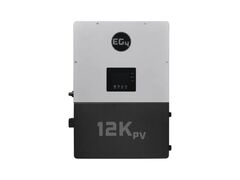
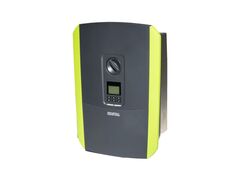
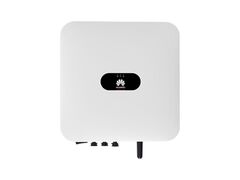
The residential hybrid inverter market has a direct rival to the Sol-Ark 15K on off-grid and DIY solar ground: the EG4 12kPV, less powerful (8000W continuous) but cheaper and fitted with a NEMA 4X enclosure, a step up in outdoor protection over the Sol-Ark's NEMA 3R. Two European hybrid inverters already compared on this site, the Kostal PLENTICORE plus 4.2 and the Huawei SUN2000-3K-LB0, target a completely different use case: the European grid, markedly lower power, and a market where whole-home backup through a single integrated switch is not part of the standard offering.
| Criterion | Sol-Ark 15K | EG4 12kPV | Kostal PLENTICORE plus 4.2 | Huawei SUN2000-3K-LB0 |
|---|---|---|---|---|
| Continuous AC power | 15000W (12000W on battery alone) | 8000W | 4200W, three-phase | 3000W, single-phase |
| MPPT | 3 | 2 | 3 | 2 |
| Backup transfer | 5 ms, integrated 200A switch (whole house) | Not specified by the manufacturer | Depends on battery configuration | About 20 ms (with LUNA2000 battery) |
| Battery | Lead-acid/lithium 48V, closed-loop, multi-brand (EG4, SOK, Pytes, Pylontech...) | Lead-acid/lithium 48V, closed-loop with EG4 and third-party brands | 10+ compatible brands (BYD, LG, Pylontech, Varta...) | LUNA2000 (proprietary range, plug and play) |
| Enclosure | NEMA 3R | NEMA 4X | IP65 | IP66 |
| Warranty | 10 years | 10 years | 5 years (10 with activation) | 10 years |
| Main market | United States | United States | Europe | Europe |
On battery compatibility, the Sol-Ark matches the more open of the two European inverters compared, the Kostal, with a 48V standard accessible to multiple brands rather than a list closed to a single manufacturer as with Huawei. The trade-off lies in its warranty return process, heavier than that of the two European inverters compared.
A price that varies widely by retailer, with no presence in Europe
Sol-Ark sells through a network of retailers and installers rather than at a single list price: the price observed for the inverter alone, excluding installation and battery, varies widely from one retailer to another, roughly from $4,800 to over $6,500, with some retailers listing a pre-discount price above $8,000. That spread is no sign of bad faith: it reflects a distribution model where each retailer sets its own margin and its own bundles with batteries or panels, rather than a price set by the manufacturer.
No official sales or warranty network exists in France or, more broadly, Europe to date: the Sol-Ark 15K remains built around US electrical codes (120/240V, UL 1741 SB certification, which incorporates and extends the requirements of the earlier UL 1741 SA standard for the advanced grid-support functions required by some utilities, in California or Hawaii among others). A European buyer importing a unit individually would have no local recourse in the event of a failure, on top of the voltage mismatch.
Who the Sol-Ark 15K suits, and who it does not
It suits a household after full whole-home backup during an outage, with a genuine solar project (up to 19500W of panels) and a preference for an open rather than imposed battery ecosystem. It is also a sound choice for an experienced solar DIYer, or one working with an installer familiar with the brand, ready to carefully configure generator start-up and to accept warranty service that involves handling a unit over 132 lb (60 kg) themselves in the event of a failure.
It suits less well anyone after simple, affordable partial backup, where the EG4 12kPV serves that need better, anyone installing outside the United States, or anyone planning to combine several units in parallel for a 120/208V output with no room for the MPPT voltage fault that has remained unresolved on that type of setup.