Sony NP-FW50: our full review

A real capacity that comes close to 95% of its rated value, and flawless recognition by the camera body: the official NP-FW50 remains the safe bet for extending a day's shoot on an APS-C Alpha or an early full-frame Alpha.

Our rating
4.3/5
Actual delivered capacity: 4.2 out of 5 (weighting 25%)Capacity4.2Compatibility and camera recognition: 4.8 out of 5 (weighting 30%)Compatibility4.8Reliability and cycle count: 3.6 out of 5 (weighting 20%)Reliability3.6Cell build and safety: 4.4 out of 5 (weighting 25%)Build4.4

How is this rating calculated?

Official Sony NP-FW50 battery for Alpha cameras

The essentials

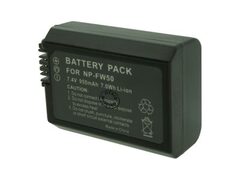
The NP-FW50 equipped the majority of Sony mirrorless cameras for years, and it still keeps its promise today. Its real capacity comes close to 95% of its rated 1020 mAh, a solid result that puts it ahead of several compatible rivals tested under the same conditions. As a genuine Sony battery, it is recognized without reservation by every compatible camera body: precise display of the remaining percentage, no warning message, no crippled function. Its compatibility spans a wide range of bodies, from APS-C mirrorless cameras (a6000 to a6500, a5100) to the early full-frame models (a7, a7 II, a7R, a7S and their Mark II versions), as well as the RX10 expert compacts and the ZV-E10. One point deserves attention though: this format gave way to the NP-FZ100 on every Sony body released from 2017 onward (a9, a7R III and later), and the two formats are not interchangeable. Sony does not publish any official figure for the number of charge cycles this reference can handle, so that remains something each owner can only judge over time. For anyone who already owns a compatible body, the official NP-FW50 remains the safest option for a spare battery or a replacement.

Strengths

  • Real capacity close to 95% of the rated 1020 mAh
  • Flawless recognition by every compatible camera body, with no warning message or crippled function
  • Precise display of the remaining charge percentage and estimated time
  • Compatible with a wide range of Sony bodies, from APS-C mirrorless cameras to early full-frame models
  • Built-in protection against overcharging and overheating

Limitations

  • No official figure for the number of charge cycles published by Sony
  • Precise CIPA battery life not published for several first-generation full-frame bodies (a7, a7R, a7S)
  • Format not compatible with Sony bodies released from 2017 onward, which use the NP-FZ100
  • Price noticeably higher than a third-party compatible battery, for a real-capacity gain more modest than the price gap
  • 1020 mAh capacity now modest against current industry standards
Sony NP-FW50: see the full details and price →

The benchmark battery for a generation of Sony mirrorless cameras

Before the NP-FZ100 arrived in 2017, the NP-FW50 equipped almost every Sony mirrorless camera, from affordable APS-C models to the early full-frame bodies. Its long commercial life still makes it a benchmark for anyone who owns one of these cameras.

1020 mAh
Rated capacity
7.2 V
Voltage
100 %
Camera recognition

Real capacity that comes close to 95% of the rating

The real capacity of the NP-FW50 generally sits around 95% of its rated 1020 mAh, a result that puts it ahead of several compatible alternatives compared under identical conditions. That is a solid score for a genuine battery, consistent with the brand's reputation for reliability on this specific point.

Flawless recognition, a wide range of compatible bodies

Being a genuine Sony battery, the NP-FW50 is recognized without reservation by every compatible camera body: precise display of the remaining charge percentage and estimated time, no warning message, no disabled function. Its range of compatibility remains wide: the APS-C Alpha mirrorless cameras a6000, a6100, a6300, a6400, a6500 and a5100, the full-frame a7, a7 II, a7R, a7R II, a7S and a7S II, the RX10, RX10 II, RX10 III and RX10 IV expert compacts, as well as the ZV-E10. One point deserves attention before you buy: this format gave way to the NP-FZ100 on every Sony body released from 2017 onward (a9, a7R III, a7 III and later generations), and the two formats are neither physically nor electrically interchangeable. The precise battery life in number of shots (CIPA standard) varies noticeably from one body to another, in the range of roughly 350 to 420 shots on the best-documented APS-C mirrorless cameras; this figure is not published with the same precision for every first-generation full-frame body.

No official figure for the number of cycles

Sony does not publish any official data on the number of charge cycles the NP-FW50 can handle before its capacity degrades noticeably, unlike what sometimes exists for other battery categories. This absence of an official figure does not signal a particular weakness, but it is a reminder not to rely on a numerical promise that simply does not exist for this reference.

The protections of a genuine battery

The NP-FW50 includes the standard protections of a genuine manufacturer lithium-ion battery: overcharging, overheating, and short-circuit protection. Nothing points to a particular safety issue with this reference, consistent with its status as a genuine rather than a compatible battery.

Up against the compatible Otech alternative

How does the official NP-FW50 compare with a compatible battery in the same format?

Technical comparison: Sony NP-FW50 against the compatible Otech NP-FW50 battery (prices observed, for guidance only)
CriterionSony NP-FW50 (official)Otech NP-FW50 (compatible)
Advertised capacity1020 mAh1020 mAh
Camera recognitionFull, with no warningStandard warning possible
Future risk (firmware update)NoneReal, not guaranteed over time
Price observed$69.95$28.83

The official NP-FW50 remains the safest choice for anyone who wants to avoid any risk of imperfect recognition or a future block from a camera firmware update. For a tight budget and occasional use as a spare battery, the compatible Otech alternative represents a substantial saving, at the cost of the uncertainties inherent to any third-party battery in this ecosystem.

The rating in detail

Our rating
4.3/5
Actual delivered capacity 4.2
Compatibility and ecosystem breadth not measured
Reliability and long-term endurance not measured
Charge time and tool runtime not measured
Build and interface not measured
Compatibility and camera recognition 4.8
Reliability and cycle count 3.6
Cell build and safety 4.4
Sony NP-FW50: see the full details and price →

The product and its alternatives

Sony NP-FW50

Sony NP-FW50

See price (24)

Run out of battery mid-shoot and you lose the moment. The genuine Sony NP-FW50 keeps Alpha and RX10 bodies powered with none of the guesswork.

View product
Otech NP-FW50 battery

Otech NP-FW50 battery

$28.83 (15)

Replacement battery for the Sony Alpha A6000, A6400, A6100, A7 II and RX10. Restore your device's original runtime when the battery gets tired.

View product
Sony NP-FZ100 battery

Sony NP-FZ100 battery

See price (20)

Replacement battery for Sony Alpha A7 IV, A7 III, A7R V, A9 II, ZV-E1 and FX3. Restore your device's original runtime when the battery gets tired.

View product

Frequently asked questions

Only if your camera body predates 2017. Sony bodies released from that date onward (a9, a7R III, a7 III and later generations) use the NP-FZ100 format, which is not compatible with the NP-FW50.

That depends heavily on the camera body: in the range of roughly 350 to 420 shots under the CIPA standard on the best-documented APS-C mirrorless cameras (a6000, a6100, a6300, a6500). The precise battery life for first-generation full-frame bodies is less widely published.

Sony does not publish any official figure on this point for this reference. Like any lithium-ion battery, gradual degradation is normal after several hundred cycles, with no precise figure available.

For the guarantee of flawless recognition by the camera body, with no risk of a warning message or a crippled function, and no risk of a future camera firmware update affecting how it works, a real risk with some third-party batteries.

Yes, the ZV-E10 is among the bodies compatible with this battery format, alongside the APS-C Alpha mirrorless cameras and the early Sony full-frame models.