90W, three outputs and a cable that never gets lost
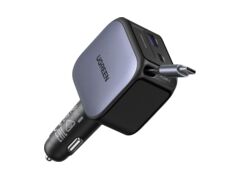
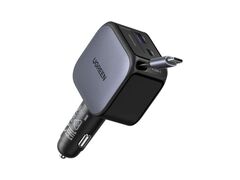
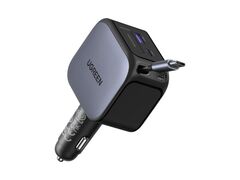
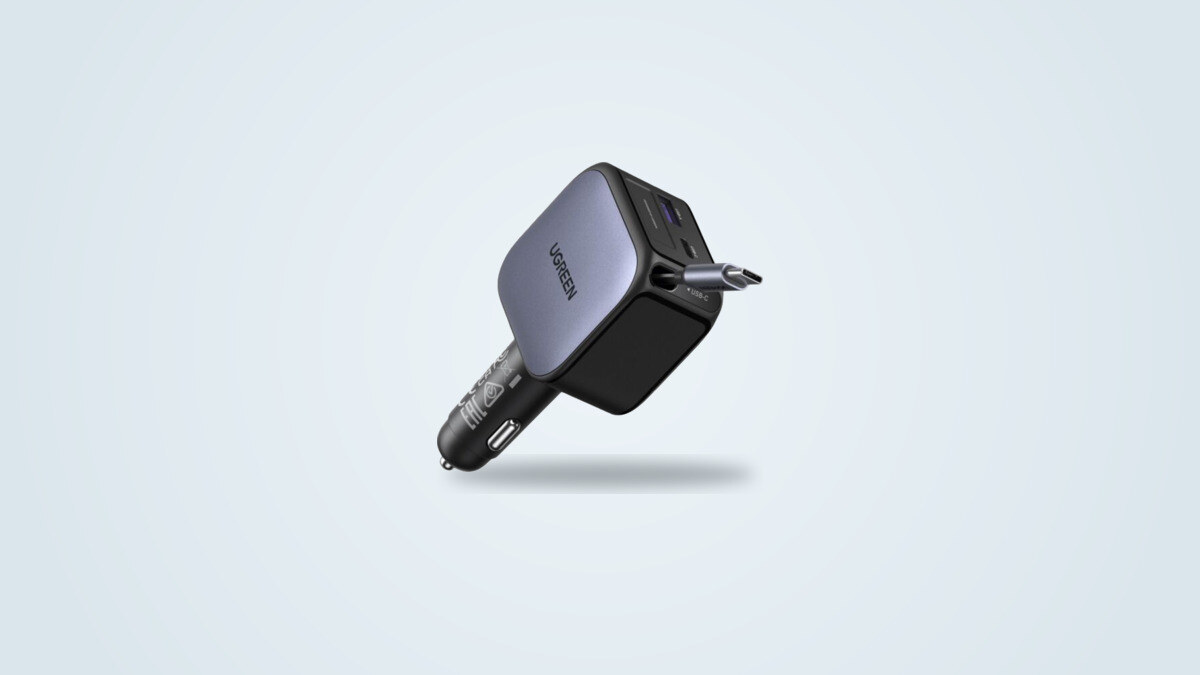
The Ugreen 90W Car Charger plugs into any 12V or 24V cigarette-lighter socket and offers three outputs usable at the same time: a built-in retractable USB-C cable, an extra USB-C port and a USB-A port. It sits in the middle tier of a Ugreen retractable-cable lineup that also includes a simpler 60W version and a more powerful 145W version with four outputs.
The unit weighs 3.1 oz (87g) at 5.3 x 3.9 x 1.5 in (135 x 100 x 37.5 mm) once the cable is retracted. Its slate-grey top and black base set it apart from the all-black chargers more common in this segment.
The retractable cable: up to 60W, the Nexode lineup's signature feature
The centerpiece of this charger is its built-in USB-C cable: it extends up to 27.6 in (70cm) with a single pull and winds itself back in the moment it is released, saving the need to carry or hunt for a separate cable for a passenger. Ugreen rates this mechanism for 25,000 retraction cycles and 10,000 bend cycles for the cable itself, two separate durability figures that each cover years of daily use.
Used alone, this cable delivers up to 60W, double the equivalent cable on the Ugreen 60W in the same lineup, which is capped at 30W. That 30W gap is what really sets the two models apart: the extra USB-C and USB-A ports are identical on both chargers, capped at 30W each.
30W, 30W, 60W: what each output is worth on its own
Each output has its own ceiling when used alone: 60W on the built-in USB-C cable, 30W on the extra USB-C port, 30W on the USB-A port. These three ceilings line up with the voltage and current profiles the charger offers (up to 20V/3A on the cable, 12V/2.5A at most on the other two ports), and are plenty for fast-charging a phone or tablet on any of the three outputs.
| Output | Power alone | Suited to |
|---|---|---|
| Retractable USB-C cable | 60W | Phone, tablet, small ultrabook as a top-up |
| USB-C port | 30W | Phone, tablet, small accessory |
| USB-A port | 30W | Phone, small accessory, older device |
A power-hungry laptop (a 16-inch MacBook Pro or an ultrabook needing more than 60W) will not hit its full charging speed on any of the three outputs: that is the territory reserved for the 100W port on the Ugreen 145W in the same lineup.
90W with two devices, 75W with three: what the product page only half spells out
Add up the charger's three individual ceilings and you get 120W (60 plus 30 plus 30), well above the 90W actually available from the 12V socket. That gap is nothing unusual: no multi-port charger of this size can power every output at its maximum at the same time. What matters is how the power actually gets shared once several devices are plugged in.
With two devices, the answer is simple and favorable: the cable paired with either secondary port reaches the full 90W together (60W plus 30W), with no compromise at all. This is the scenario Ugreen itself highlights in its own product visuals, with both the cable-plus-USB-C and cable-plus-USB-A combinations explicitly labeled at 90W.
The nuance shows up with three devices: Ugreen states that with all three outputs active together, the cable keeps priority at 60W while the other two ports fall back to 7.5W each, for a total of 75W, fifteen watts under the figure printed on the box. In practice, a third device still charges, just slowly: 7.5W is enough to hold a battery level steady rather than fast-charge a phone. Measured against its own individual ceilings, this charger still comes out proportionally less oversold than the 145W in the same lineup, whose four combined ceilings add up to 220W for 145W actually available.
PD, QC, PPS, AFC, FCP, SCP: wide protocol compatibility
The product page highlights three protocols: USB PD 3.0, QC 3.0 and PPS, already enough for the vast majority of recent phones and tablets, iPhone and Android alike. This charger goes further, though: it also supports AFC, Samsung's own fast-charging protocol, plus FCP and SCP, the two protocols used by Huawei and Honor. Few cigarette-lighter chargers in this price bracket pack such a complete list onto a single socket.
This protocol breadth translates into real compatibility with almost the entire current Android lineup, beyond the basic PD/QC/PPS trio. The one limit is shared by every general-purpose charger: the fastest proprietary charging standards from certain brands, such as SuperVOOC (Oppo) or Warp Charge (OnePlus), only kick in with that manufacturer's own charger, and fall back here to a standard PD or QC profile, which is slower.
Electronic protections and warranty: what the brand states
Ugreen states six layers of protection for this model: against overvoltage, overcurrent, short-circuit, overheating and overload, a thorough safety baseline for an accessory that stays plugged into the vehicle's battery continuously while driving. The housing is made of V0-rated flame-retardant plastic, the most demanding fire-resistance class for this kind of plastic.
No recall or recurring manufacturing defect has been identified for this specific model to date. That said, the product is still too recent on the market to judge its long-term reliability on the same footing as an accessory that has been available for several years, especially on the single moving mechanical part it contains: the cable's retraction mechanism.
A no-frills format, with no GaN claim
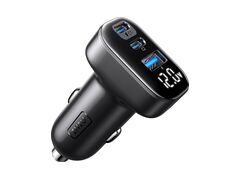
At 3.1 oz (87g) and 5.3 x 3.9 x 1.5 in (135 x 100 x 37.5 mm) once the cable is retracted, this charger stays more compact and lighter than the 145W in the same lineup (4.2 oz/118g), but noticeably bulkier than a minimalist cigarette-lighter charger with no built-in cable: for comparison, a direct competitor with the same total power gets down to 0.9 oz (26g) by relying on two plain USB-C ports with no retractable mechanism.
The gap has a simple explanation: the retraction reel and the cable that goes with it take up space a bare-port charger does not need to make room for. This product also makes no GaN claim, unlike some higher-end wall chargers on the market: the format stays the more conventional, silicon-based kind, which does not stop the stated power ceilings from lining up with the protocols it supports.
Against the 60W, the 145W and a direct rival
How does this 90W model compare with the rest of the Ugreen retractable-cable lineup, and with a direct rival offering the same total power?
| Criterion | Ugreen 90W | Ugreen 60W | Ugreen 145W | Iniu 90W |
|---|---|---|---|---|
| Total power | 90W | 60W | 145W | 90W |
| Built-in cable | Yes, up to 60W | Yes, up to 30W | Yes, up to 60W | No |
| Most powerful port besides the cable | 30W | 30W | 100W | 45W |
| Weight | 3.1 oz (87g) | Not stated | 4.2 oz (118g) | 0.9 oz (26g) |
| Stated warranty | 24 months | Not stated | 24 months | 3 years (general brand policy) |
| Observed price | $27.99 | $19.99 | $34.99 | $18.99 |
Against the 60W, the 90W doubles the built-in cable's power for a limited price gap, a clear win the moment one of the connected devices needs more than 30W. Against the 145W, it stays more compact and cheaper, at the cost of a dedicated high-power port able to charge a laptop at full speed. Against the Iniu 90W, the same total power is advertised but the approach is the opposite: two symmetrical 45W USB-C ports with no built-in cable, in a much lighter housing. The choice between the two comes down to the convenience of a cable always at hand versus a minimalist format with a slightly more powerful single port.
Who it suits, and who it does not
This charger suits a family or a mobile team that most often charges one or two devices at a time (driver and passenger) and appreciates never having to hunt for a USB-C cable in the glovebox again. Its wide protocol compatibility, including AFC, FCP and SCP, makes it a sound pick for a household mixing iPhone, Samsung and Huawei or Honor devices.
It suits less well anyone who regularly charges three devices at full speed at the same time, a scenario where the real 75W total makes itself felt, or anyone who needs to charge a laptop drawing more than 60W from the car: the Ugreen 145W and its dedicated 100W port are the better fit there. For a simple two-phone setup with no need for a built-in cable, the cheaper Ugreen 60W covers it easily.