The first GaN charger to break the 300 W mark
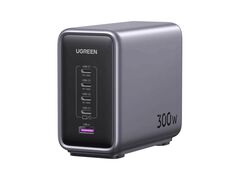
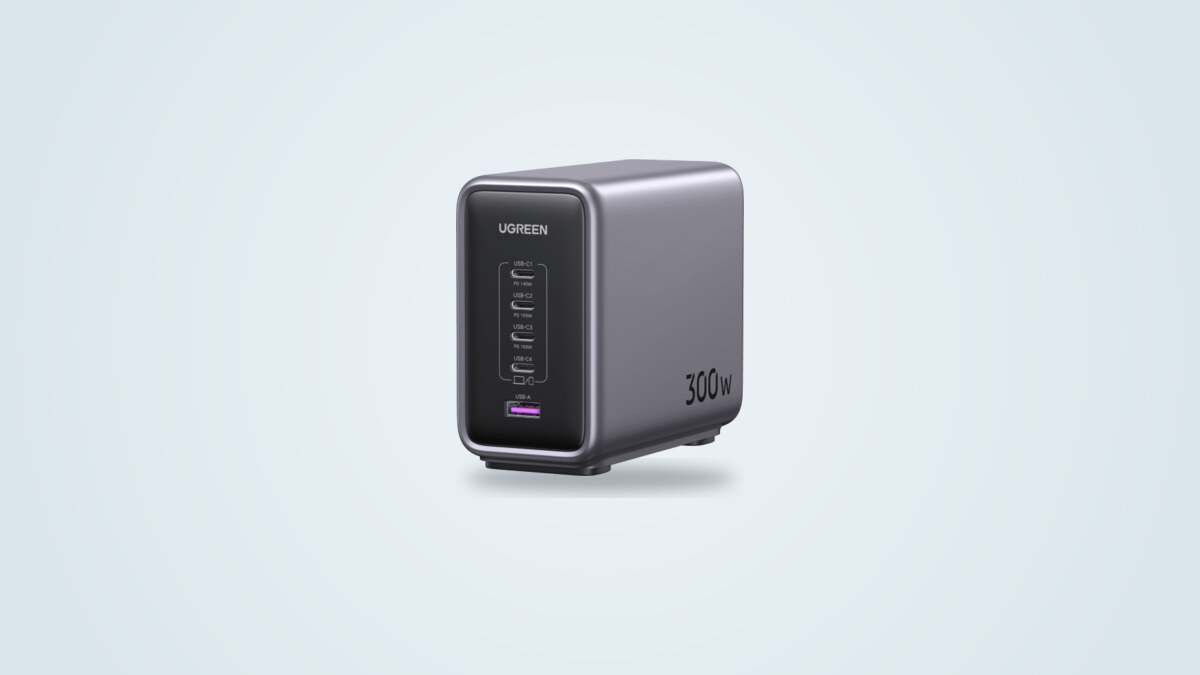
The Ugreen Nexode 300W is a 5-port GaN desktop charger: 4 USB-C and 1 USB-A, for an advertised total of 300 W. The USB-C1 port delivers up to 140 W over USB PD 3.1, enough to power a demanding laptop on its own while the other four ports charge phones, tablets, or a second and third laptop.
Two GaN chips and a system Ugreen calls PowerDispenser share power out across the active ports. The stated goal is to replace several separate wall chargers with one central hub, aimed at a desk that genuinely needs to feed several devices at once rather than occasional travel use.
Do not confuse it with the Nexode Pro 300W, a different product with 8 ports, a smart display and app control: the unit in this review is the simple version, with no screen, controlled only by small status lights on each port.
140 W on the main port: what actually holds up
The 140 W figure is the maximum available on the USB-C1 port over USB Power Delivery 3.1, using the 240 W USB-C cable included in the box (a cable not rated for that power would cap the charge regardless of what the charger can supply). On a compatible device, that ceiling stays remarkably stable no matter how many other ports are active at the same time.
| Configuration | USB-C1 port |
|---|---|
| 2 ports active | 130 W |
| 3 ports active | 120 W |
| 4 ports active | 134 W |
| 5 ports active | 132 W |
On a recent 16-inch MacBook Pro plugged into this port alone, charging reaches about 50% in 26 minutes and 80% in 49 minutes, very close to the manufacturer's own claim (56% in 30 minutes); a full charge takes a little under two hours. On a large recent smartphone, the port starts around 27 W and reaches 50% in about 25 minutes, 80% in about 51 minutes, with a full charge in two hours.
With all five ports loaded, never more than about 268 W total
The product listing shows a simplified split across 3 active ports (140 + 100 + 60 W = 300 W). In real use, the total power available depends on the exact combination of devices plugged in and the voltage each port negotiates, but it climbs in clear steps as more ports join in, never crossing the 300 W ceiling.
| Configuration | Total |
|---|---|
| 2 ports active | 191 W |
| 3 ports active | 218 W |
| 4 ports active | 267 W |
| 5 ports active | 268 W |
Efficiency and heat: the GaN promise, with caveats
The two onboard GaN chips push efficiency up to about 92.6%, very close to the 93% maximum Ugreen highlights. That figure is not constant, though: depending on the load drawn, efficiency drops to about 76%, a gap that shows the difference between a marketing peak and a real-world average.
In everyday use, without pushing all five ports at full power continuously, the case stays noticeably cooler, under 95 °F (35 °C). It is only after an hour at 140 W continuously on the main port that the front panel reaches about 124 °F (51 °C), with the back near 122 °F (50 °C), warm to the touch but within the usual range for this kind of compact device. Standby draw, on the order of a few milliwatts, is negligible on an electricity bill.
PD 3.1, PPS, Quick Charge: broad compatibility
The Nexode 300W supports the main fast-charging protocols in use today: USB Power Delivery 3.1, PPS for fine-grained charging on Android phones, and Quick Charge. That combination covers the vast majority of USB-C laptops on the market (MacBook, Dell XPS, ThinkPad, Surface), smartphones (iPhone, Galaxy, Pixel) and tablets, with no particular restriction found on a common device.
The included braided 240 W USB-C cable covers the main port on its own; the other four ports accept any standard USB-C cable rated for their respective power. The detachable power cord also makes it easy to replace if it wears out.
The real friction point: long-term port reliability
The ThermalGuard system monitors temperature continuously and guards against short circuits, overvoltage, overload and overheating; the PowerDispenser system automatically adjusts the power sent to each port based on what the connected device needs. No safety issue is tied to this charger to date.
Against that risk, the manufacturer's contractual warranty, set at 2 years on this model, is a real safety net: it beats the 18 months several rival GaN chargers offer. Keeping your receipt and contacting customer support as soon as a port shows the first signs of weakness remains the best protection against this specific risk.
1.85 lb (839 g): a shape that owns its power
At 1.85 lb (839 g) and 4.41 x 3.70 x 2.09 in (112 x 94 x 53 mm), the Nexode 300W is a tall desktop brick built to sit on a desk rather than travel in a bag. That is the logical price of the power on offer: replacing three separate laptop chargers, often 0.66 to 0.88 lb (300 to 400 g) each at equivalent power, with a single unit under 1.87 lb (850 g) is still a net space saving on a crowded desk.
With no screen or control dial, the interface stays minimal: simple status lights show the state of each port without displaying the exact power being delivered. Checking precisely what a connected device is receiving still requires an external USB-C meter.
Against the Anker 140W GaN and the Anker Prime 250W station
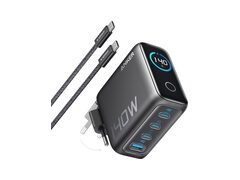
Two direct points of comparison already exist in this same section of the site. Against the Anker 140W GaN (4 ports, 140 W peak on a single port), the Nexode 300W holds its power better as more ports join in: its main port stays between 120 and 134 W across 2 to 5 active ports, whereas the Anker's main port drops to 65 W once all four of its ports are in use, a far steeper proportional decline. In return, the Anker 140W GaN shows no failure recorded over more than 250 hours of use, whereas the Nexode 300W carries a real long-term reliability concern on its ports: on that specific point, the Anker stays ahead.
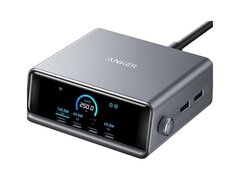
Against the Anker Prime 250W station (6 ports, LCD screen and dial), the Nexode 300W has the opposite advantage: its spec sheet publishes weight, dimensions and a port-by-port power breakdown, whereas Anker discloses neither the exact weight nor dimensions nor a detailed breakdown across its six ports for that station. The Nexode 300W gives up the Anker station's screen and dial, but it is markedly more transparent about what it actually delivers, a point that matters to anyone who wants to know precisely what they are buying.
| Criterion | Nexode 300W | Anker 140W GaN | Anker Prime 250W |
|---|---|---|---|
| Advertised total power | 300 W | 140 W | 250 W |
| Ports | 5 (4 USB-C + USB-A) | 4 (USB-C) | 6 (USB-C + USB-A) |
| Control screen | None | Yes | LCD + dial |
| Weight and dimensions published | Yes (1.85 lb (839 g)) | Yes (≈ 0.65 lb (295 g)) | Not disclosed |
| Manufacturer warranty | 2 years | 18 months | Not specified |
Who the Nexode 300W suits, and who it does not
This charger suits a desk that genuinely needs to feed several machines at once: two or three laptops, plus a phone and a tablet, without stacking wall chargers behind the monitor. The main port's stability regardless of how many devices are plugged in is a real asset for that exact use case, and the 2-year warranty offers some reassurance over time.
It suits less well anyone after a light travel charger: 1.85 lb (839 g) and a tall brick shape have no place in a bag for occasional use. For a single laptop with no need for extra ports, a smaller and cheaper GaN charger does the job just as well. And given the real long-term concern over port reliability, it is worth testing every port as soon as it arrives and keeping your receipt.