What the advertised 537Wh are really worth
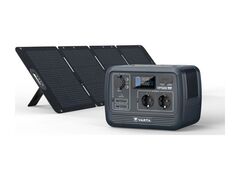
The Varta VP500 packs a 537Wh LiFePO4 (lithium iron phosphate) battery, a chemistry known for its thermal stability and longevity: the manufacturer rates it for 2500 charge and discharge cycles before any meaningful capacity loss, several years of regular use for a typical household. It is a reassuring choice on paper, the same chemical family used by nearly every serious power station sold today.
The advertised 537Wh describe the battery itself, not the energy the unit actually delivers at its 230V output once something is plugged in. As with any station built around an inverter, part of that energy is lost converting DC to AC, and another part continuously powers the control electronics (screen, battery management). This gap between rated capacity and usable energy exists on every product in the category, to varying degrees depending on the inverter's quality and design.
No independent measurement of the VP500's actually delivered capacity has been found to date, whether in the US, Germany, Japan, or elsewhere. The VP500 only launched in June 2025, sold exclusively through a single German retailer, which partly explains this lack of hindsight: the labs that regularly measure this kind of device have not yet published a test protocol for this specific model. It is therefore not possible to claim that the VP500 delivers more or less energy than its direct rivals: that is a genuine unknown, worth keeping in mind rather than treating as an assumed flaw.
700W continuous, 1400W peak: power that matches its format
The VP500 delivers 700W continuous and up to 1400W peak through its two 220 to 240V sockets, enough for the vast majority of everyday household needs: a laptop, a router, a small fridge, lighting, multiple chargers, or a light power tool. A powerful hotplate, an electric oven, or a professional hair dryer, on the other hand, sit well beyond that ceiling.
No independent load-bank test has measured to date whether the VP500 truly holds its rated 700W over an extended period without thermal throttling or a nuisance protection shutdown. The official spec sheet does not mention any specific time limit tied to this 700W tier either, unlike some rivals that state a maximum duration before throttling kicks in. In the absence of any contrary report found across the German, English-language, or Japanese markets, nothing currently points to a gap between the claim and reality on this front.
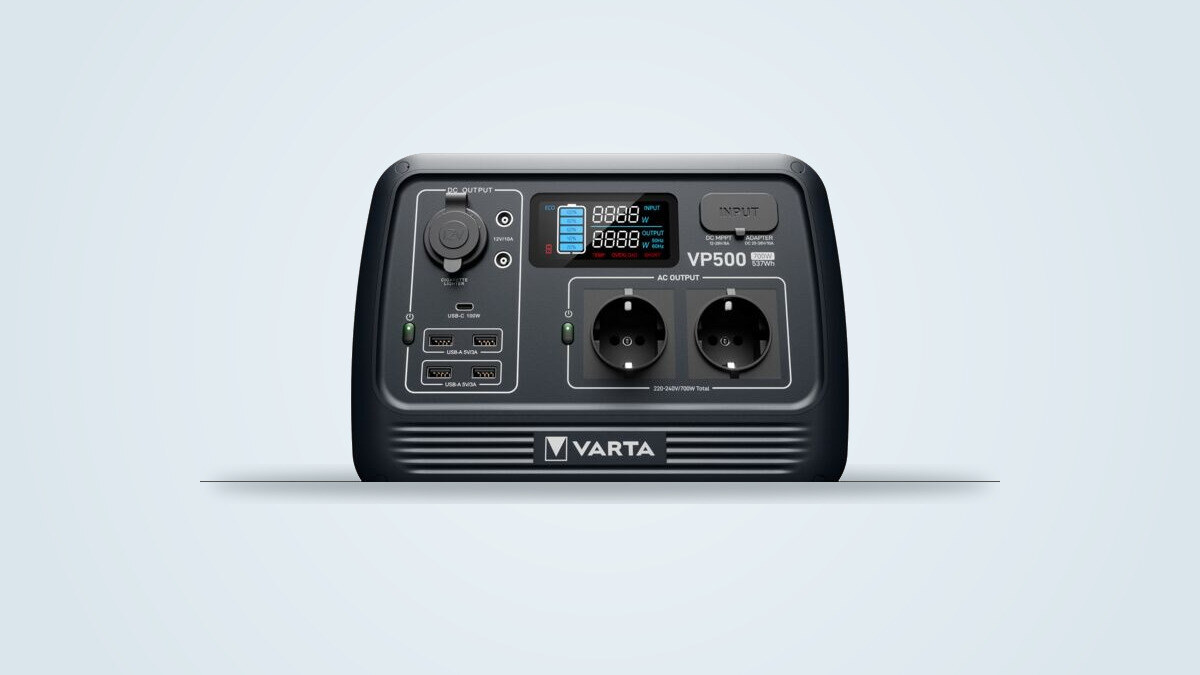
One connectivity detail deserves attention: the 12V cigarette-lighter socket and the two DC5521 outputs share a common 10A (120W) budget rather than each having its own. Using the cigarette-lighter socket and both DC5521 ports at full power at the same time is therefore not possible: the combined draw of all three cannot exceed 10A. A detail rarely highlighted in general marketing copy, but spelled out clearly in Varta's official technical documentation.
Three ways to charge, only one of them genuinely fast
The VP500 charges three ways: from the mains via the included adapter (200W maximum, on the European 230V standard), via solar through its dedicated input (200W maximum, compatible with the foldable Varta VS200 panel), or from a car's cigarette lighter. These three maximum input figures, all stated plainly by the manufacturer, are far from equal in practice.
The car-charging case deserves a closer look, because it is the one point where Varta's official documentation goes further than most competing spec sheets: the power actually available depends directly on the vehicle's electrical system voltage. On a 12V system, standard on the vast majority of passenger vehicles, charging caps at 98W. It only climbs to 196W on a 24V system, found on some vans, trucks, and motorhomes. Presenting cigarette-lighter charging as a generic "charge while you drive" feature misses that nuance: in the large majority of cases, it remains a slow top-up rather than a genuinely fast charging solution.
The Dual-Charge function, which combines mains and solar simultaneously to reach up to 400W combined, remains the only one of the three methods designed to approach fast charging: Varta itself states around 2 hours to reach 80% charge. A simple calculation from the official input figures, however, reveals an interesting gap.
On the maximum stated input power alone (400W), the 80% milestone, about 430 Wh, would theoretically be reachable in just over an hour. The figure Varta itself states for that same milestone, roughly double, is most likely explained by the absorption taper that slows any lithium battery charge as it nears full capacity, combined with a charging efficiency below the theoretical maximum. That is not a flaw in itself, it is expected behavior for this type of battery, but the gap between the raw calculation and the published figure illustrates well the difference between a maximum input power rating and an actually achieved charging time.
A wireless charging pad, 100W USB-C… and no app whatsoever
The VP500's connectivity is complete for its format: two 220 to 240V sockets, a 100W USB-C PD3.0 port (enough to fast-charge most laptops), four USB-A ports at 5V and 3A each, two DC5521 outputs, a 12V cigarette-lighter socket, and a wireless charging pad built into the top of the unit, capable of up to 15W depending on the device placed on it.
This wireless pad remains an uncommon feature at this price point: setting a compatible smartphone straight down without hunting for a cable is a genuine everyday convenience. One detail is worth knowing before buying: the pad only works once the unit's DC output has been switched on via its dedicated button. Without that step, placing a phone on it does nothing, which can easily be mistaken for a fault in the pad itself.
The clearest weak point in this area is the total absence of any wireless connectivity for controlling the unit itself: no Bluetooth, no WiFi, no mobile app. Tracking charge level, incoming and outgoing power, and overload or overheating alerts all rely solely on the built-in LCD screen, which turns itself off after 30 to 60 seconds unless an output is active. A good share of the direct competition in this format now offers at least basic Bluetooth remote monitoring: that is a genuine gap for a station launched in mid-2025, even though it does not affect the unit's core functionality.
Eco mode and automatic shutdown: a real friction point to know about
A behavior the manufacturer describes itself deserves close attention for anyone considering the VP500 as a long-duration backup reserve: the mains and 12V outputs switch off automatically after 4 hours if the connected load stays very light (10W or less on AC, 1W or less on DC) or at zero. This behavior, called Eco mode in the official manual, is meant to preserve battery runtime by preventing it from draining needlessly on negligible parasitic loads.
On paper, this behavior is logical and genuinely saves energy. In practice, it can catch out an extended backup scenario powering a very low-draw device, a router or a small lamp for instance: without manually restarting the output, power cuts out after 4 hours even though the battery is still largely charged. Eco mode can be turned off manually through a button combination described in the manual, but it is not the factory default setting.
The same power-saving logic applies to the LCD screen, which only stays lit for 30 to 60 seconds unless an output is active, a short window for a quick glance at the charge level.
LFP chemistry, warranty, and the weight of a first product from Varta
Varta is a century-old German brand in the battery sector, historically associated with rechargeable batteries and automotive starter batteries rather than nomadic power stations. The VP500 is the very first product in its new mobile-energy lineup, launched in June 2025 alongside the foldable VS200 solar panel.
Being a first product cuts both ways. On one hand, the LiFePO4 chemistry chosen is a serious, already widely proven option across the industry, and the official technical documentation stands out for its precision, going as far as detailing points many manufacturers leave in the dark, such as charging power varying with the vehicle's electrical system voltage. No safety recall or documented alert has been found to date for this product. On climate tolerance, Varta states a discharge range of -4 °F (-20 °C) to 104 °F (40 °C) and charging from 32 °F (0 °C) to 104 °F (40 °C), with optimal storage between 68 °F (20 °C) and 86 °F (30 °C): ranges consistent with current LiFePO4 standards.
On the other hand, the VP500 carries no longer-term reliability track record of its own, having only been on sale for a little over a year at the time of writing. No independent teardown has been published to date to identify the cell supplier or the design of the battery management system (BMS), information available for many more established rivals in this segment. The manufacturer warranty is set at 2 years, standard for this price bracket without being the most generous on the market.
Camping, power outages, festivals: the uses that actually make sense
The VP500's format and runtime suit camping or occasional backup power best. Its 537Wh run an electric cooler, evening lighting, and charging for several devices over a weekend, and its 700W continuous occasionally allow a kettle or a small hotplate. The emergency light built into the side of the unit proves genuinely useful once night falls, without needing a separate flashlight. The LiFePO4 battery holds its charge for months, a real plus for occasional use: it is ready straight from the closet.
As home backup during a power outage, the VP500 covers the essentials (router, lighting, phone charging) for several hours, but without an automatic UPS-style switchover: it must be plugged in manually once the outage is noticed, unlike stations designed specifically for that role. On a small job site or for DIY work with no outlet nearby, its 700W is enough for a drill, a sander, or site lighting, but not for a genuinely demanding tool like a powerful circular saw, and the lack of a UPS function makes it more of a backup solution than proper professional site equipment.
For a festival or event, the wireless pad and the four USB-A ports cover a small group's charging needs well, as long as the connected sound or equipment stays light: 700W continuous is not enough for professional sound systems. On a road trip, charging from the cigarette lighter, limited as noted to 98W on a 12V system, usefully tops up solar charging at sunny stops, without replacing a proper mains charge between legs, wherever that mains charge is actually available.
Against the EB3A and the rest of the compact segment: what is missing, what stands out
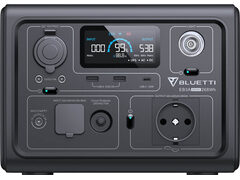
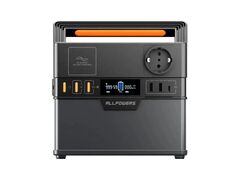
In the compact all-rounder power station segment, the Bluetti EB3A remains a useful point of comparison, even though it is now discontinued by its manufacturer. Both units share a LiFePO4 chemistry and a 2-year warranty, but diverge clearly on format and connectivity.
| Criterion | Varta VP500 | Bluetti EB3A |
|---|---|---|
| Capacity | 537 Wh | 268 Wh |
| Continuous power | 700 W | 600 W |
| Weight | 16.5 lb (7.5 kg) | 10.1 lb (4.6 kg) |
| Wireless charging | Yes, up to 15 W | Yes, 15 W |
| Warranty | 2 years | 2 years |
The VP500 wins clearly on capacity, for a weight increase that stays reasonable given the gap, well under 3 kg more for nearly double the capacity. Both stations share a feature that is rare at this price point, a built-in wireless charging pad. A good share of the more recent direct competition now offers at least basic Bluetooth remote monitoring, an area where the VP500 lags noticeably behind. Unlike the VP500, US versions of rivals in this segment are natively built for 120V/60Hz household power.
The most structural difference between the two has less to do with the spec sheet than with time on the market: the EB3A benefits from several years of hindsight, while the VP500 has only been around for a little over a year with a single confirmed source of distribution.
A narrow footprint, and a voltage mismatch US buyers need to know about
Launched in June 2025, the VP500 is to date sold by a single retailer, in Germany. No availability has been confirmed on Amazon.com or any other US marketplace, nor on other major European marketplaces, nearly fifteen months after launch. For a US buyer, that already means international shipping costs and after-sales service handled by a foreign seller if importing it directly.
A second, more fundamental issue sits on top of that distribution gap: as specified by Varta, the VP500 outputs 220 to 240V AC at 50Hz through European-style sockets, the European electrical standard, not the 120V/60Hz standard used in US households. Even with a plug adapter, feeding a European-spec unit from a US 120V outlet, or running US 120V appliances off its 230V output, is not something the manufacturer's documentation supports, and would require dedicated voltage-conversion equipment rather than a simple adapter. This is a genuine, structural mismatch for the US market, separate from the question of the product's underlying quality.
None of this necessarily signals a problem with the product itself for the market it was actually designed for: it may simply reflect a deliberate, market-by-market rollout strategy for a brand new to this category, starting at home in Germany. But combined with the voltage mismatch, it makes the VP500, as currently sold, an impractical choice for a US household rather than merely a hard-to-find one.
Who the VP500 suits, and who it does not
It suits a European buyer looking for a versatile, not-too-heavy backup reserve for camping, an event, light DIY work, or a power outage at home, without needing remote monitoring through an app. Varta's LiFePO4 chemistry, 2-year warranty, and transparent spec sheet make it a reassuring choice for buyers who prefer an established battery brand over a lesser-known specialist.
It does not suit a US household: beyond the missing UPS-style switchover, fast mains-only charging, and app-based monitoring found on more established rivals, its 220 to 240V/50Hz output and European-style sockets are not built for US 120V/60Hz power, and there is no confirmed US retail listing to begin with.