The 2560 Wh claim versus lead-acid: what 100% depth of discharge really changes
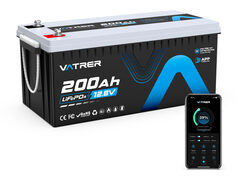
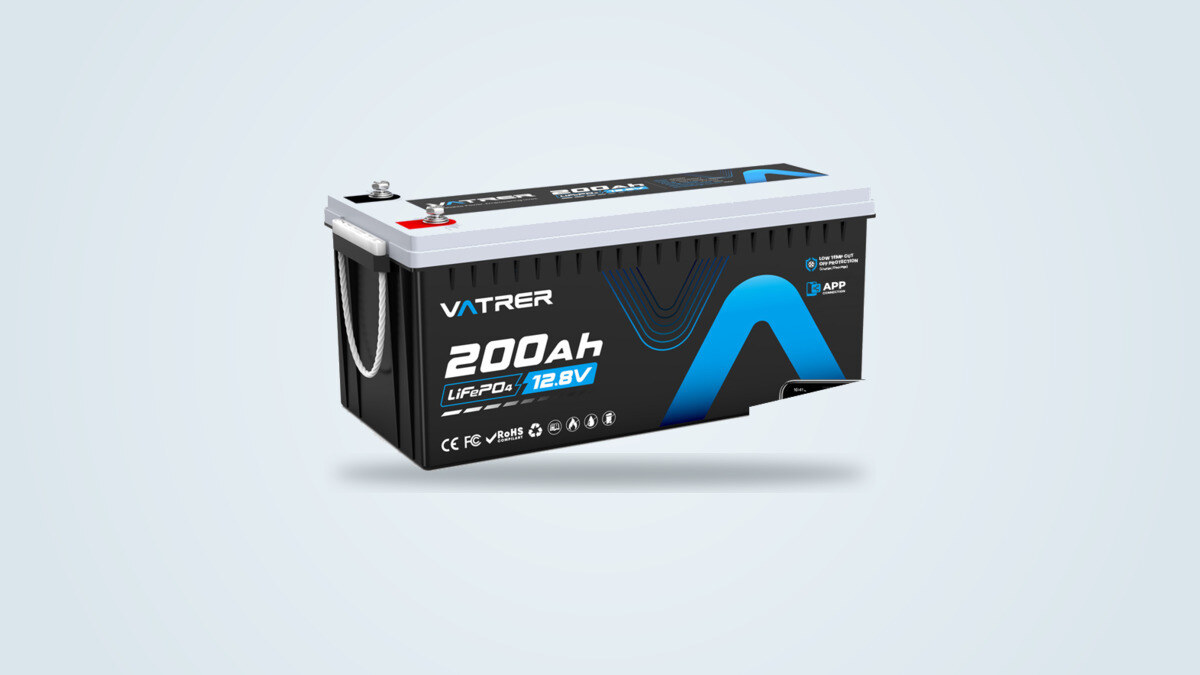
The Vatrer Power 200Ah Bluetooth is rated at 2560 Wh (200 Ah at a nominal 12.8 V) with a stated depth of discharge of 100%, a trait of LiFePO4 chemistry. A lead-acid battery should never be run below 50% depth of discharge without noticeably shortening its life, so matching the same usable energy as these 2560 Wh would take a lead-acid bank with a much bigger nominal capacity to start with.
An AGM lead-acid bank putting out the same usable energy (oversized to make up for its 50% discharge ceiling) would need a nominal capacity close to 400 Ah: in practice, two 12 V 200 Ah blocks weighing roughly 132 to 143 lb (60 to 65 kg) apiece, so 265 to 287 lb (120 to 130 kg) total against 48.5 lb (22 kg) here. The real-world gap runs well past the simple weight number printed on the label.
| Criterion | AGM lead-acid (equivalent usable energy) | Vatrer Power 200Ah (this product) |
|---|---|---|
| Nominal capacity | About 400 Ah (2 x 200 Ah) | 200 Ah (2560 Wh) |
| Recommended discharge | 50% maximum | 100% claimed |
| Real usable energy | About 2560 Wh | 2560 Wh |
| Weight | 265 to 287 lb (120 to 130 kg) | 48.5 lb (22 kg) |
The manufacturer also lists over 5000 cycles at 100% depth of discharge for this specific model, a number that shows up on this product's own spec sheet: a general FAQ shared across the whole battery lineup, on the same official site, gives a lower floor of just 2000 cycles at 100% depth of discharge, a generic figure that is less specific than the one on the product's own spec sheet. No independent measurement of the actual delivered capacity behind the claimed 2560 Wh could be cross-checked as of this writing: it is a manufacturer number, not yet confirmed by a third party, and should be treated as a confidence gap rather than a proven flaw.
The 200A BMS and its real inverter-side ceiling
The manufacturer's spec sheet lists a maximum continuous discharge current of 200 A, which works out to a theoretical 2560 W at the nominal 12.8 V (not to be confused with the 2560 Wh total capacity number, a different quantity that just happens to share the same figure). That 200 A rating is what gives this battery its reputation next to BMS units often capped at 100 A on this format.
The same spec sheet lists a separate ceiling further down, though: a maximum charge/load power (inverter) of 1280 W, exactly half of the theoretical number worked out from the rated discharge current. A promotional graphic on that very same product page states 2560 W of "max load power" on its own, double the figure shown in the same manufacturer's detailed spec table, for the same product. The two do not match.
This ceiling does not take away from the point of a 200 A BMS for other jobs: a high discharge current still matters for continuous 12 V DC loads (a winch, a big DC appliance) or for wiring several units in parallel, where each battery only carries a fraction of the total current. It is specifically pairing a single unit with a single inverter that should be sized to the more conservative number.
Safety and BMS protections
The built-in BMS guards against overcharge, deep discharge, overcurrent, and short circuits, with precise thresholds published by the manufacturer: cutoff above 15 V on overcharge, cutoff below 8.8 V on deep discharge, and a thermal cutoff once the internal temperature hits 167 °F (75 °C). The cells are described as prismatic, automotive-grade LiFePO4 cells and carry a UL testing certificate for the cell itself, a level separate from certification of the fully assembled pack (UN38.3 for shipping or UL1973 for the assembled system, for instance), a distinction the manufacturer's marketing material does not spell out.
The BMS itself is a generic JBD-brand unit, a component found across several consumer LiFePO4 brands on this format, paired with the Xiaoxiang app. It is not a design exclusive to Vatrer Power, but a widely used choice that is generally well regarded in the DIY solar community for its reliability and for how much data it exposes (per-cell voltage, temperature, protection history).
The IP65 rating protects against dust and water splashes from any direction, a level suited to a boat locker exposed to spray or an RV floor exposed to light water intrusion. It is not a submersion rating: a battery left underwater for good is not covered at this protection level.
Cold-weather behavior: automatic cutoff, no self-heating
Charging is automatically disabled below 32 °F (0 °C), with a manufacturing tolerance of ±7.2 °F (±4 °C) stated by the manufacturer, so the actual trip point could land anywhere between about 25 °F and 39 °F (-4 °C to +4 °C). Discharging is disabled below -4 °F (-20 °C), also ±7.2 °F, so an actual trip point between about -11 °F and 3 °F (-24 °C to -16 °C). The stated storage range runs from 14 °F to 122 °F (-10 °C to 50 °C). This specific model, identified by the manufacturer under the reference 12V-200AH-200A-APP, has no active cell self-heating feature: the cutoff below freezing is a passive safeguard, not an active fix for cold weather.
For boat or RV use in shoulder-season weather, this automatic cutoff avoids the main risk of charging lithium in the cold (metallic lithium plating on the electrode during a too-cold charge, which permanently degrades the cell) with no action needed from the owner. The trade-off is that a charge attempted on a chilly morning simply will not start until the temperature climbs back above the threshold, with no heating element to speed that along.
Bluetooth and the Xiaoxiang app: what it actually does
The Xiaoxiang app, paired with the built-in JBD BMS, shows state of charge, total voltage, current, instantaneous power, and temperature in real time. The detail goes down to individual cell voltage and the maximum spread between cells (handy for keeping an eye on balancing), plus a log of protection events. The battery works fine on its own with no phone around: the BMS runs its protections continuously, and the app is only an optional monitoring layer.
For anyone running several units in parallel, the app can show a combined system capacity instead of a single battery at a time, handy once the setup grows past one unit. Nothing here replaces a wired monitoring network (CAN or RS485) for a fixed home setup juggling several power sources: this product does not offer one, unlike higher-end lineups from other manufacturers in this same segment.
The 5-year warranty: the registration step to remember, and a more forgiving clause than the competition
The stated warranty is 5 years for the 12 V, 100 to 600 Ah battery category, a term at the top of this price bracket. The official warranty policy, though, spells out a condition that is easy to miss: to get full coverage, the order has to be registered and the warranty activated online before the product goes into service. Skip that two-step process, and there is no guarantee the full term applies if something goes wrong.
The exclusion clause for extended storage is worth comparing against a direct rival in this segment: the warranty policy excludes a battery left discharged for more than a year, a noticeably more forgiving rule than the quarterly clause enforced by at least one direct competitor of the same format (a recharge required every 3 months to keep the cell covered). A meaningful gap in timing for a product whose main use case (boat, RV, off-grid solar setup) involves exactly the kind of long, unattended stretches that clause is meant to guard against.
The remaining listed exclusions are pretty standard: an unsecured mount, reversed polarity, undersized wiring, series or parallel wiring beyond the stated limits, unauthorized opening or modification of the case, and heavy-duty commercial cycling beyond the stated duty cycle. Nothing unusual for this type of product, but reading the full policy before buying still saves headaches if something goes wrong down the line.
Expandability: up to 4 units in series and 10 in parallel
The manufacturer states compatibility for up to 4 units in series (to build a 48 V system out of 12.8 V blocks) and up to 10 units in parallel (to stack capacity at the same voltage). The documentation does not spell out whether both limits can be combined at once in a single setup: to be safe, treat each limit separately rather than multiplying the two numbers together.
To stay reliable, this kind of setup calls for batteries from the same batch, brought to the same charge level before being put into service together, a precaution that applies to any LiFePO4 chemistry wired this way and not just to this brand. For a more modest job (a straight lead-acid swap on a van or a boat), a single unit remains the most common and simplest route, with none of these assembly precautions to worry about.
Build quality, case, and ownership feedback
The case (20.55 x 9.44 x 8.58 in, or 522 x 240 x 218 mm, for 48.5 lb / 22 kg) is sealed shut with adhesive rather than accessible screws, a choice that rules out any internal work (checking a cell, swapping a part) without risking damage to the case itself. The terminals are M8 bolts, a common format that needs matching lugs: the lugs off an old lead-acid battery are not always the right diameter, worth checking before ordering rather than after the battery shows up.
The prismatic cells and the overall design of this lineup draw mostly favorable buyer feedback, most often citing solid build quality and a limited performance gap against more established, noticeably pricier brands on this same format. A handful of isolated reports mention a finicky end-of-charge detection or a state-of-charge readout that jumps sharply from a high number to zero on this generation of BMS: a warranty replacement resolved the situation in the known cases, without this looking like a mass defect across production.
Nothing points to the isolated reports above being specific to this 200 A Bluetooth model rather than another capacity in the same lineup, but the underlying design (the JBD BMS and its firmware) applies to that whole generation of component, across the several brands that use it.
Up against the direct competition
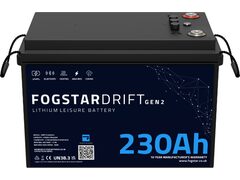
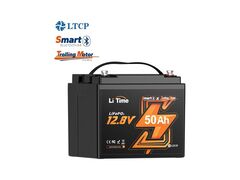
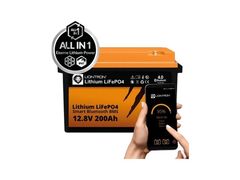
In the 200 to 230 Ah lithium battery bracket, the Vatrer Power 200Ah Bluetooth regularly comes up against three direct rivals: the Fogstar Drift 230Ah, a premium pick with built-in heating and a slightly higher capacity (2944 Wh) but a noticeably higher price tag; the LiTime 200Ah Plus, one of the most compared brands in this segment; and the Renogy Core 200Ah Bluetooth, which also packs a 200 A BMS and an IP65 rating.
| Criterion | Vatrer Power 200Ah | Fogstar Drift 230Ah | LiTime 200Ah Plus | Renogy Core 200Ah BT |
|---|---|---|---|---|
| Energy | 2560 Wh | 2944 Wh | 2560 Wh | 2560 Wh |
| BMS / continuous discharge | 200 A | Built-in (unspecified) | 200 A | 200 A |
| Rated cycles (100% DoD) | 5000+ | 4000+ | 4000+ | 5000 (at 80% DoD) |
| Self-heating | No | Yes | No (this version) | Unspecified |
| Ingress protection | IP65 | Unspecified | IP65 | IP65 |
At near-identical energy, the Vatrer Power 200Ah stands out for throwing in a 200 A BMS and an IP65 rating as standard, while the pricier Fogstar Drift 230Ah leans mainly on its built-in heating and slightly higher capacity. On rated cycles at full depth of discharge alone, its 5000 cycles beat the 4000 claimed by the LiTime 200Ah Plus. None of the alternatives listed here publishes, as far as we could find, an inverter power limit separate from the raw BMS discharge current in its technical documentation: there is no way to tell whether the gap flagged above is specific to Vatrer Power or affects these other picks too, given the lack of equally detailed documentation on their end.
Who it's for, and who should look elsewhere
This battery is the best fit for anyone swapping out a lead-acid bank on a converted van, a boat, or a small off-grid solar setup, running a pure sine inverter of 1000 to 1200 W at most per unit, and wanting to move to lithium without paying premium-brand prices. The near-standard M8 format and Bluetooth for day-to-day monitoring also make it a reasonable entry point for anyone who has never left lead-acid behind.
It is a poorer fit for anyone who needs a single high-power inverter (beyond 1200 to 1500 W) on one unit, remote monitoring with no Bluetooth range limit, active charging in severe cold with no one watching (the same manufacturer's self-heating version answers that specific need better), or a case that opens up for internal servicing. It is also worth registering and activating the warranty as soon as it arrives rather than putting that paperwork off for later.