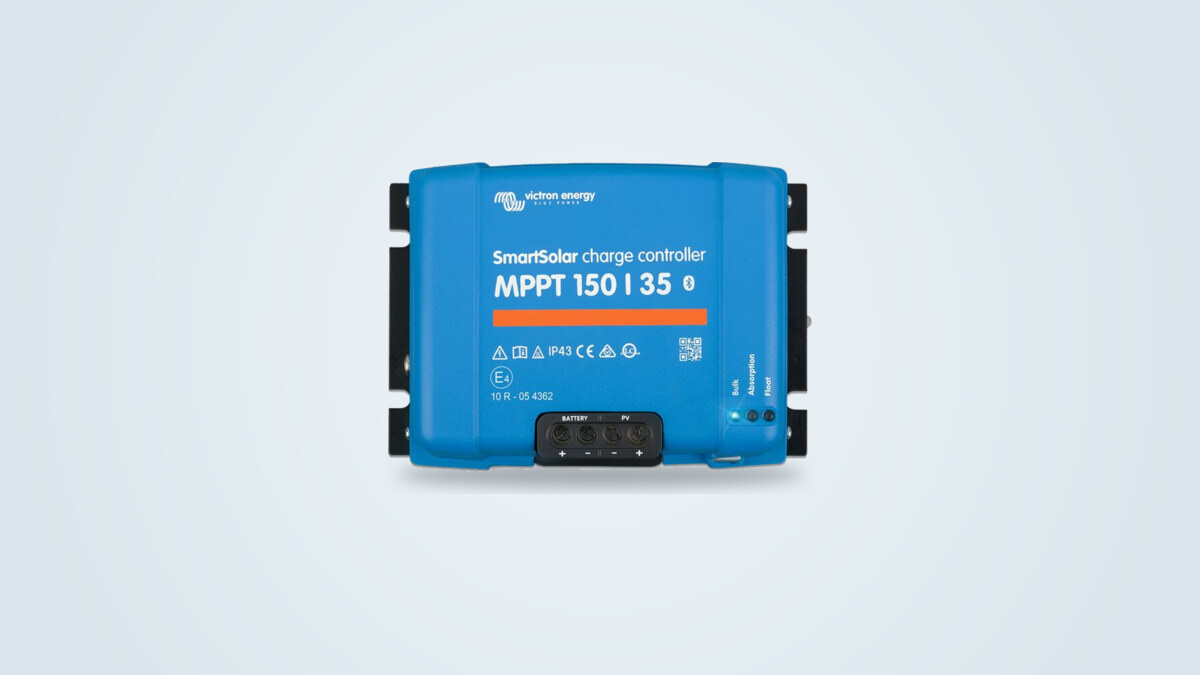
What the 150V ceiling changes: wiring panels in series
The SmartSolar 150/35 is the only controller in the Victron range in our catalogue rated for up to 150V of PV input, where the BlueSolar 75/15 tops out at 75V and the SmartSolar 100/20 at 100V. This higher voltage changes how an installation gets wired: it allows several panels to be mounted in series (a string) rather than in parallel. The current running through the cables is then lower for the same power, which cuts line losses over a long run between the panels and the controller, and allows a thinner cable gauge.
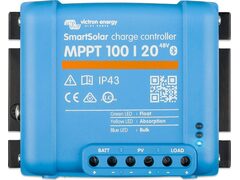
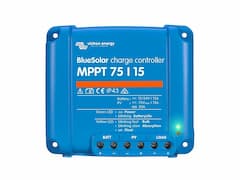
In practice, the controller handles up to 500W of panels on a 12V system, 1000W at 24V, 1500W at 36V and 2000W at 48V. That is a clear step up from the SmartSolar 100/20 (290W at 12V, 1160W at 48V) and well ahead of the BlueSolar 75/15, capped at 220W at 12V. This jump in power targets installations that outgrow a 100V controller: several panels spread across a van roof, a boat installation, or an off-grid site where the panels sit far from the battery bank.
MPPT efficiency and the partial-shading algorithm
The SmartSolar 150/35 shares its MPPT tracking algorithm with the rest of the Victron range, with a conversion efficiency that can reach 98%. Its technology continuously searches for the panels' maximum power point: the manufacturer states up to 30% more energy harvested than a plain PWM controller, and up to 10% more than a slower MPPT unit, with the gap widening especially under changing or partly cloudy skies.
A partial-shading tracking algorithm is built in: instead of locking onto the first power peak it encounters, a classic trap for generic MPPT units when part of the array is shaded, it scans the whole power curve to find the true maximum. That is a genuinely useful mechanism whenever an installation suffers recurring partial shade, a mast, a roof vent on a van, a boat's superstructure.
Battery compatibility and voltage ranges
The controller is compatible with lead-acid batteries (gel, AGM, flooded) and lithium LiFePO4, via 8 pre-programmed charge algorithms plus a fully customizable profile. It covers the widest system voltage range of the three Victron controllers in our catalogue: 12V, 24V and 48V auto-detected on first power-up, plus 36V available through software configuration, absent from both the SmartSolar 100/20 and the BlueSolar 75/15.
As with the rest of the range, the default lithium preset applies a 2h absorption time, longer than the actual need of a generic LFP battery, which reaches its absorption threshold faster: it is best shortened manually through the app. Automatic voltage detection also locks after the first installation, a point worth knowing before moving the unit to a system of a different voltage.
Built-in Bluetooth and monitoring through VictronConnect
Bluetooth comes built in as standard, just like on the SmartSolar 100/20: no dongle to add to reach the VictronConnect app. It shows output in real time, the voltage and current on both the panel and battery sides, and keeps a 30 day history viewable straight from a smartphone with no internet connection, the link being purely local over Bluetooth.
Several Victron controllers wired to the same battery can synchronize their charge stages with each other over Bluetooth, so that one controller does not stay in absorption while another has already switched to float. A wired VE.Direct port remains available for integration into a larger Victron system (Cerbo GX, remote monitoring through the VRM portal). There is no physical screen on the unit itself: without a smartphone nearby, only the status LEDs (Bulk, Absorption, Float) give a basic indication of what is happening.
The real point of caution: the voltage margin to respect
The SmartSolar 150/35 lists 150V as its maximum input voltage, but that ceiling is not actively protected by the unit: beyond that limit, the controller's electronics can be permanently damaged, with no cut-off mechanism that reliably shields it. This is a characteristic shared across the Victron MPPT range at this voltage class, but it becomes more practically relevant on the 150/35, precisely the model chosen to approach this limit with series wiring.
The technical point worth knowing before buying: the open-circuit voltage (Voc) of solar panels rises in cold weather, sometimes noticeably on a winter morning. A panel string sized right up against 150V at standard temperature can therefore exceed that limit during a cold snap. The recommended safety margin is to calculate the open-circuit voltage under the coldest realistic conditions at the installation site, and to keep a buffer below 150V rather than aiming right at that ceiling.
Protections and long-term reliability
The controller includes the standard protections found across the Victron range: reverse-polarity protection on both the PV input and the battery, overheating protection, and a block on the reverse current that would otherwise drain the battery back into the panels at night. Its idle consumption stays very low, under 35 mA at 12V and under 20 mA at 48V, a notable point for a unit that stays connected permanently, including when the panels produce nothing.
Its stated operating range runs from -22 °F (-30 °C) to 140 °F (60 °C), with full charging power guaranteed up to 104 °F (40 °C). The IP43-rated enclosure copes well with everyday use in an RV, boat or off-grid site, but still needs shelter from direct water spray. The Victron MPPT range benefits from an established reputation for reliability in the off-grid sector, backed by a 5 year manufacturer warranty and a long-standing presence in this market. No product recall was found for this model in the American and European safety databases consulted.
Against the BlueSolar 75/15 and SmartSolar 100/20 already in the catalogue
The SmartSolar 150/35 tops off the range of Victron controllers already in our catalogue. Its positioning is clear: it targets installations that outgrow a 100V controller, particularly once series wiring or the distance between panels and controller comes into play.
| Criterion | SmartSolar 150/35 | SmartSolar 100/20 | BlueSolar 75/15 |
|---|---|---|---|
| Max PV voltage | 150V | 100V | 75V |
| Charge current | 35A | 20A | 15A |
| Series-wired panels | Yes | No | No |
| Compatible systems | 12/24/36/48V | 12/24/48V | 12/24V |
| Built-in Bluetooth | Yes | Yes | No (optional dongle) |
| Weight | 2.8 lb (1.25 kg) | 1.4 lb (0.65 kg) | 1.3 lb (0.6 kg) |
Against the SmartSolar 100/20, the difference is not in MPPT tracking quality, identical across the range, but in input capacity and the ability to wire in series. Against the BlueSolar 75/15, add the built-in Bluetooth already found on the 100/20. For a small installation with one or two panels in parallel, the 100/20 or the 75/15 remain more than enough and cheaper; the 150/35 earns its keep once the installation outgrows that scale.
Price and availability
The price observed generally sits around $193.80, above the SmartSolar 100/20 (around $88.92), consistent with the jump in rating (35A versus 20A, 150V versus 100V) and the added 36V support. It is the most expensive of the three Victron controllers in our catalogue, well ahead of PWM units or entry-level Chinese MPPT controllers. No product recall was found for this model in the American and European safety databases consulted.
Who the 150/35 is for, and who should look elsewhere
The SmartSolar 150/35 suits an installation that outgrows a 100V controller: several panels to wire in series, a significant distance between the panels and the battery bank, or a system that needs to stay flexible between 12V, 24V, 36V and 48V. It is a sound choice for a van with several panels spread across the roof, a boat, or an off-grid site with a technical room set well away from the panels.
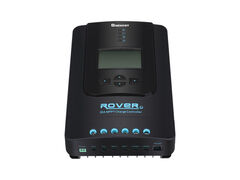
It is not worth it for a small installation with one or two panels close to the battery bank: the cheaper SmartSolar 100/20 already covers that need with the same built-in Bluetooth. A tight budget with no need for remote monitoring points instead to the BlueSolar 75/15 or a third-party controller with a screen, such as the Renogy Rover 20A already in the catalogue. A 12V or 24V installation drawing beyond 35A of charge current calls for the 150/45 in the same range, built for more current.