A compact DC-DC booster, on the market since 2018
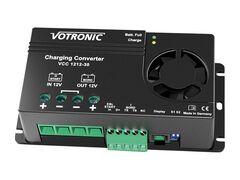
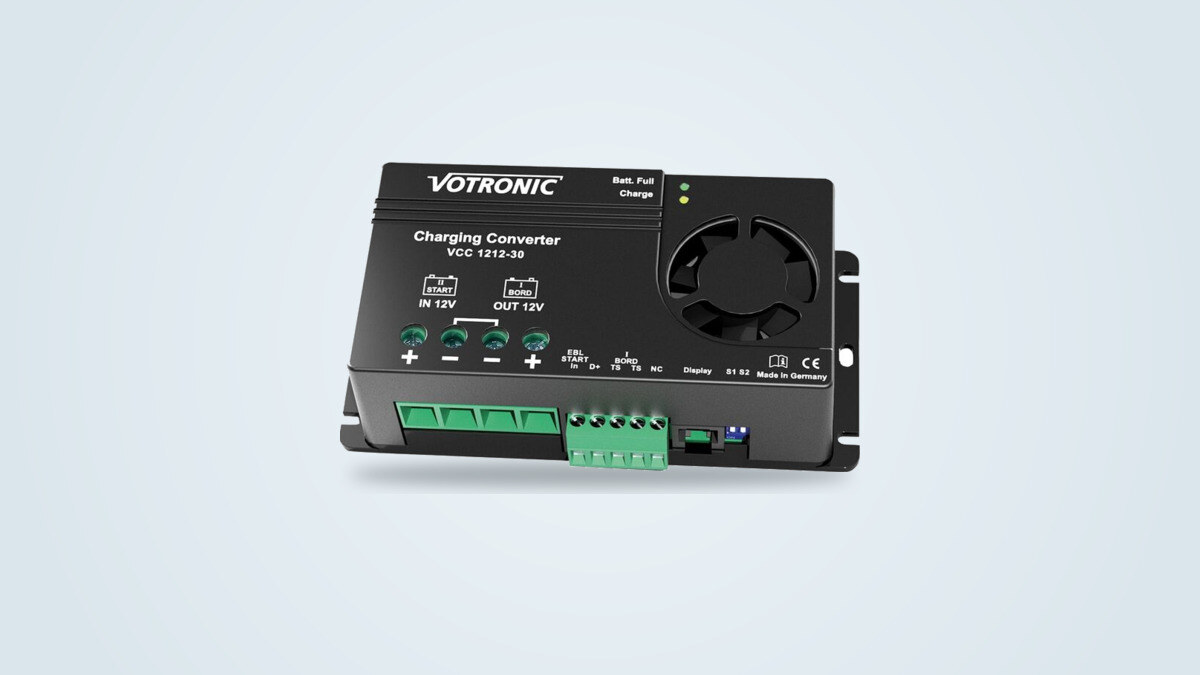
The VCC 1212-30 charges a house battery in a van, RV, or boat from the vehicle's alternator while driving. Not galvanically isolated, it runs in a fully automatic mode: once wired in, it turns on as soon as the engine is running and shuts off as soon as the starter battery's voltage drops, with no day-to-day intervention needed. The housing, manufactured in Lauterbach, Germany, has been sold since 2018 and remains one of the most compact alternator chargers on the market.
The unit draws its energy from the starter circuit (alternator and STARTER battery) and feeds it to the house battery (BORD) using an IU1oU2 charging curve, without ever directly tapping into the starter circuit itself: as far as the alternator is concerned, it simply behaves like a large additional load. A small trickle-charge branch (0 to 1A, active between 13.1V and 13.0V for a lead-acid battery, between 13.5V and 13.4V for a LiFePO4 battery) also keeps the starter battery topped off during an extended period of AC charging, a handy side feature for winter storage.
30A regulated as standard: the 'Power Limit' to 20A is only an option
The VCC 1212-30's spec sheet is often summed up as '20A limited, 30A max,' a phrasing that invites confusion. In its official technical documentation, Votronic states a charging current regulated from 0 to 30A as standard: the 20A figure is only a voluntary reduction, activated through the 'Power Limit' function, and only available if an optional remote (LED Remote Control S or LCD-Charge Control S-VCC) is connected. Without that accessory, the unit regulates its charge up to a full 30A, matching the Victron Orion-Tr Smart compared further down.
For a deeply discharged battery (below 8V), the unit first applies a reduced pre-charge current, up to 15A, before switching to full-power main charging. The whole cycle (pre-charge, main charge, absorption, then float) is fully automatic and continuously monitors voltage and elapsed time, with no fixed charging current for the user to set.
Four charging programs, from lead-acid to heated lithium
Two DIP switches on the side of the housing select one of the four stored charging programs, each with its own voltage curve. No app is involved in this choice: it's a physical setting, made once during installation.
| Program | Main voltage (U1) | Float voltage (U2) | Target chemistry |
|---|---|---|---|
| 1. Gel | 14.4 V | 13.8 V | Gel / flooded lead-acid with no other guidance |
| 2. AGM | 14.7 V | 13.6 V | Sealed AGM, check the voltage recommended by the battery maker |
| 3. LiFePO4 | 14.4 V | 13.8 V | Standard LiFePO4 lithium |
| 4. Heated LiFePO4 | 14.4 V | 13.8 V | Internally heated LiFePO4 lithium only |
A classic flooded lead-acid battery, with no contrary guidance from its maker, defaults to the Gel program. The recommended capacity range runs from 60 to 200Ah, up to 260Ah max, for a starter battery of at least 50Ah on the input side. The unit remains a 12V-to-12V model: no 24V variant exists in this lineup.
Each program also handles running in parallel with other charging sources already present on the same house battery (AC charger, solar panel), managed automatically with no extra setup thanks to a built-in bus filter.
The temperature sensor: included, but mandatory in LiFePO4 mode
A temperature sensor is supplied as standard and clips onto the house battery, an accessory that Renogy and Victron don't include by default on the models compared further down. On the lead-acid programs, it automatically adjusts the charging voltage to the battery's actual temperature: more voltage in cold weather for a fuller charge, less in hot weather to limit gassing. Above 122 °F (50 °C), the voltage drops to a safety value of 12.8V and the maximum current is cut in half until the battery cools down.
On both LiFePO4 programs, this sensor becomes mandatory: without it connected, the unit refuses to charge at all, and its two indicator lights flash alternately to signal the fault. Below 32 °F (0 °C), the standard LiFePO4 program limits the current to about 2A once voltage exceeds 12.0V, a precaution that protects ordinary lithium batteries; the program reserved for internally heated batteries, on the other hand, keeps full charging power available even below 32 °F (0 °C), with the heating element's own energy still available to onboard loads while it warms up. Outside the -4 °F to 122 °F (-20 °C to 50 °C) range, the safety voltage drops to 12.0V. On both LiFePO4 programs, the 'Charge' light briefly switches off every two seconds once the battery drops below 32 °F (0 °C), a simple visual cue that lets you spot this derated mode without any other instrument. Votronic explicitly recommends keeping a LiFePO4 battery above 32 °F (0 °C) to preserve its service life, a rule that applies to almost every lithium charger on the market, not just this one.
The point Votronic had to document itself: the internal fuse
The VCC 1212-30 was the subject of an official statement Votronic published in April 2024, a rare document for this type of product. In it, the manufacturer explicitly acknowledges that some units suffered a failure of the internal fuse on the input side, the component under the most strain when the unit runs at full power ('boost mode'). Two causes are identified: insufficient ventilation around the housing that keeps heat from escaping, and a poor connection to the starter battery (frequently on the ground side), which causes a higher-than-expected momentary current draw.
The manufacturer also states that the unit's current draw is capped at 39A, and that the standard 40A fuse tripping necessarily points to a prior, larger overload, which is why it recommends a check before putting the unit back into service. For a unit bought today, this point mostly comes down to the model's history; it remains, though, a concrete reminder that ventilation quality (the 10 cm of clearance around the housing called for in the manual) and the quality of the connection to the starter battery directly determine the reliability of a charger capable of pushing 30A continuously. Few manufacturers in this space publish the technical detail of a past fault on their own initiative rather than just offering quiet customer support.
Real protections, but not against reversed polarity
Aside from the fuse episode, the VCC 1212-30 includes a list of protections that are standard for this type of unit: a cutoff for input overvoltage beyond 16.5V, progressive thermal regulation and shutdown in case of overheating, short-circuit protection, and an automatic cutoff that keeps the starter battery from being drained if its voltage falls too low.
| Control mode | Charging increases | Charging reduces | Shutdown (30 seconds) |
|---|---|---|---|
| Controlled by D+ signal | > 11.70 V | < 11.40 V | < 11.20 V |
| Voltage-only control | > 13.30 V | < 13.00 V | < 12.90 V |
On one specific point, the official manual leaves no room for doubt: reversing polarity on the main terminals 'can cause serious damage to the unit.' Unlike the Renogy DCC50S, which explicitly claims reverse-polarity protection in its own spec sheet, the VCC 1212-30 has no such protection on its power input: a wiring mistake during installation isn't caught electronically. The CTEK D250SE shares this same lack of protection, also stated plainly by its own manufacturer.
Two indicator lights as standard, zero Bluetooth even as an option
As standard, the VCC 1212-30 shows its status through two LEDs on top of the housing: 'Charge' (yellow, lit during the main charging phase) and 'Batt. Full' (green, flashing then solid once the battery is full). No app, no Bluetooth, not even as a paid option, rounds out this information: unlike the LCD-Batterie-Computer 100S and 200S from the same brand, already reviewed on this site and which offer at least an optional Bluetooth module, the VCC 1212-30 offers no wireless bridge whatsoever.
Against the three competitors compared further down, this puts the VCC 1212-30 clearly behind: the Renogy DCC50S offers an optional Bluetooth module (BT-2), and the Victron Orion-Tr Smart natively integrates Bluetooth with the VictronConnect app. Only the CTEK D250SE shares a similar lack of screen and app, using a simple three-position selector cable as its only configuration.
Wiring, ventilation, and EBL/EVS compatibility
The official documentation specifies a minimum cable gauge depending on the length of the run between the batteries, a requirement for reaching full charging power.
Two automatic control modes exist: connected to the vehicle's D+ signal (recommended for any vehicle with a smart, variable-voltage alternator or an engine start-stop system, for an EBL or EVS control unit already fitted, or for long cable runs), or voltage-only control, reserved for vehicles with a conventional alternator and short, well-sized cables. An 'EBL START In' terminal also restores the starter battery's voltage display on an EBL or EVS control unit already fitted in the vehicle, a scenario the manufacturer documents precisely.
The unit also supports two more advanced setups: parallel charging of several house batteries of the same voltage, type, and capacity, and pairing two VCC 1212-30 units in parallel to double the total charging power available, provided both units are wired symmetrically, with cables of the same length and gauge. For two batteries in parallel, the manual recommends diagonal wiring (the incoming negative to one battery's positive terminal, the incoming positive to the other battery's negative terminal) so that both batteries in the bank get strictly identical voltage. On the mounting side, a minimum clearance of about 4 in (10 cm) around the ventilation grilles is required to reach full power without the unit throttling its own charge, a point directly tied to the reliability history covered above.
The most compact in its category, backed by a 60-month warranty
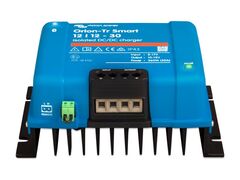
At 9.9 oz (280 g) and 5.35 x 2.87 x 1.57 in (136 x 73 x 40 mm), the VCC 1212-30 is by far the most compact and lightest of the four alternator chargers compared in this review, well ahead of the CTEK D250SE's 1.5 lb (700 g) or the Victron Orion-Tr Smart Isolated's 3.5 lb (1.6 kg). That compactness comes at the cost of galvanic isolation, a feature only the Victron offers among the four.
| Product | Weight | Manufacturer warranty |
|---|---|---|
| Votronic VCC 1212-30 | 9.9 oz (280 g) | 60 months |
| CTEK D250SE | ≈ 1.5 lb (700 g) | 24 months |
| Renogy DCC50S | ≈ 2.2 lb (1 kg) | Not stated |
| Victron Orion-Tr Smart Isolated | 3.5 lb (1.6 kg) | 60 months |
Votronic backs the unit with a 60-month manufacturer warranty from the date of delivery, a duration that matches Victron's and doubles CTEK's. The manufacturer handles customer support itself from its Lauterbach facility, and its 2024 statement on the internal fuse (previous section) explicitly states that a repair remains possible even when the warranty seal is no longer intact, a level of communication transparency rarely seen among the competitors compared here. The same housing also forms the basis for other models in Votronic's VCC 1212 lineup, which points to a design proven over several years rather than a product fresh off the drawing board.
Against the CTEK D250SE, the Renogy DCC50S, and the Victron Orion-Tr Smart
How does the Votronic VCC 1212-30 stack up against other alternator chargers already reviewed on this site?
| Criterion | Votronic VCC 1212-30 | CTEK D250SE | Renogy DCC50S | Victron Orion-Tr Smart Isolated |
|---|---|---|---|---|
| Charging current | 30 A | 20 A (derates to 13-16 A) | 50 A | 30 A |
| Galvanic isolation | No | Not stated | Not stated | Yes, 200 V |
| Built-in MPPT solar input | No | Yes (300 W max) | Yes (660 W max) | No |
| Temperature sensor included | Yes | No | No | No |
| Bluetooth / app | None, not even as an option | None | Optional (BT-2) | Native (VictronConnect) |
| Weight | 9.9 oz (280 g) | ≈ 1.5 lb (700 g) | ≈ 2.2 lb (1 kg) | 3.5 lb (1.6 kg) |
| Manufacturer warranty | 60 months | 24 months | Not stated | 60 months |
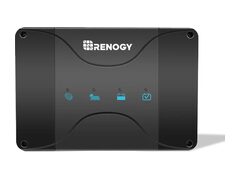
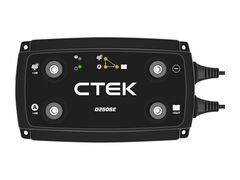
The Renogy DCC50S remains the most powerful of the group and the only one with at least optional Bluetooth, but its spec sheet stays quiet on several points (weight, IP rating, warranty). The Victron Orion-Tr Smart Isolated is the only one to offer full galvanic isolation and native Bluetooth, at the cost of a much heavier housing. The CTEK D250SE combines an alternator charger and solar in an intermediate format, making the same choice as here to skip any screen. The VCC 1212-30 stands out for its temperature sensor included as standard, its compactness, and a warranty on par with Victron's, but remains the only one of the four to offer no remote-monitoring option at all, and the only one whose manufacturer has publicly documented a fuse failure.
Who the Votronic VCC 1212-30 is for
This charger suits a simple setup, with no solar input to combine and no need for remote monitoring: a lead-acid, Gel, AGM, or LiFePO4 lithium house battery charged from the alternator, in a vehicle where the ground can be shared between the starter battery and the house battery. Its compactness also makes it a smart pick wherever space is tight for a bulkier unit.
For full galvanic isolation between the two circuits, the Victron Orion-Tr Smart Isolated remains the reference, with native Bluetooth thrown in. To combine an alternator and a solar panel in a single housing with a higher current, the Renogy DCC50S is better equipped. And for optional Bluetooth monitoring from the same Votronic brand, the LCD-Batterie-Computer 100S and 200S battery monitors usefully complement this charger, without replacing its charging function.