90W per USB-C port: a real figure, under two conditions
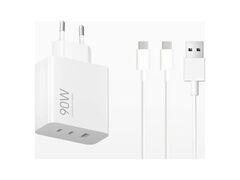
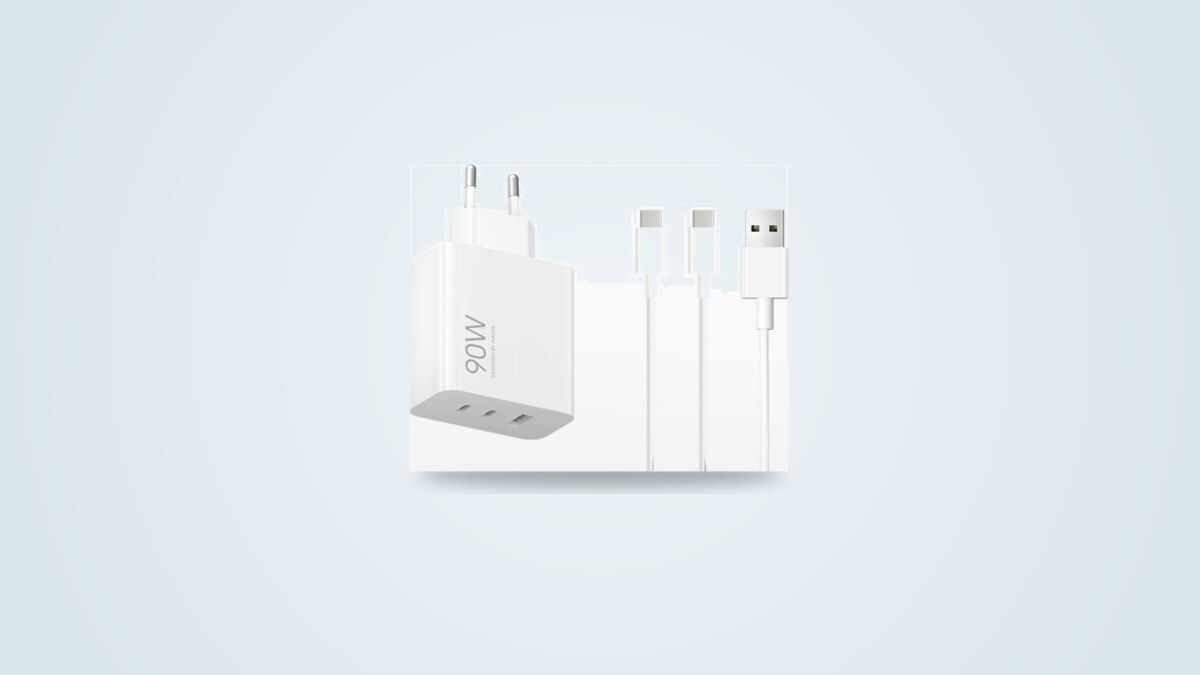
The Xiaomi 90W HyperCharge holds the figure that gives it its name: each of its two USB-C ports can deliver up to 90W when used on its own, on a 20V at 4.5A tier. That is a genuine technical maximum, not a rounded-up figure, but two conditions need to be met to reach it.
The first concerns the cable: this 90W tier relies on the PPS (Programmable Power Supply) protocol, which negotiates a variable voltage between 3.6V and 20V. Without a certified 6A cable, or with a device that does not support PPS, output falls back to the fixed-voltage tier of standard PD, capped at 20V and 3.25A, or 65W. The USB-C cable is not included in the box: a certified 6A cable, such as Xiaomi's official one, or an equivalent certified third-party cable, is needed to use the full power advertised on a single port.
The second condition depends on the device plugged in. A Xiaomi Pad 6S Pro tablet reaches a full charge in 57 minutes, with a peak close to 80W, a value consistent with the advertised tier given the battery's capacity. A Samsung Galaxy S22 Ultra, a device from another manufacturer, goes from 5% to 100% in 56 minutes for a maximum of around 38W: a result that mostly reflects that phone's own charging ceiling rather than a limit of the charger, and one that confirms genuine compatibility beyond Xiaomi's own ecosystem.
One point to watch: holding up under a fixed, continuous load
One technical gap is worth flagging before treating the 90W figure as a given in every circumstance. Under a fixed load close to the maximum rating and sustained continuously, output on the USB-C port can cut out after a few minutes rather than settling on a reduced plateau. That is a more abrupt behavior than the gradual step-down used by several rival GaN chargers of similar power, which reduce output in stages after around 30 minutes rather than cutting off outright.
This nuance does not appear on any spec sheet for the product, which only shows the peak figure. It is worth adding to the list of things to know before expecting sustained 90W in every circumstance.
67W then 15W: a fixed split table, not a live negotiation
As soon as a second or third device joins the outlet, available power follows a fixed table set by the manufacturer rather than a real-time reallocation based on what each device actually needs.
| Configuration | Split | Total |
|---|---|---|
| 1 port (USB-C alone) | 90W | 90W |
| 2 ports (USB-C + USB-C, or USB-C + USB-A) | 67W + 18W | 85W |
| 3 ports (all active) | 67W + 15W shared | 82W |
The cumulative total holds up well: 82W out of 90W with three devices plugged in, or 91% of the theoretical maximum retained. The more awkward point lies in the split itself: with all three ports active, the two secondary devices share just 15W between them, a tight allowance for, say, a smartphone and a smartwatch plugged in alongside a laptop on the main port. By comparison, other multiport chargers of similar power free up 24 to 40W for their secondary ports once the main port is maxed out.
The main USB-C port is therefore clearly prioritized, a logic that suits anyone whose laptop is the top charging priority, and suits less well anyone who genuinely wants to split charging evenly across three devices.
Proprietary protocol, PD/PPS and Quick Charge: broad compatibility
The charger brings together three families of fast-charging protocol: Xiaomi's proprietary protocol (reserved for Xiaomi, Redmi and POCO smartphones compatible with HyperCharge, which can then negotiate specific charging tiers), USB Power Delivery with PPS for variable voltage, and Quick Charge, older but still present across part of the Android install base. This combination covers a wide share of current USB-C devices, beyond the manufacturer's own ecosystem.
Charging a Samsung Galaxy S22 Ultra at a power consistent with that phone's own ceiling confirms this cross-brand compatibility: the charger correctly negotiates PPS with a device that has no connection to Xiaomi. The proprietary protocol, for its part, only brings a gain on Xiaomi devices that explicitly recognize it: on everything else, PD, PPS and QC remain the only levers available, which stays the norm for this category of product.
4.7 oz: the lightest footprint in its power category
At 4.7 oz (132 g) for 2.9 x 2.2 x 1.2 in (74.8 x 55.5 x 30 mm), the Xiaomi 90W HyperCharge is the lightest of the GaN multiport chargers of comparable power gathered here. GaN (gallium nitride) technology explains this compactness: it dissipates less heat than a conventional silicon-based charger, which allows for a smaller housing with no fan or bulky heatsink.
| Model | Xiaomi 90W HyperCharge | Anker 140W GaN | Anker Prime 160W | Belkin BoostCharge 67W |
|---|---|---|---|---|
| Power | 90W | 140W | 160W | 67W |
| Weight | 4.7 oz (132 g) | ≈ 10.4 oz (295 g) | 7.8 oz (220 g) | 5.5 oz (156 g) |
| Technology | GaN | GaN | GaN | Silicon |
The housing operates across a range of 14 °F (-10 °C) to 104 °F (+40 °C) per the manufacturer's spec sheet, a wide span that covers both winter use and a bag left somewhere warm. It also accepts any wall voltage worldwide (100 to 240V), an advantage for international travel with no separate voltage adapter.
UL94-V0 and four protections: a standard but solid base
The housing is built from UL94-V0 flame-retardant material, a precise Underwriters Laboratories fire-resistance standard rather than a vague marketing claim: it designates a self-extinguishing plastic that stops burning quickly once the heat source is removed. The manufacturer pairs this with intelligent temperature control and four electrical protections: against overvoltage, overheating, overcurrent and short circuit, a standard but complete list for this category of product.
The internal circuitry of a sibling model in the same range (the MDY-18-EU, a two-port version of the same Xiaomi GaN family) uses a Navitas control chip alongside established capacitor brands (Koshin, CapXon) and an assembly reinforced with a potting compound, solid construction for this price segment. This does not guarantee that the three-port unit shares the exact same board, but it fits a consistent level of engineering across this generation of the manufacturer's GaN chargers, identified by the manufacturer's product code MDY-19-EK.
No safety recall exists to date for this charger or for the brand's range of GaN wall chargers. A separate reservation is still worth mentioning for overall confidence in the manufacturer: a power bank model from the same brand (33W, 20,000mAh, with no technical link to this charger) was recalled over an overheating risk in 2025. The risk mechanism of an onboard lithium battery has nothing in common with that of a passive wall adapter like this one, but the episode remains a piece of context on the manufacturer's quality control.
Six months of manufacturer warranty, the shortest in this comparison
The manufacturer states a standard 6-month warranty for its chargers worldwide, notably shorter than the 18 to 24 months offered by several direct rivals on comparable products. Of every GaN multiport charger referenced here, this is the shortest commitment.
For anyone who wants coverage beyond that 6-month window, checking the terms of a credit card's purchase-protection benefit or a retailer's extended warranty is worth doing before treating this as a multi-year investment.
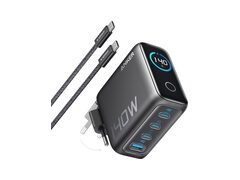
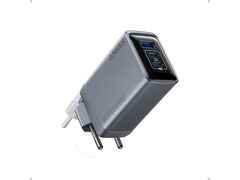
Against the Anker 140W GaN, the Prime 100W and the Belkin BoostCharge 67W
The Xiaomi 90W HyperCharge sits in an intermediate position against three multiport chargers already reviewed on this site.
| Criterion | Xiaomi 90W HyperCharge | Anker 140W GaN | Anker Prime 100W | Belkin BoostCharge 67W |
|---|---|---|---|---|
| Power (single port) | 90W | 140W | 100W | 67W |
| Ports | 2 USB-C + 1 USB-A | 4 ports | 2 USB-C + 1 USB-A | 3 USB-C |
| Secondary split published | Yes (67 + 15W at 3 ports) | Yes (65+45+12+12W at 4 ports) | Not published | Yes (25+20+20W at 3 ports) |
| Protocols | Proprietary, PD/PPS, QC | PD/PPS | PD/PPS | PD 3.1/3.0, PPS, SFC 2.0 |
| Manufacturer warranty | 6 months | 18 months | Not stated | 24 months |
The Xiaomi stands out for the broadest protocol support (proprietary protocol included) and a notably lower weight, but it shares with the Anker Prime 100W a less generous secondary split than the Anker 140W GaN or the Belkin, both of which free up more on their non-priority ports. On warranty length, only the Belkin clearly beats the sector norm; the Xiaomi sits at the opposite end, below all three direct rivals.
Who it suits, and who it suits less well
This charger particularly suits anyone wanting to centralize charging for one priority device, laptop or smartphone, on a light, compact brick to carry everywhere: 4.7 oz (132 g) for a potential 90W on one port is a rare combination in this power segment. Its broad protocol support (proprietary protocol, PD/PPS, QC) covers the vast majority of recent USB-C smartphones and laptops, beyond Xiaomi's own ecosystem.
It suits less well anyone who regularly charges three devices in parallel and expects a generous split across all of them: the 15W shared between the two secondary ports at full load remains this charger's most limiting point against rivals that free up more on their non-priority ports. Anyone specifically targeting a very demanding laptop under prolonged continuous charging, beyond an hour at full power, should also keep the reservation on sustained fixed-load output in mind before making this their sole desk charger.