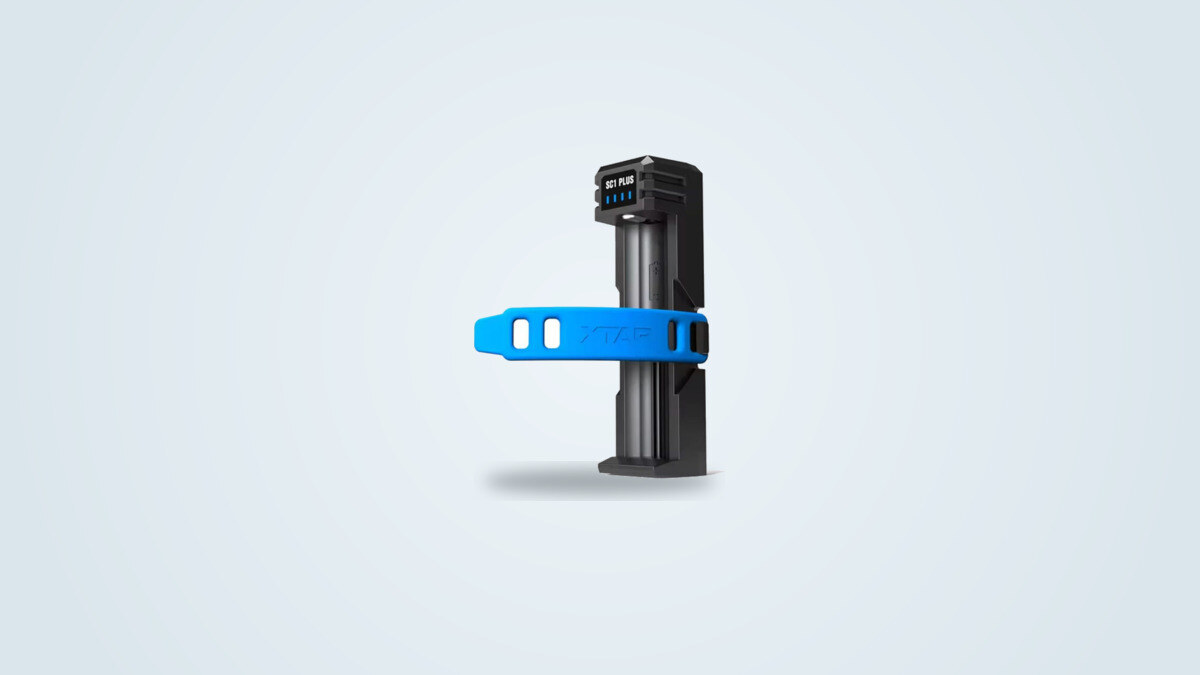
A single bay built for the largest formats, not for versatility
The Xtar SC1 Plus is a single-bay charger for cylindrical Li-ion cells and NiMH batteries that also acts as a backup power bank. It occupies a distinct spot in the Xtar lineup: where the VC2L, VC4SL or VC8 rely on several independent bays to charge a whole cell collection at once, the SC1 Plus puts everything into a single one, pushed to 3A and extended to the largest common cylindrical format, the 26800. It should not be confused with the original SC1 without the Plus: that model caps at 2A and has no power bank function, two additions that define this model entirely.
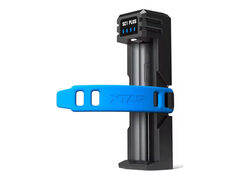
The fire-retardant plastic housing measures 4.9 x 1.5 x 1.3in (125 x 38 x 33mm) for 1.7oz (47g), with an adjustable silicone strap that holds the cell in place and makes it easier to carry. A single USB-C input powers the whole unit, and a single USB-A output lets you draw the energy stored in the inserted cell back out to a phone or any other device.
From 18650 to 26800, but nothing smaller
On the 3.6/3.7V Li-ion side, the manufacturer lists the 18650, 18700, 20700, 21700, 22650, 26650 and 26800 formats, protected or not. The bay adjusts its usable length from about 2.2 to 3.5in (57 to 90mm) to fit each size. On the 1.2V NiMH side, compatibility is limited to the D format, typically around 10,000mAh for common cells of that size, charged at 2A maximum: AA, AAA and C cells are not supported, unlike the VC2L, which covers exactly that range but stops at the 26650 on the Li-ion side.
The smallest supported format remains the 18650: a bay whose usable length starts at around 2.2in (57mm) cannot reliably contact smaller formats like the 10440 (about 1.7in / 44mm) or the 14500 (about 2.0in / 50mm). That is the direct flip side of its specialty: the SC1 Plus is built for large formats, not for the format versatility that defines the rest of the Xtar range.
Precise 3A charging, but no manual setting
The SC1 Plus runs a three-stage charge (low current, constant current, constant voltage), with a cutoff fixed at 4.2 plus or minus 0.05V for Li-ion and 1.45 plus or minus 0.1V for NiMH, and a cutoff current held under 150 to 160mA. The final voltage settles between 4.14V and 4.19V depending on the cell and the rest time before reading, a spread consistent with the stated tolerance.
The charging current, however, cannot be set manually: unlike the VC2L (0.5, 1 or 2A to choose from) or the VC4SL (0.25 to 3A in steps), the SC1 Plus automatically draws the maximum current its USB-C source can supply, up to 3A. To reach it, the manufacturer states that a QC or PD source above 15W is required: with a more modest source (5V/1.2A, 6W for example), the real current drops to around 1.2 to 1.5A, an automatic reduction rather than a fault, but one that leaves little room for a deliberate lower setting to go easy on a fragile cell.
Charging times, format by format
An 18650 rated at 3000mAh reaches a full charge at 3A in about 1h18, a 21700 rated at 4000mAh in 2h00, and a 26650 rated at 5000mAh in 2h24, a progression consistent with each format's growing capacity at equal current. On already-used 21700 and 18650 3000mAh cells charged at a slightly lower current (2.2 to 2.5A rather than a full 3A), the total time lands closer to 2h10 to 2h30, still within the same range given the lower current.
For D-size NiMH batteries, the current caps at 2A, with no reliable figure yet available for the total time of a full charge at that setting.
The power bank function: handy for backup, with limited real-world efficiency
The display is limited to an LED indicator showing the inserted cell's charge level, with no numeric readout of voltage, current or capacity: a simplicity that contrasts with the LCD screen on the VC2L, VC4SL or VC8, but one that suits the unit's main purpose. Its activation function follows the same principle already seen on the VC2L: a cell that has dropped below its minimum voltage receives a very low current for about ten minutes, and if the voltage rises, normal charging resumes; otherwise the cell is declared unusable.
The power bank function is what sets the SC1 Plus apart the most from every Xtar sibling compared here, none of which offer a USB output: insert a charged cell, plug a phone or headset into the USB-A output, and the stored energy flows out, up to a claimed 10W (5V/2A). Pass-through even lets you charge the cell while powering a device at the same time, though cell charging and USB output do not always run simultaneously in every case.
In practice, with a fully charged cell rated at close to 16.2Wh and a current draw close to 1.5A, the usable energy delivered over USB reaches about 11.8Wh, an efficiency close to 73%. Output voltage then sags to around 4.4V, below the nominal 5V. That sag explains a real everyday friction: some devices do not immediately recognize the output as a valid charging source and need the USB cable unplugged and replugged to start.
Full protections, real heat buildup on extended use
The SC1 Plus includes the usual protections for this type of device: reverse polarity, short circuit, overcurrent and overheat, with FCC certification and RoHS compliance. Standby draw, once the cell is removed, drops to a few dozen microamps, a very low figure for this price segment.
One point deserves an honest caveat: during extended use as a power bank, the housing gets noticeably warm, to the point that thermal throttling reduces output current on the heaviest power draws. That is consistent with the voltage sag already described in power bank mode, and it suggests keeping the unit for occasional backup rather than continuous use over long sessions.
The manufacturer's warranty follows Xtar's standard policy: a free replacement within 15 days of purchase, then free repair for 24 months, with parts charged beyond that.
Against its Xtar siblings and the Nitecore UMS4: single-bay speed versus multi-bay versatility
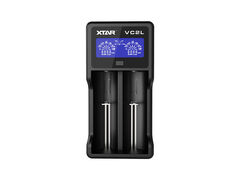
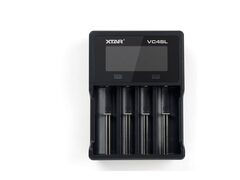
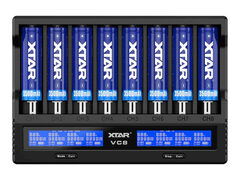
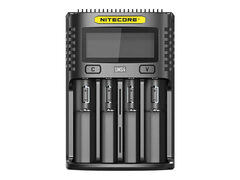
Against its Xtar siblings and the Nitecore UMS4, the SC1 Plus takes the opposite stance: where the VC2L, VC4SL, VC8 and UMS4 rely on several independent bays (from 2 to 8) to charge a whole cell collection at once, the SC1 Plus offers only one, but extended to the largest format in the comparison (26800) and paired with a power bank function none of the other four offer.
| Criterion | Xtar SC1 Plus | Xtar VC2L | Xtar VC4SL | Xtar VC8 | Nitecore UMS4 |
|---|---|---|---|---|---|
| Bays | 1 | 2 | 4 | 8 | 4 |
| Li-ion range | 18650 to 26800 | 10440 to 26650 | 10440 to 32650 | 10440 to 26650 | 10440 to 26650 |
| NiMH | D only | AAAA to C | AA/AAA | AA/AAA/C | AA/AAA |
| Max current (1 cell) | 3A | 2A | 3A | 3A | 3A |
| Current setting | No | Yes (3 steps) | Yes (0.25 to 3A) | Yes (5 steps) | Yes (3 modes) |
| Display | Plain LED | Tachometer-style LCD | LCD + internal resistance | LCD + internal resistance | LCD + cell health |
| Power bank function | Yes, 10W | No | No | No | No |
| Weight | 1.7oz (47g) | 4.2oz (120g) | 7.5oz (212g) | 12.3oz (350g) | 9.0oz (255g) |
| Street price | $10.90 | $16.90 | $29.90 | $37.99 | $38.95 |
This choice is a genuine niche strength rather than an arbitrary limitation for one specific use case: a single large cell to charge fast, or the occasional USB phone top-up. It becomes a real limitation as soon as the use case involves several cells at once, a collection to cycle through regularly, or the need to read internal resistance: on those points, the VC4SL, VC8 and UMS4 (4.3 to 4.4, with a full LCD screen and independent charging per bay) remain noticeably more versatile, and the VC2L (4.0) already offers two-bay redundancy for barely more size and price. The SC1 Plus mostly earns its place through what the others lack, the 26800 support and the power bank function, not through faster charging in absolute terms: its 3A simply matches what the other compared chargers deliver on a single occupied bay, never beating it.
The pocket companion for flashlights and emergency kits
The SC1 Plus's shape, 4.9 x 1.5 x 1.3in (125 x 38 x 33mm) for 1.7oz (47g), makes it a credible pocket companion for flashlight, e-cigarette or camera gear users who typically carry only one or two large spare cells. The adjustable silicone strap holds the cell in place during transport, a detail built for life on the move rather than a fixed charging station.
Its power bank function also makes it a relevant item for a first-aid kit or a hiking bag: with a dead phone and a charged large cell on hand, the SC1 Plus provides an occasional backup, with the efficiency and heat caveats already noted above. It does not replace a dedicated power bank for intensive or daily use, but it fills a specific emergency need.
Who the SC1 Plus is for
The SC1 Plus is aimed first at anyone who already owns one or more large cylindrical cells (18650 to 26800) for a flashlight, an e-cigarette or a camera, and wants a fast pocket charger that also doubles as an occasional USB backup. Its compact size, price and power bank function make it a clever accessory to slip into a bag, without replacing a proper bench charger.
It suits less well anyone managing a varied cell collection, small formats included, or wanting to charge several cells at once: the VC2L already covers dual charging and smaller formats for a similar price, and the VC4SL, VC8 or UMS4 make far more sense once bay count or internal-resistance readouts come into play. It also suits less well anyone planning to use it as a main, regular power bank: its power bank function remains a backup, not a credible replacement for a dedicated one.