A compact two-bay charger, built for travel use
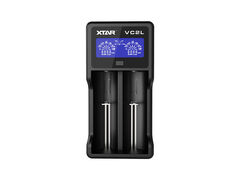
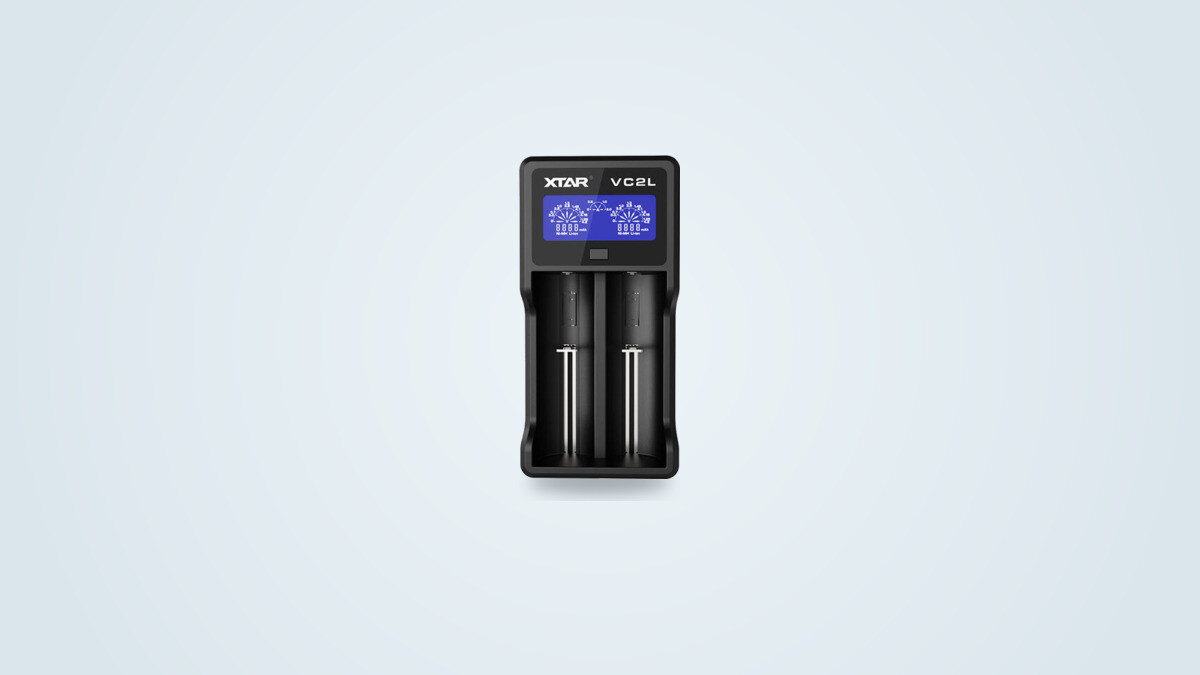
The Xtar VC2L is a smart charger with two independent bays, designed for Li-ion cells and NiMH/NiCd batteries. It stands out from the rest of the Xtar range through a deliberate choice: fewer bays than the VC4, VC4SL or VC8, but a noticeably more compact shape and a friendlier price. Its LCD screen borrows the look of a car tachometer rather than the plain digit block of conventional chargers: one dial shows the charging current, a second the cell's voltage, complemented by a charged capacity readout in mAh for each bay.
The manufacturer's official manual lists 23 supported battery and cell formats: in 3.6/3.7V Li-ion, from 10440 to 26650, including the ubiquitous 14500, 16340, 18650, 20700 and 21700 (protected cells included, slightly longer than a bare cell); in 1.2V NiMH/NiCd, from AAAA to C. The D format that some product listings advertise does not appear in any of the manual's ten language versions.
Very wide compatibility, with one exception
On the Li-ion side, the VC2L covers a wide range: 10440, 14500, 16340, 18350, 18650, 20700, 21700 up to 26650, seventeen references in total according to the official manual. On the NiMH/NiCd side, it accepts AAAA, AAA, AA, A, SC and C formats. Each bay works independently: you can charge an 18650 and an AA cell at the same time, each with its own profile, without one affecting the other, a real advantage over entry-level chargers that force matched pairs.
A notable difference with some product listings that also advertise the D format: Xtar's manual, identical across its ten language versions, stops at the C cell. A D cell measures roughly 1.3 in (34mm) in diameter, against 1.0 in (26mm) for a 26650, the widest officially accepted cell: it is unlikely to fit into the VC2L's bays without an adapter, which is not supplied.
An adjustable 0.5 to 2A current, with a precise cutoff
The VC2L runs a three-stage charge (TC-CC-CV): a low current at the very start of the cycle to identify the inserted cell's chemistry, then a constant current, then a constant-voltage phase at the very end of the charge. A single button selects the current: 2A, 1A or 0.5A in a cycle when one bay is occupied, 1A or 0.5A when both are. The cutoff triggers at 4.2 ± 0.05V for Li-ion, with a cutoff current of 150mA maximum, two thresholds set by the manufacturer with unusual precision for this price segment.
On a 21700 set to 2A, the USB input current drops to around 0.15A right at the end of the charge, against a peak close to 1.9A at the start of the cycle: the gap is explained by the voltage conversion (the current shown on screen corresponds to the cell-side current at 4.2V, while the input current flows on the USB side at 5V) and by the normal decrease in current during the constant-voltage phase, not by a precision flaw. An 18650 rated at 3000mAh charged at 1A on each of the two bays reaches a full charge in 3h18, while a 21700 rated at 4000mAh set to 2A on a single bay takes 2h47.
On the NiMH side, the minimum 0.5A setting is a high rate for the smallest formats like the 10440 (roughly 350mAh): over 1C, a full charge in under 45 minutes on paper, an oversized rate for such a small cell, for lack of a lower dedicated setting. A 750mAh AAA NiMH cell charged at 0.5A reaches a full charge in 2h15, a 2450mAh AA in 6h20.
The 0V activation function: a genuine second chance for cells
Many entry-level chargers simply refuse to recognize a cell that has dropped below its minimum voltage, wrongly treating it as dead. The VC2L applies an activation function specific to Xtar: a very low current, around 50mA, is applied for 10 minutes to a cell detected below 2.9V. If the voltage rises within that window, charging continues at a stronger rate (0.5 to 1A) up to roughly 90% of capacity, then finishes with an 80mA current up to the 4.2V cutoff threshold. If the voltage does not rise within 10 minutes, the cell is declared unusable and the screen shows the Err code.
One technical nuance is worth noting: for a Li-ion cell that has dropped below 2V, normal chemistry recognition becomes slower and needs more patience, a limitation the manufacturer's own manual points out. Above that threshold, activation works normally.
A tachometer-style screen, not a plain block of digits
The VC2L's LCD screen borrows the look of a car tachometer: a semi-circular dial shows the selected charging current (0 to 2A), a second dial the cell's voltage, complemented by a four-digit readout for the charged capacity in mAh and a Ni-MH or Li-ion label depending on the detected chemistry. It is an original presentation for this segment, where most competitors settle for plain aligned digits.
This originality has a trade-off: a virtual-needle dial reads a little less quickly at a glance than a direct numeric value, and the VC2L shows neither internal resistance nor a cell health indicator, two data points offered by the Xtar VC4SL and the Nitecore UMS4. A single button is enough to change the current setting; a long press turns the backlight off or back on.
USB-C everywhere, with two real everyday frictions
The VC2L runs exclusively on a USB-C port, with a maximum input of 5V/2.1A: it plugs into a phone charger, a computer, a power bank or a car outlet already owned by the user, with no dedicated wall adapter required. The manufacturer states that the charging current automatically drops if the supplied power is insufficient, rather than trying to force a current the source cannot provide.
Two real frictions show up in everyday use. The first: if a Li-ion cell is already sitting in a bay when a USB-C Power Delivery source is plugged in, the charger does not start charging automatically; the cell must be removed then reinserted to trigger recognition. The second concerns the 10440 format: its negative terminal, slightly recessed under the insulator, can make contact uncertain unless the cell is carefully pushed toward the top of the bay, while an AAA cell sits there without any difficulty.
A compact shape, a warranty worth reading in detail
The VC2L measures roughly 5.4 x 2.7 x 1.3 in (137 x 68 x 34mm) and weighs 4.2 oz (120 g) on the scale, one of the most compact and lightest formats in the entire Xtar range, far from the roughly 7.4 oz (210 g) of the VC4 or the 12.3 oz (350 g) of the VC8. The fire-retardant plastic housing rests on spring-loaded metal contact arms, a classic and proven construction for this type of device. Its operating range spans 32 °F to 104 °F (0 to 40 °C).
The warranty deserves to be read in detail rather than summed up in a single figure. The official manual, identical across its ten language versions, describes three tiers: a free replacement within 15 days of purchase, free repair for 12 months, then lifetime technical support beyond that, with replacement parts charged from then on. This is a real, clearly written commitment from the manufacturer, but a more limited one than the round warranty figure usually advertised elsewhere for this type of product.
Facing its Xtar siblings and Nitecore, a deliberate trade-off
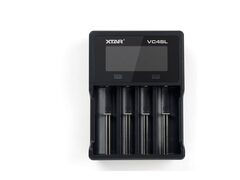
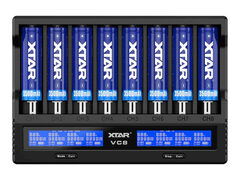
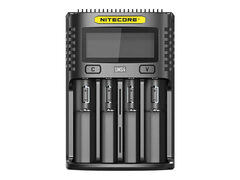
The Xtar VC2L shares most of its technical base with the rest of the VC range, but clearly positions itself at the entry level: fewer bays, fewer diagnostic functions, but also cheaper and noticeably more compact. The table below compares it with three direct alternatives: the Xtar VC4SL (internal resistance, up to 32650), the Xtar VC8 (eight bays for a large cell collection) and the Nitecore UMS4 (the only one in this selection to handle LiFePO4).
| Criterion | Xtar VC2L | Xtar VC4SL | Xtar VC8 | Nitecore UMS4 |
|---|---|---|---|---|
| Bays | 2 | 4 | 8 | 4 |
| Li-ion range | 10440 to 26650 | 10440 to 32650 | 10440 to 26650 | 10440 to 26650 |
| Chemistries | Li-ion, NiMH, NiCd | Li-ion, NiMH, NiCd | Li-ion, NiMH, NiCd | Li-ion, LiFePO4, NiMH, NiCd |
| Max current (1 cell) | 2A | 3A | 3A | 3A |
| Internal resistance | No | Yes | Yes | Yes |
| Power input | USB-C 5V/2.1A | USB-C QC3.0 | USB-C QC3.0 | USB-C (QC needed for full speed) |
| Street price | $16.90 | $29.90 | $37.99 | $38.95 |
On raw compatibility, the VC2L has nothing to be ashamed of: it covers the same Li-ion range as the VC8, and its most concrete gap, the missing D format despite some commercial claims, rarely comes up in everyday flashlight or camera-battery use. Where it gives ground is on advanced diagnostics (no internal resistance, unlike the VC4SL and the UMS4) and on simultaneous volume, with half as many bays as the VC4SL or the UMS4, and a quarter as many as the VC8. In return, it stays the cheapest of this selection and, by far, the most compact.
Who the VC2L is for
The VC2L is aimed first at anyone looking for a travel or backup charger to slip into a bag or a dopp kit: an occasional user of flashlights, camera batteries or household devices, who rarely charges more than two cells at once and values the compactness and entry-level pricing of the Xtar range. Its 0V activation function also makes it a good pick for giving a second chance to cells forgotten at the bottom of a drawer.
It suits less well anyone managing a large cell collection regularly, a use case where the VC4SL or the VC8 better justify their internal resistance diagnostics and higher bay count. It also suits less well anyone who specifically needs the D format or LiFePO4 chemistry, both absent from the VC2L: the Nitecore UMS4 remains the reference there, at a noticeably higher price.