What the 20,000mAh (74Wh) really mean
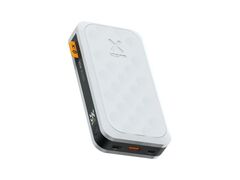
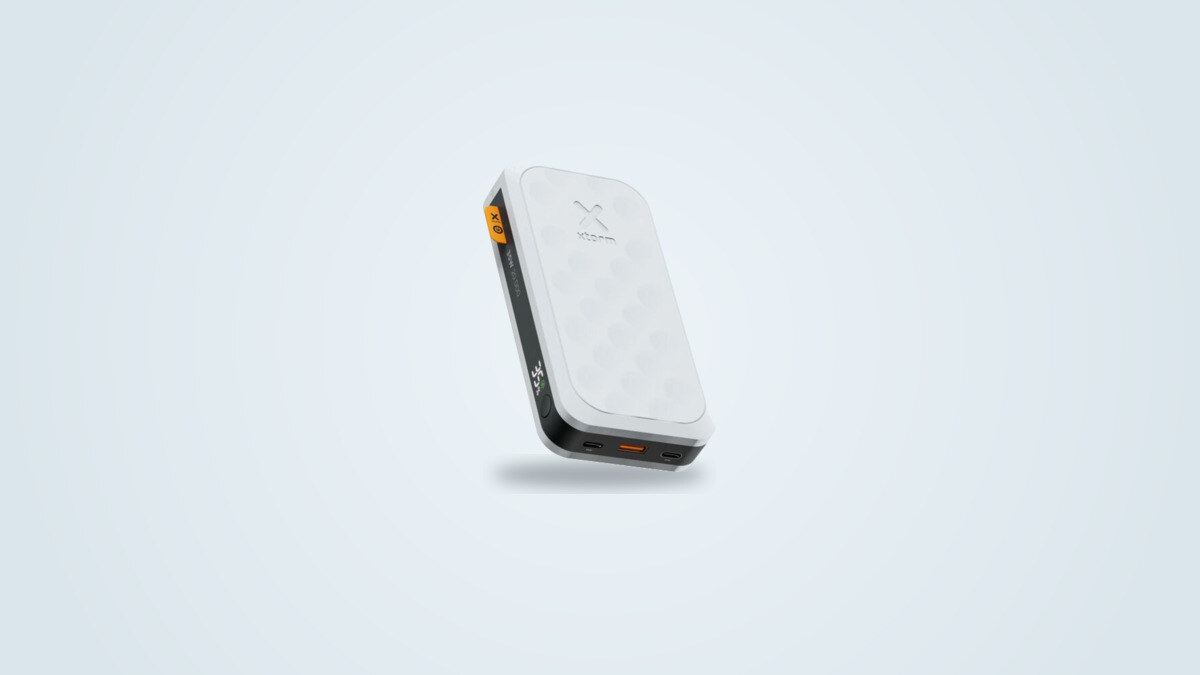
The spec sheet and the packaging both carry two figures for the Xtorm FS5200: 20,000mAh, and 74Wh. The first is the total charge of the lithium-polymer (LiPo) cells that make up the pack, counted at a voltage close to 3.7V. The second is the energy that charge represents, the figure that lets you compare two batteries running at different voltages. Xtorm states both values directly in its official manual, which avoids the most common mix-up on this kind of product: converting a milliamp-hour figure into watt-hours without ever stating the voltage used.
That 74Wh figure, though, isn't what the FS5200 actually delivers once conversion losses are accounted for. Real capacity, obtained by discharging the pack at a constant current, sits between 64 and 70Wh depending on the load, or 86 to 94% of the nominal rating. That's a healthy figure for this kind of cell: neither exceptional nor a red flag, toward the high end of what a compact LiPo pack typically manages once its conversion electronics are factored in.
Overall efficiency for a full cycle, from the wall outlet to the connected device, sits between 72 and 82% depending on the port used: a fairly typical range for a compact power bank of this size, not to be confused with the delivered-capacity figure above, which covers the pack's discharge alone. No detail on the cell brand itself is available: Xtorm's own manual refers to cells of premium quality, a marketing phrase rather than a verifiable technical reference.
At 74Wh nominal either way, the FS5200 stays well under the 100Wh threshold usually allowed without paperwork in airline cabin baggage. Unlike higher-capacity batteries that fall into the intermediate bracket requiring prior approval, the FS5200 never raises that question at the gate.
35W alone, 15W the moment a second port joins in
The FS5200's box shows 35W in bold, and the figure holds up: a single USB-C port genuinely delivers up to 35W, a claim confirmed at 34.83W when used on its own. The catch lies in a condition the manufacturer's manual spells out in black and white but the marketing copy never highlights: that output only applies to one port used at a time.
The manual publishes a power-sharing table for all three outputs (two USB-C ports and one USB-A port). The moment a second port comes into play, whichever combination is involved, every active port drops to 15W. The same rule applies when all three outputs run together: each then settles for 15W. In other words, the advertised 35W only ever applies to a single connected device; the moment a second or third one joins in, none of the ports keeps its maximum output.
15W per port remains enough for most smartphones, which often cap their own charging rate around that value anyway, but it becomes limiting for a tablet or any device that would accept more if the port allowed it. None of the three ports is flagged as a priority port in the manual: unlike rivals that reserve a main port at full power and only restrict the secondary ones, the FS5200 applies the same 15W ceiling to every port once more than one is in use, including the one used first.
Recharging the FS5200: 3h30 quoted, 3h15 in practice
The FS5200 accepts input through a USB-C Power Delivery port, up to 35W. Xtorm quotes a full recharge in 3 hours 30 minutes (210 minutes) in this setup. In practice, a full charge takes less time, around 3 hours 15 minutes (195 minutes), a welcome margin that puts the FS5200 on the right side of a commercial promise that, for once, is more cautious than reality.
The input port supports the PPS (Programmable Power Supply) protocol across two ranges, 3.3 to 11V at up to 3A and 3.3 to 18V at up to 2.3A, a detail that matters for recent phones whose adaptive charging relies on this standard rather than the fixed steps of classic PD. Pass-through charging, which lets a connected device keep drawing power while the FS5200 itself recharges, is supported by the manufacturer.
Set against its capacity, an input capped at 35W places the FS5200 among the batteries that refill at a moderate rather than fast pace: direct rivals of the same capacity accept noticeably higher input power and therefore recharge faster in absolute terms, usually at the cost of a heavier shell (see further down this review). For travel or office use, where the battery most often spends the night on a plug, this pace remains more than enough.
The USB-A port: 18W or 22.5W depending on the phone
The FS5200's third port, a USB-A, rounds out the two USB-C outputs. Its power depends on the phone plugged in: 18W with the widespread Quick Charge 3.0 protocol, and up to 22.5W with the SCP (Super Charge Protocol) standard used by some Samsung phones. Most commercial spec sheets for the product only quote the 18W figure, more representative of everyday use, a fair simplification since the 22.5W peak only applies to part of the compatible phone base.
This third output follows the same sharing rule as the two USB-C ports: on its own against the other two, it gets its full power; the moment a second port is active, it also drops into the 15W range described above. It still earns its keep for topping up a third device, a smartwatch or wireless earbuds for instance, neither of which ever needs much power anyway.
14.1oz (400g) advertised, about 13.4oz (381g) in practice
14.1oz (400g) on the spec sheet, in a 5.6 x 3.0 x 1.1in (143 x 77 x 28mm) shell: that's the FS5200's central selling point, and the real-world figures confirm it. Real-world units come in a touch under the advertised figure, around 13.4 to 13.5oz (381 to 382g), and the real width sits closer to 2.85 to 2.86in (72.5 to 72.7mm) rather than the quoted 3.0in (77mm), the unit turning out both lighter and slightly slimmer than its own spec sheet suggests.
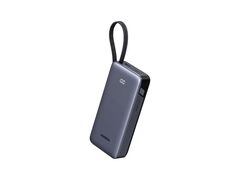
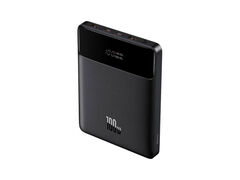
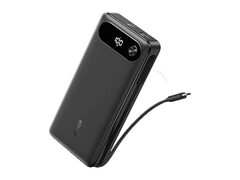
Against three power banks of the same nominal capacity (20,000mAh), the FS5200 is the lightest of the comparison, even counting only its advertised weight. The gap widens further once real-world weight is factored in: more than 1.7oz (49g) separates it from the Anker Power Bank 20000, more than 3.0oz (86g) from the Ugreen Nexode 45W, and more than 4.4oz (124g) from the Baseus Blade 100W. This result comes down mainly to what the FS5200 doesn't have: no built-in cable, no output above 35W, two things that usually add weight to a power bank without necessarily adding stored energy.
This format also explains the choice of a simple LED display rather than a detailed LCD one: fewer components, a slimmer shell. The trade-off shows up in display detail, covered in a later section of this review.
GRS and FSC certified recycled plastic: beyond the marketing line
The FS5200's shell is made largely from recycled plastic (ABS and polycarbonate), certified GRS (Global Recycled Standard), a standard that verifies traceability and the real proportion of recycled material throughout the production chain, beyond a simple marketing claim. The product also carries FSC (Forest Stewardship Council) certification, a standard usually associated with paper and cardboard, which suggests the commitment extends to the product's packaging rather than the shell alone.
At this price point, that commitment remains rare: none of the three direct rivals compared later in this review (Ugreen Nexode 45W, Baseus Blade 100W, Anker Power Bank 20000) claims an equivalent certification on its shell materials. It's a genuine selling point, even if it isn't measured in watts or watt-hours: for a buyer who cares where materials come from, it's a criterion in its own right.
The FS5200 comes in two colors, Dusk White and Midnight Black, the latter sold under the FS5201 code: the two products share identical specifications, only the shell color changes. Both finishes are matte.
LED display, buttons and pass-through in everyday use
The FS5200's LED display shows the remaining charge percentage with a single press of the power button. A long press turns the battery fully on or off. That's a more limited level of detail than the full LCD displays on several rivals, which also show the instantaneous power on each port or the time remaining until charging finishes: the FS5200 sticks to an overall percentage, with no per-port breakdown.
The FS5200 includes stated protection against overcharging, short circuits and overheating. These are manufacturer claims, with no independent measurement available to verify them precisely, but no recurring fault or recall specific to this model is identifiable at this point. No wireless charging, no built-in light: the FS5200 focuses on wired charging alone, without the extra features found on some rivals or on other, more outdoor-focused Xtorm ranges.
Against three direct rivals
Typically priced between $40 and $110 depending on the retailer and the time of year, the FS5200 goes up against several sought-after 20,000mAh power banks. Here is how it stacks up against three picks from the catalogue, on the criteria that actually matter when buying.
| Criterion | Xtorm FS5200 | Ugreen Nexode 45W | Baseus Blade 100W | Anker Power Bank 20000 |
|---|---|---|---|---|
| Capacity | 20,000mAh (74Wh) | 20,000mAh | 20,000mAh | 20,000mAh |
| Maximum power (1 port) | 35W | 45W | 100W | 87W (combined) |
| Display | LED (percentage) | LED (percentage) | LCD (detailed) | LCD (detailed) |
| Materials | GRS + FSC recycled plastic | Standard | Standard | Standard |
| Advertised weight | 14.1 oz (400 g) | 1.0 lb (468 g) | 1.1 lb (506 g) | 15.2 oz (431 g) |
| Typical street price | ≈ $77 | ≈ $41 | ≈ $106 | ≈ $54 |
The table sums up the FS5200's position fairly well: it isn't the most powerful on any criterion against these three rivals, but it's the lightest of the four and the only one to claim certified recycled materials. The Baseus Blade 100W targets a different job, charging a laptop, where the FS5200 sticks to small devices. The Ugreen Nexode 45W remains the most affordable option with slightly higher power per port. Against the Anker Power Bank 20000, more powerful in combined output, the FS5200 wins clearly on weight and materials, but not on throughput with multiple devices plugged in.
Brand, build and warranty
Xtorm is a Dutch brand published by Telco Accessories Group, based in Houten in the Netherlands; design is Dutch, manufacturing is Chinese, an arrangement common across most of the consumer-electronics accessory sector. The brand presents itself as Europe's leading charging-accessory maker, with several awards received for business growth and product quality.
The FS5200's standard warranty runs 2 years. Xtorm offers to extend it to 3 years (2 years plus 1) through free product registration within three months of purchase, a policy applied across the brand's whole catalogue rather than specific to this model. The manufacturer states it uses premium quality cells and includes automatic fast-charge management.
The brand's after-sales support draws broadly positive feedback, alongside recurring complaints about turnaround times and about the documentation (photos or video) required before a replacement in case of a fault. No recurring fault or recall specific to the FS5200 is identifiable at this point, but the product remains, compared with the best-selling picks in this comparison, still fairly little-discussed, which limits how statistically meaningful any available customer feedback is.
Real-world uses: travel, office, backup
The FS5200's positioning is clearly geared toward travel and office use, not the outdoors. Three concrete situations show where its mix of light weight, capacity and understated design earns its keep.
On a business trip or vacation, its 74Wh recharges a modern smartphone roughly four times depending on its own battery size, comfortably enough for several days away from an outlet, and its real 13.4 to 13.5oz (381 to 382g) weight slips into a bag pocket without drawing attention. Well under the 100Wh threshold, it never raises a question at security, unlike higher-capacity batteries that fall into a bracket requiring prior approval.
At the office or in a meeting, being able to plug in up to three devices avoids the usual wait for an outlet, provided each device then settles for 15W rather than full power: enough for a phone or a smartwatch, tighter for a power-hungry tablet. For charging a laptop, though, the FS5200's 35W falls short from the outset of what that kind of device typically needs.
As an emergency backup at home, finally, its capacity is enough to keep a phone and a small connected accessory running through a short power outage, though its more modest capacity compared with the catalogue's larger emergency batteries limits this use to a top-up rather than an extended backup solution.
Who it's for, and who should look elsewhere
The FS5200 suits anyone after a light, compact power bank for travel or office use, who mainly charges one phone or tablet at a time, and who cares about where the shell materials come from. Its real 13.4 to 13.5oz (381 to 382g) weight, its GRS certification and its healthy delivered capacity (64 to 70Wh out of a 74Wh nominal rating) make it a coherent choice for that specific use.
It suits less well anyone who regularly charges several demanding devices at once: the drop to 15W per port the moment a second one is active works directly against that use case. It also suits less well anyone wanting to charge a laptop, even occasionally: the FS5200's 35W maximum, already shared from the second port onward, falls short from the outset of what that kind of device typically needs. Finally, anyone after a detailed display (per-port wattage, time remaining) or wireless charging won't find either here: the FS5200 chooses simplicity and light weight over a richer feature set.