Zendure 420W Flexible Panels: our full review

At about 9.5 lbs per panel and bending up to 220°, this pair of flexible panels solves a real balcony-solar problem: mounting on a round railing or an uneven surface, something its rigid bifacial sibling from the same brand, heavier and with no stated warranty, simply can't do.

Our rating
3.8/5
Efficiency: 3.7 out of 5 (weighting 25%)Efficiency3.7Portability and size: 4.0 out of 5 (weighting 25%)Portability4.0Weather resistance: 3.6 out of 5 (weighting 20%)Weatherproofing3.6Output ports: 3.8 out of 5 (weighting 20%)Output3.8Build and endurance: 3.9 out of 5 (weighting 10%)Build3.9

How is this rating calculated?

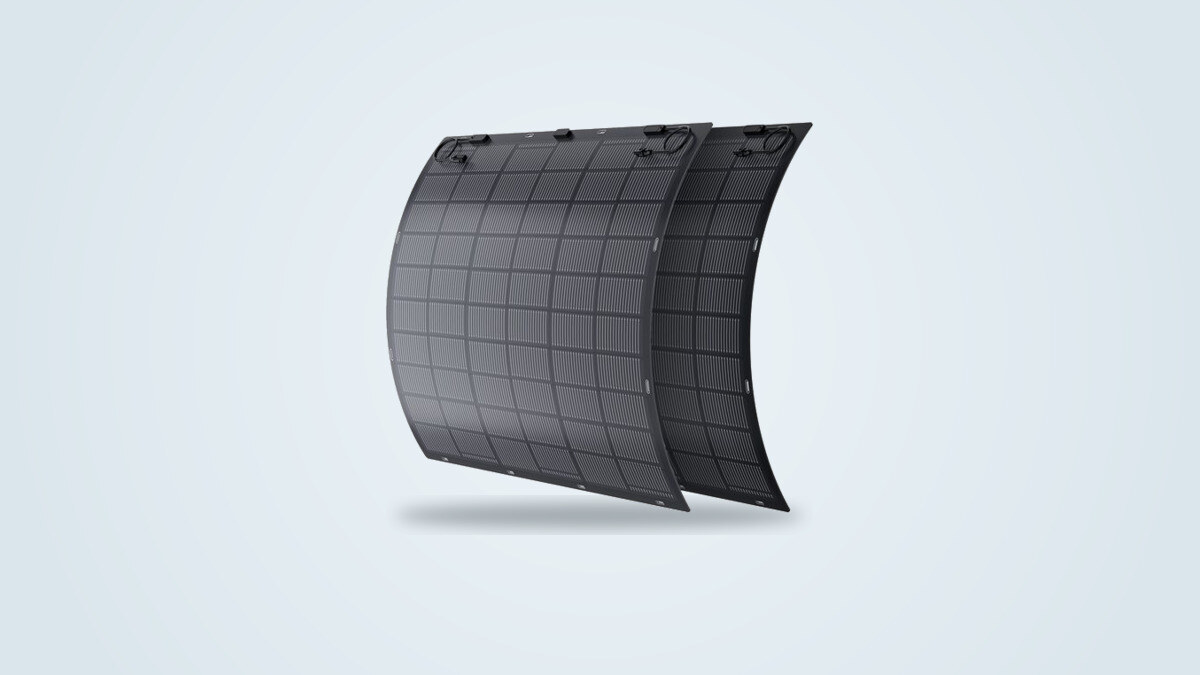
Zendure 420W flexible solar panel slightly bent, monocrystalline cells and ETFE surface visible

The essentials

This pair of flexible 210W panels solves a real problem rigid panels can't: mounting on a round railing, a curved roof, or any surface that isn't perfectly flat. At about 9.5 lbs per panel, installation is a one-person job with no heavy drilling. The claimed 23% efficiency is solid for a flexible panel, IP68 protects effectively against water, and crucially, the 12-year warranty is clearly stated, unlike the same brand's rigid 500W bifacial panels, which state no length at all. The trade-off is physical and known across the whole flexible category: these panels run hotter than a well-ventilated rigid one, which shaves off some output at the height of summer, and they stay more sensitive to repeated bending over time. For dressing a curved surface with no option for rigid mounting, this pair remains one of the most complete choices in the catalogue.

Strengths

  • Claimed flexibility up to 220°, allowing installation on a round railing, a curved roof, or a hull, where a rigid panel simply doesn't fit
  • Just about 9.5 lbs per panel, roughly 70 to 80% lighter than an equivalent-output rigid panel: a job one person can handle alone
  • 12-year warranty clearly stated on the listing, unlike the same brand's rigid 500W bifacial panels
  • Claimed cell efficiency of up to 23%, a good figure for flexible technology
  • IP68 junction box and MC4 connectors compatible with Zendure's SolarFlow ecosystem and most third-party microinverters
  • Built-in bypass technology that limits losses under partial shading

Limitations

  • Like any flexible panel, it runs hotter than a well-ventilated rigid panel on a frame, which slightly reduces output at the height of summer
  • More sensitive to repeated bending over time than a rigid panel, worth watching for a setup that's frequently taken down and reinstalled
  • No independent measurement of the claimed 23% real-world efficiency exists to date
  • No specific certified wind or snow load rating stated, unlike the same brand's rigid 500W bifacial panels
  • Observed US pricing runs over $418, notably higher than the roughly $335 equivalent seen on eurozone listings, worth checking before buying
Zendure 420W Flexible Solar Panels: see the full details and price →

Two flexible 210W panels, for surfaces that aren't flat

This Zendure product bundles two flexible solar panels at 210W each, 420W total. Their central advantage comes down to one word: flexibility. Each module bends up to 220°, allowing installation on a curved balcony railing, an RV roof, a boat hull, or a domed shelter, where a rigid panel simply wouldn't fit.

2 x 210 W
Combined rated output
220 °
Claimed flexibility
9.5 lb
Weight per panel

The cells are monocrystalline, with a laminated ETFE surface known for good light transmission and durability. Each module delivers about 41V at 5A at its optimal operating point, and connects via standard MC4 connectors.

23% efficiency: a good score for flexible technology

Zendure claims cell efficiency of up to 23%, a very good figure for flexible technology, which generally trails dual-glass rigid panels due to different manufacturing constraints. A built-in bypass technology limits output losses when part of the panel falls into shade, a useful feature on a balcony install that's often partially shaded over the course of the day.

Worth knowing: like any flexible panel, this one runs hotter than a rigid panel mounted on a ventilated frame, lacking an air gap behind it. That temperature difference slightly reduces efficiency at the height of summer, a phenomenon known across the whole flexible category, not a flaw specific to this model.

No independent measurement of this claimed 23% efficiency exists for this model to date: it's a manufacturer figure, consistent with market standards for premium flexible panels.

9.5 lbs per panel: a job one person can handle

This is the central practical argument for this product. At about 9.5 lbs per panel, roughly 70 to 80% lighter than an equivalent-output rigid panel, handling and mounting take no particular effort, often achievable solo with no heavy drilling.

Zendure 420W flexible against the Zendure 500W bifacial (same brand)
Criterion420W flexible (this product)500W bifacial
TypeFlexible, bends to 220°Rigid, dual-glass
Weight per panel~9.5 lb~60 lb
Solo installationYesNo (~120 lb for the pair)
Stated warranty12 yearsNot stated

The flip side of this lightness: flexible panels stay more sensitive to repeated bending over time than rigid ones. For a setup mounted once and left in place, that's a non-issue; for one regularly taken down and reinstalled, it's worth keeping an eye on.

IP68 and MC4, but no specific wind/snow certification

The junction box carries an IP68 rating, the best common protection against water and dust, suited to permanent outdoor installation. MC4 connectors ensure direct compatibility with Zendure's SolarFlow ecosystem (Hub 2000, Hyper 2000, SolarFlow 800) and the vast majority of third-party setups on the market.

Unlike the same brand's rigid 500W bifacial panels, this product states no specific certified wind or snow load rating. That isn't necessarily a sign of fragility, but it's a less precise figure to weigh before buying, particularly for an installation at altitude or in a very exposed location.

On pricing, observed US pricing sits around $418, notably higher than the roughly $335 equivalent seen on eurozone listings for the same product, a gap worth checking before buying.

Who this flexible pair is for

This pair of flexible panels suits, first and foremost, anyone dealing with a surface that isn't flat: a curved balcony railing, an RV or boat roof, a domed shelter, where a rigid panel simply can't be mounted. The light weight (about 9.5 lbs) also makes it a sensible choice for anyone installing solo, with no help or heavy tools.

For a flat surface with good ground reflection, the same brand's rigid 500W bifacial panels produce more (up to 1300W against 420W), at the cost of much greater weight and installation demands. For anyone who values a clearly stated warranty before buying, this flexible panel has the clear edge with its stated 12 years.
The rating in detail

Our rating
3.8/5
Efficiency 3.7
Portability and size 4.0
Weather resistance 3.6
Output ports 3.8
Capacity and expansion not measured
Solar input and MPPT not measured
Control and smart features not measured
Installation and compliance not measured
Build and endurance 3.9
Battery compatibility not measured
Safety and protections not measured
Zendure 420W Flexible Solar Panels: see the full details and price →

The product and its alternatives

Zendure 420W Flexible Solar Panels

Zendure 420W Flexible Solar Panels

$418.39 (2)

Two 210W flexible solar panels that hug the curves of a balcony or roof: 23% efficiency, bendable to 220°, IP68 and just 9.5 lb (4.3 kg) each.

View product
Zendure 500W Bifacial Solar Panels

Zendure 500W Bifacial Solar Panels

$487.44 (2)

Two 500W dual-glass bifacial panels that catch light on both faces: up to 1300 Wp combined, 22.5% efficiency and genuine all-weather toughness.

View product
Zendure Hub 2000

Zendure Hub 2000

$540.25 (2)

The smart PV hub that adds storage to an existing balcony setup: 2 MPPT (1800 W), AB batteries up to 7.68 kWh and fine control, at a lower cost.

View product

Frequently asked questions

Yes, that's their main strength: they bend up to 220° to fit a round railing, a curved roof, or a hull. At about 9.5 lbs per panel, installation is easy with no heavy drilling.

Yes. Their junction box is rated IP68, protecting against rain and dust. They're built for permanent outdoor installation and come with a 12-year warranty.

The 420W flexible is far lighter (about 9.5 lbs against roughly 60 lbs per panel) and states a 12-year warranty, against no stated length on the bifacial. In return, the bifacial produces more on a flat, reflective surface (up to 1300W).

Yes. With their MC4 connectors and an output of about 41V/5A per panel, they connect directly to the SolarFlow ecosystem (Hub 2000, Hyper 2000, SolarFlow 800) as well as most microinverters on the market.