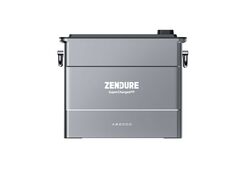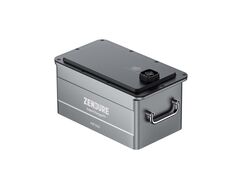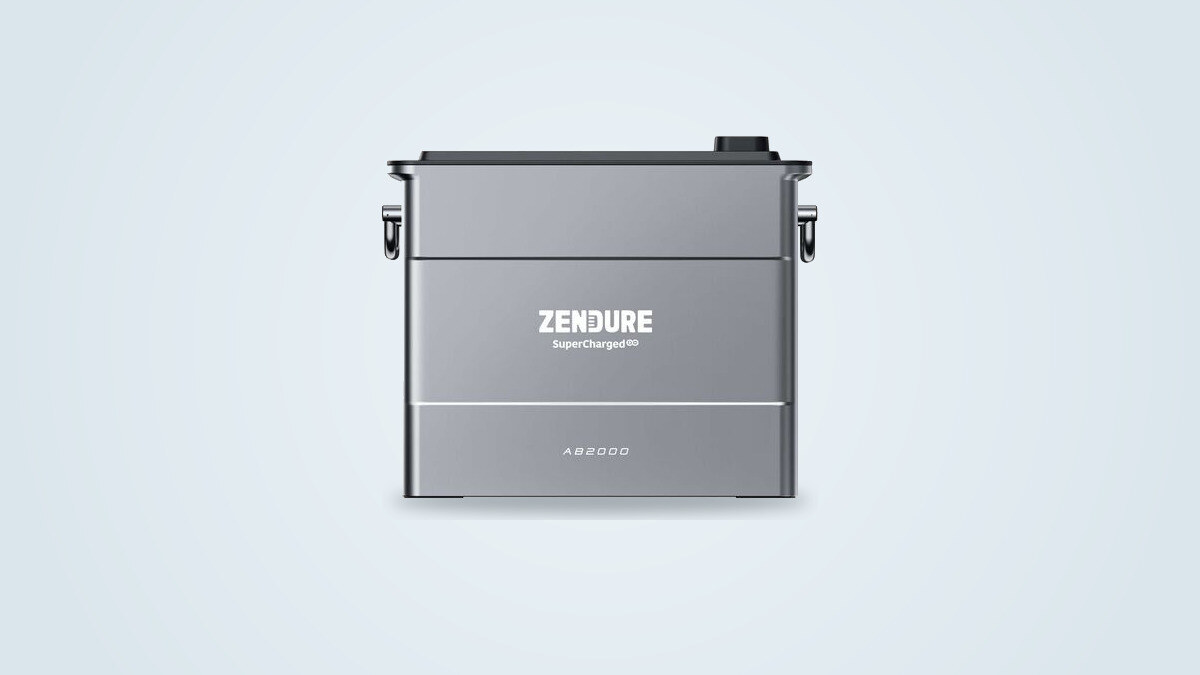
What the AB2000L really is: a module with no conversion electronics of its own
The AB2000L has no MPPT tracker, no inverter, and no usable output port of its own. It is a block of LiFePO4 cells, a BMS and a safety system, nothing more. All the conversion work, whether capturing solar power or feeding current into the home, happens entirely on the hub side: the Hub 2000 or the Hyper 2000, the only two boxes this module talks to.
Without a Hub 2000 or a Hyper 2000 already installed, the AB2000L is useless on its own: no standalone mode, no direct output, no way to charge it from a panel wired straight to it. That is not a hidden flaw, it is simply what this product is: a pure storage brick, unlike a portable power station that packs everything into a single case.
The real advantage over other Zendure batteries: a genuine MPPT solar input, on the hub side
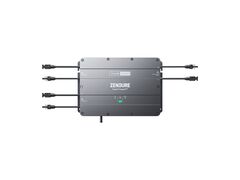
This is what sets the AB2000L apart most clearly from other Zendure expansion modules. The Hub 2000 carries two MPPT regulators accepting up to 1800 W of panels on a direct input. The Hyper 2000 goes further: four independent solar inputs, still split across two MPPT trackers for a combined 1800 W, plus a built-in 1200 W bidirectional inverter that handles both feed-in to the home and charging the battery from the grid during off-peak hours.
This capability changes the nature of the purchase: unlike a module reserved for a hub that is entirely AC-coupled, with no connector at all for panels, the AB2000L's ecosystem can take in direct solar production, store it, and return it in the evening. The hub's solar input does not grow with the number of AB batteries stacked on it: adding modules increases the available reserve, never the capacity to capture sunlight, which stays entirely down to the box they are connected to.
Real system efficiency: around 80% round trip, a standby draw worth watching
Since the conversion electronics sit entirely in the hub, figures gathered on a Hyper 2000 paired with an AB2000 battery (the module the AB2000L replaces in the line-up, with an identical electrical interface) remain the best available basis for judging this family's real efficiency. A 900 W charge returns 861 W actually stored, a 95% charging efficiency.
On this same system, 1910 Wh could be drawn back out of a battery rated at 1920 Wh, close to 99% of nominal capacity: the gap between the marketing claim and reality is minimal here. Sitting idle, the reserve drops by around 5% in 24 hours, a standby draw that mostly comes down to the hub's own electronics (Wi-Fi, Bluetooth, BMS supervision) rather than the LiFePO4 cells' own self-discharge, which is normally far lower on this chemistry. On an installation that sits lightly used for several days running, that standby draw ends up mattering in the real-world balance.
Up to 7.68 kWh stacked, a weight that calls for picking a spot in advance
Each module adds 1920 Wh to the system, recognised automatically by the hub. The ceiling actually documented by the manufacturer for the AB2000L on its Hub 2000 and Hyper 2000 hubs is four modules, or 7680 Wh (7.68 kWh): some retail listings wrongly advertise expansion to six units, a figure that actually belongs to the AB2000X on other boxes in the range, not to this one.
According to the manufacturer, the AB2000L is compatible and stackable with the AB2000X: the two modules can be mixed within the same system despite belonging to different generations. That is a genuine plus over the AB3000 line, where the old and new modules do not work together. On weight, each module runs around 44 lb (20 kg): reason enough to fix its position at install time rather than move it around often, especially past two stacked units, which already tops 88 lb (40 kg).
ZenGuard safety: aerosol suppression at 320 to 356 °F (160 to 180 °C), no incident identified on this module
The AB2000L carries the ZenGuard safety architecture common to the recent AB line: a condensed-aerosol fire suppression system that triggers automatically between 320 °F and 356 °F (160 °C and 180 °C) on a technical fault, without releasing toxic gas, paired with a BMS that continuously monitors voltage, current and temperature for each cell, plus protection against overcharging, deep discharge and short circuits.
The manufacturer lists CE, VDE and TÜV Rheinland certification for this module, all European standards; no UL listing has been confirmed for it, so US buyers should check current UL status directly with the retailer or manufacturer before wiring it into a home electrical system. A confirmed fire took place in Germany on a Zendure AiO 2400, a different product from this one, which the manufacturer attributed to a contact fault at a solar MPPT input connector. That exact mechanism does not apply to the AB2000L, which has no solar connector of its own to begin with: the failure point identified on the other product simply does not exist on this module. No incident specific to the AB2000L has been identified so far, a gap best read with the usual caveat for a product launched in June 2026 and therefore still young on the market.
The self-heating function extends the charging range down to -4 °F (-20 °C), against 32 °F to 131 °F (0 °C to 55 °C) for normal charging, while discharging stays possible from -4 °F to 140 °F (-20 °C to 60 °C), a wide range that covers year-round outdoor use, harsh winters included.
Hub 2000 or Hyper 2000, and why US grid rules change the picture
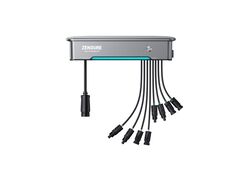
The AB2000L only sells paired with one of these two boxes, which follow very different logics. The Hub 2000 is the more affordable option: it manages solar input and the battery, but needs a compatible external micro-inverter to feed current into the home. The Hyper 2000 packs everything in, 1200 W bidirectional inverter included, for what Zendure markets in Europe as a plug-and-play install with no extra part to shop for.
| Criterion | Hub 2000 | Hyper 2000 |
|---|---|---|
| Built-in inverter | No, external micro-inverter required | Yes, 1200 W bidirectional |
| Solar inputs | 2 (2 MPPT trackers, 1800 W) | 4 (2 MPPT trackers, 1800 W) |
| Storage with the AB2000L | Up to 7.68 kWh | Up to 7.68 kWh |
| Multi-unit coordination | No | Yes, ZenLink |
| Unit weight | 11.5 lb (5.2 kg) | 18.7 lb (8.5 kg) |
That plug-and-play framing does not carry over to the US the way it applies in parts of Europe. Several European countries allow a simplified registration path for small balcony-style solar kits under a wattage threshold, with no licensed electrician required. The US has no federal equivalent of that category: a grid-tied inverter, even a small one, generally requires a formal interconnection agreement with the local utility, permitting through the local Authority Having Jurisdiction, and installation consistent with the National Electrical Code and UL 1741 for the inverter, regardless of whether the Hub 2000 or the Hyper 2000 is chosen. Requirements vary by state and by utility, so this should be confirmed locally before ordering rather than assumed from European marketing material.
Hub reliability: isolated glitches, not a mass-market fault
The hub can freeze completely and need a manual restart. The automatic charging mode also has a real quirk: it sometimes keeps charging the battery all the way to 100% instead of switching to feed-in toward the home once the reserve is full. Data reporting to the app can also drop out for more than forty minutes at a stretch, without the system's local operation actually stopping.
One freeze case was resolved with a full hardware replacement, after several weeks of back-and-forth with support before getting a satisfactory outcome. Another case, tracked over four months of use of a Hub 2000 with an AB2000 battery, ultimately traced back to a faulty external inverter and a poorly seated hub-to-battery cable rather than to the battery itself.
AB2000, AB2000S, AB2000X, AB2000L: four generations in three years
The same advertised capacity, 1920 Wh, has changed names four times since 2023, each time with different secondary specifications. The table below sums up the manufacturer reference points available.
| Module | Period | Weight | Aerosol suppression | Max stacking |
|---|---|---|---|---|
| AB2000 | 2023 | 47.6 lb (21.6 kg) | No | 4 units |
| AB2000S | Late 2023 | 48.7 lb (22.1 kg) | Yes | 4 units |
| AB2000X | 2025 | 44.8 lb (20.3 kg) | Yes | 6 units |
| AB2000L (this product) | 2026 | About 44 lb (20 kg) | Yes | 4 units |
The AB2000L positions itself as the successor to the AB2000S, at a launch price well below it for very similar specifications. At launch, the manufacturer's own technical sheets contradicted each other on the exact height of the case, with a value for the AB2000L and another for the AB2000X appearing swapped between documents. Usable capacity, once the BMS protection reserve is taken out, could not be confirmed independently of the rated capacity: no data available today confirms it matches the AB2000X exactly at the same rated Wh.
Checking the exact name of the module already owned remains the only reliable habit before ordering a second one: the shared AB prefix and the identical 1920 Wh rating guarantee neither the same generation nor the same secondary performance.
Price positioning: a real gap from one European market to another
Street prices for this module vary noticeably from one market to another: closer to 400 euros on some European markets, well above 500 euros before promotion on others, for a strictly identical module. That gap works out to roughly 0.20 to 0.31 euro per Wh depending on the market and any ongoing promotion, against roughly 0.25 euro per Wh for the AB3000X, a newer and larger-capacity module from the same manufacturer. US availability for this specific module has been inconsistent, and it should not be assumed to ship or be priced the same way as in Europe.
This variation reflects no technical difference at all: it is a matter of distribution and local promotions, not a signal about the module's quality. It is still worth comparing several sources before buying, since the gap can exceed 30% for an identical product at the same point in time.
Who the AB2000L suits, and who it does not
This module suits anyone who already owns a Hub 2000 or a Hyper 2000 and wants to add enough reserve to cover a full evening, or to grow an existing installation at a gentler price than the older AB2000S. Its delivery accuracy (around 99% of nominal), its genuine hub-side solar input and its 10-year warranty make it a solid choice for that use case.
It suits less well anyone chasing top-tier efficiency (the system caps out around 80% round trip) or total peace of mind: isolated reports of hub freezes and a faulty charging routine exist, even if they are not widespread. In the US specifically, the lack of a simplified interconnection path means the real hurdle is often permitting and utility approval rather than the hardware itself, and that should be priced into the decision before ordering. For a first purchase in this family anywhere, checking exactly which module generation matches the hub in question remains essential, given the AB2000 line has changed name four times in three years for an unchanged advertised capacity.