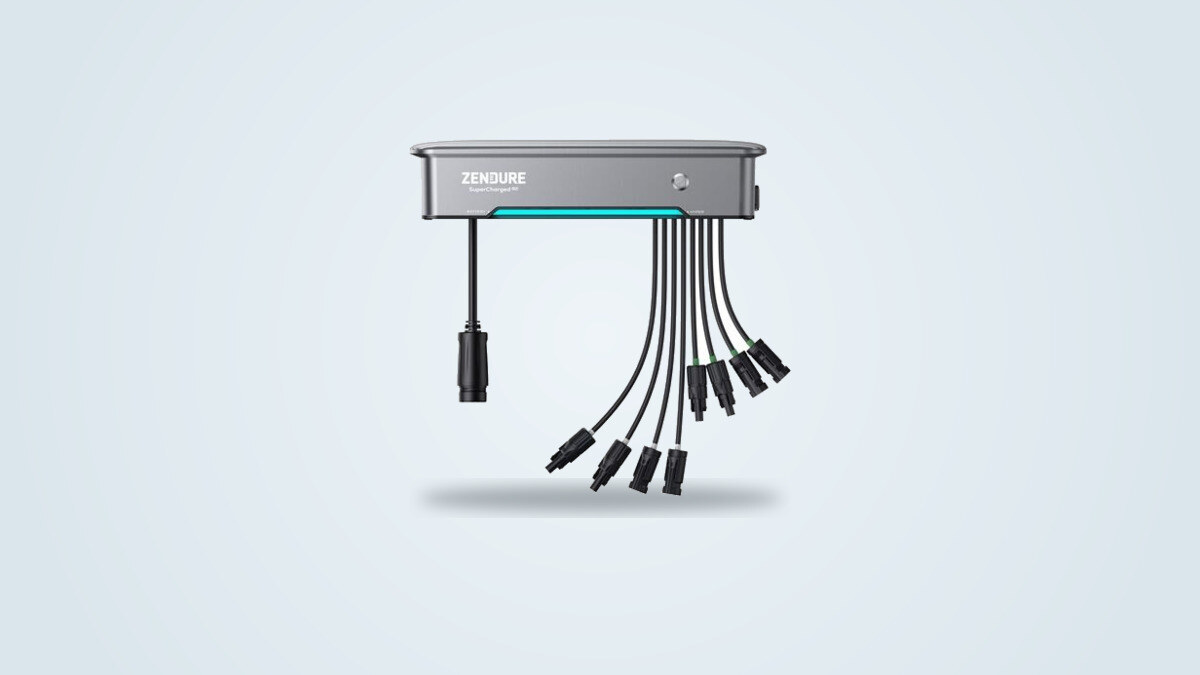
What the Hyper 2000's own electronics actually change
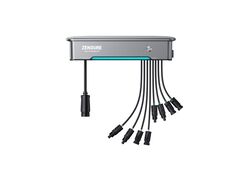
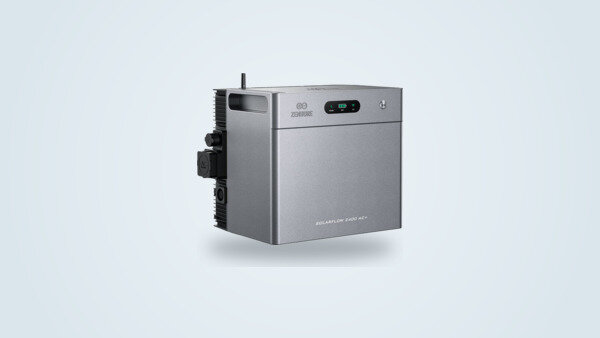
Unlike the AB-family modules (AB1000, AB2000, and their variants), which are nothing more than cell blocks with zero power electronics of their own, the Hyper 2000 is the only box in the SolarFlow lineup with its own brains: two MPPT regulators, a bidirectional inverter, and full control of the system. It is the Hyper 2000 that decides, moment to moment, whether energy goes to the battery, to the home, or to both at once.
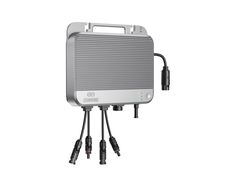
That 1200 W output isn't a fixed number: it's adjustable from the app anywhere between 30 and 1200 W in 1 W steps, both for feeding the home and for charging the battery off the grid. This bidirectional output is exactly what sets the Hyper 2000 apart from the cheaper Hub 2000, which has no inverter of its own: that unit needs an external microinverter to push even a single watt into the home.
Without an AB1000 or AB2000 battery attached, the Hyper 2000 loses most of what makes it worth buying: it doesn't store anything by itself. It's still usable on pure grid arbitrage, with zero solar panels wired up, scheduling a battery charge during off-peak hours and a discharge during peak hours, a function that runs independently of solar self-consumption.
Efficiency depends on which path the energy takes
This is the single most important finding in this review, and it's nowhere on the spec sheet: the Hyper 2000's round-trip efficiency doesn't just depend on how much power is drawn, it depends on the path the energy follows. A direct solar charge, where DC current from the panels reaches the battery through the MPPT regulators with no AC conversion involved, runs at roughly 80% round-trip efficiency. A charge scheduled off the grid during off-peak hours, exactly the bidirectional feature the product's marketing leans on hardest, drops to near 73%.
The gap comes down to a straightforward physical mechanism: a solar charge crosses just one conversion stage (DC from the panels to DC in the battery, through the MPPT regulator), while a grid charge crosses two extra stages through the bidirectional inverter (AC from the grid to DC in the battery, then back to AC on discharge). Every conversion stage costs a few points of efficiency: the feature that sounds smartest on paper, arbitraging between off-peak and peak rates, is also the one that hands back the least energy per kWh stored.
In practical terms, a kWh bought at an off-peak rate and discharged during peak hours is only really worth about 730 Wh once it has made the full round trip through the Hyper 2000, against roughly 800 Wh for a kWh of solar origin stored and used later the same day. Any payback math on a time-of-use rate plan needs to factor in that loss, something the sales pitch rarely brings up.
1800 W of MPPT advertised, 1600 W actually usable for the battery
The Hyper 2000 splits its four solar inputs across two independent MPPT regulators, each capped at 900 W nominal, for 1800 W of combined peak power. That four-input layout is a genuine practical advantage: it lets panels face different directions (east, west, south) without shading or orientation on one input dragging down the other three, unlike a single-tracker setup that matches its output to the weakest panel in the group.
| Figure | Value |
|---|---|
| Combined peak MPPT power (4 inputs, 2 trackers) | 1800 W |
| Power actually routed to battery charging | 1600 W |
| Power simultaneously fed to the home | 200 W |
This ceiling shows up nowhere in the marketing: out of the 1800 W peak the two trackers can pull in together on a good sunny day, only 1600 W actually goes toward charging the battery once one is attached, with the leftover 200 W feeding the home directly. A system sized to hit the full 1800 W input (Zendure recommends up to 2400 W of panels) never charges its battery at full MPPT power, then: part of the solar harvest is structurally set aside for immediate self-consumption, not storage.
Each input accepts 15 to 55 V, with a recommended 350 to 600 W per input: push past that and clipping kicks in before the tracker's own ceiling is even reached. For a setup using standard-voltage panels (around 40 V open-circuit), staying under that per-input ceiling takes a bit of checking beforehand rather than just adding up total wattage.
The compatible battery lineup, and its limits
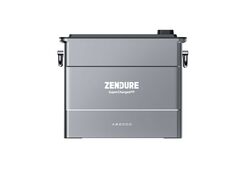
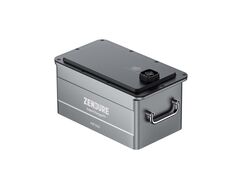
The Hyper 2000 doesn't store anything on its own: it drives Zendure's AB-family batteries, and the compatibility runs wider than the family resemblance between the catalog's various generations would suggest.
| Module | Capacity per unit | Works with the Hyper 2000 |
|---|---|---|
| AB1000 / AB1000S | 960 Wh | Yes |
| AB2000 / AB2000S / AB2000X / AB2000L | 1920 Wh | Yes |
| AB3000X / AB3000L | 2880 Wh | No, reserved for the SolarFlow 2400 AC hub and its successors |
Up to four AB1000 or AB2000 batteries (any variant, and they can be mixed) hook up to a single Hyper 2000, for a ceiling of 7680 Wh (7.68 kWh). The AB3000X and AB3000L modules, which pack more capacity per unit, only work with a completely different hub, the SolarFlow 2400 AC and its successors: checking exactly which hub is already installed before ordering an add-on battery is worth the extra minute, since the shared AB prefix guarantees zero compatibility between the two families.
ZenLink: coordinating multiple Hyper 2000 units with no electrician
Beyond a single unit, ZenLink can pair up to three Hyper 2000 units on the same electrical phase, something few competing manufacturers pull off in this form. Units find each other automatically as soon as they connect to the grid and handle that local coordination without leaning on home Wi-Fi. Phase detection itself runs automatically too: there's no need for an electrician to manually confirm that multiple Hyper 2000 units share the same phase before grouping them.
A complete three-unit cluster tops out at up to 5400 W of combined MPPT power and over 23 kWh of storage. That's a real selling point for anyone planning to grow a system step by step, one box at a time, instead of sizing everything at the first purchase.
The app and off-peak scheduling: useful, but with real bugs
Time-of-use scheduling genuinely works, even with zero solar panels attached: you can schedule a battery charge at the start of an off-peak window, then a discharge to the home at a chosen wattage at the start of the peak window, all controlled from the app over a plain grid connection. Real-time tracking of production, charge level, and consumption stays readable, and the initial setup (naming the system, picking the country's regulations, setting the max output power) takes only a few minutes.
But the automatic control logic isn't bulletproof. One specific case, tracked over several months, counts three to four complete hub freezes, each one fixed with a simple manual reboot, with no clear trigger (firmware version, charge level) ever pinned down; the unit was eventually swapped under warranty for a simpler model in the same lineup. That same case turns up a more annoying bug in the automatic charging logic: battery sitting at 99 or 100% charge, a few hundred watts of solar production on tap, and the system just keeps charging instead of switching over to feed-in, even after a manual reboot and in the app's alternate control mode.
Nothing here points to a widespread or systemic failure across the lineup so far: the number of specific cases on record stays limited, and support came through in the case tracked above. But these software rough edges, on a device whose whole selling point is smart control, are worth knowing about before buying rather than finding out the hard way after.
Easy physical setup, but never a simplified permitting path
The physical setup itself is quick: the unit mounts in a matter of minutes, MC4 solar connectors click into place with no tools needed, and the whole thing plugs into a standard household outlet with no work on the breaker panel. The IP65 housing is rated for outdoor mounting exposed to rain and dust.
On the paperwork side, though, the picture looks very different from parts of Europe. Several European countries allow a simplified registration path for small balcony-style solar kits under a wattage threshold, with no licensed electrician required. The US has no federal equivalent of that category: a grid-tied inverter, even a small one, generally requires a formal interconnection agreement with the local utility, plus whatever permitting the jurisdiction calls for, regardless of how many watts it puts out. The Hyper 2000's built-in 1200 W output does not change that math one way or the other in the US the way it would where a simplified wattage-based bracket exists: interconnection approval and permitting apply either way. Requirements vary by state and by utility, so this is worth confirming locally before ordering rather than assuming from marketing material written for other markets.
Safety and build quality: IP65, a 10-year warranty, one nuance worth knowing
The Hyper 2000 carries an official 10-year warranty on the unit itself, matching the cell warranty on the AB batteries it powers; only accessories are limited to a one-year term. The IP65 housing and build quality that several independent hands-on write-ups judged solid add up to a solid manufacturing track record.
One nuance deserves to be spelled out plainly, though. A confirmed fire took place in Germany involving a Zendure AiO 2400, a different product from this one, which the manufacturer traced to a contact fault at a solar MPPT connector that caused localized overheating. Unlike the AB-family storage modules, which carry no solar connector of their own and for which that mechanism can be ruled out without any ambiguity, the Hyper 2000 itself carries four MPPT inputs from that same connector family: the category of failure point identified on the other product does exist, architecturally, on this unit too. No incident specific to the Hyper 2000 has turned up to date, an absence that's reassuring without being definitive proof it can't happen.
Who the Hyper 2000 is for, and who should look elsewhere
The Hyper 2000 makes the most sense for anyone building out an expandable balcony-style solar setup, piece by piece: start with one unit and one or two batteries, then add AB1000 or AB2000 modules as budget allows, or even a second or third Hyper 2000 linked through ZenLink to eventually clear 23 kWh. Its genuinely adjustable bidirectional output and four independent solar inputs make it the most complete option in the Zendure lineup for that kind of project.
It's a weaker fit for anyone hunting for the cheapest way to stay under a simplified permitting bracket, since in the US that bracket doesn't exist to begin with, and a smaller Hub 2000 setup wouldn't change that outcome either. It's also not the right pick for anyone wanting backup power during an outage, a function this unit doesn't offer, or for anyone without room in the budget for at least one AB battery: without one, the box stores nothing.