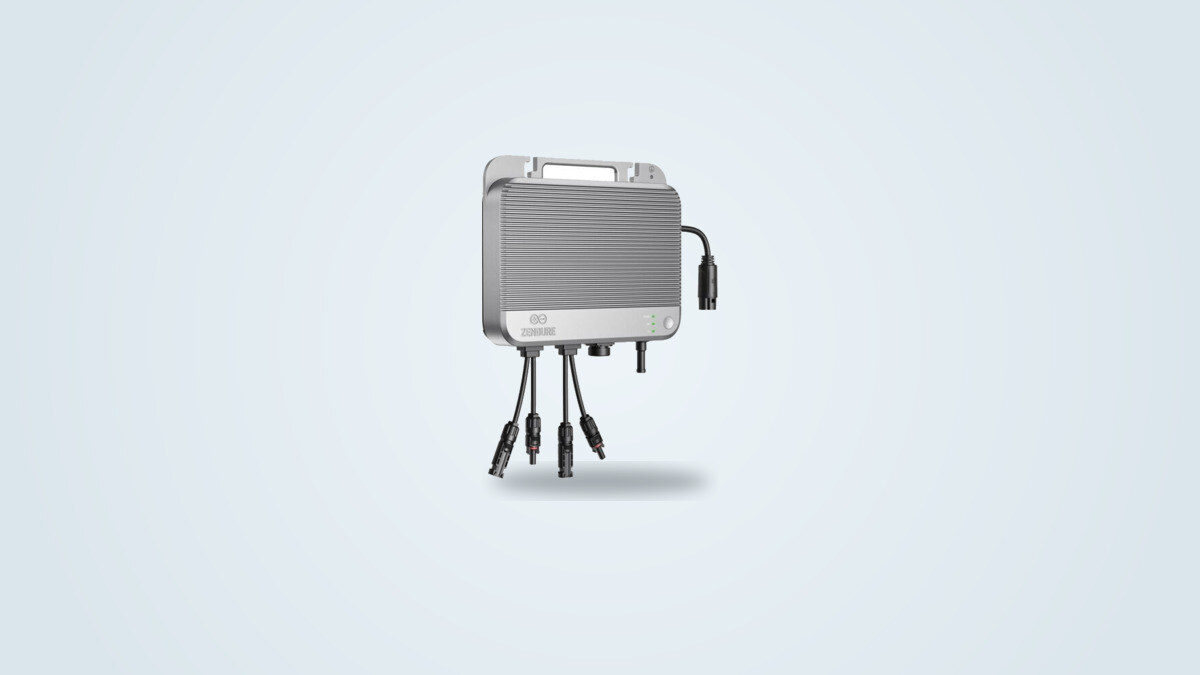
The hub alone: cheapest on paper, but not currently for sale here
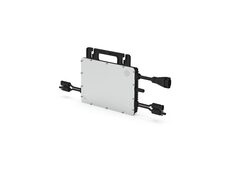
This review covers the barest version of the whole SolarFlow 800 range: an 800W bidirectional hybrid microinverter, sold ALONE, with no battery whatsoever included. On the spec sheet, its own storage capacity is nil: zero Wh out of the box. That is what sets it apart from its 800 Plus and 800 Pro / Pro 2 siblings, which all pack a 1920 Wh (about 2 kWh) battery into the same enclosure.
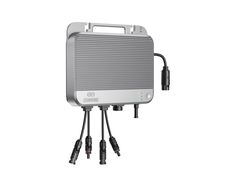
In practice, the SolarFlow 800 plugs into a standard household outlet and converts the DC output of two panel strings (two pairs of MC4 connectors, for two independent MPPT trackers) into AC fed into the home. On its own, it behaves like any plain microinverter. What changes everything is its ability to also drive the charging and discharging of a separately-bought Zendure AB1000 or AB2000 battery: that option is what turns a simple feed-in point into a genuine energy reserve. Before any of that matters here, though: at the time of writing, this hub, its compatible batteries, and its direct rivals are all listed as unavailable to buy on the US market, a point covered in full further down.
The reference cost of a first battery, if and when it ships here
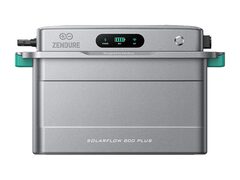
Even with US retail on hold, the sums are worth laying out, since they carry over once (or if) stock returns. The hub alone is listed at $201.75. An AB2000L battery (1920 Wh) is listed at $811.05 bought separately. Total for a first 1920 Wh reserve: $1,012.80. The SolarFlow 800 Plus bundle, which packs that same 1920 Wh capacity into the same hybrid enclosure, is listed at $729.81.
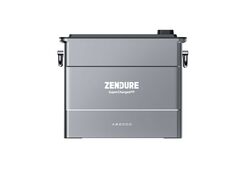
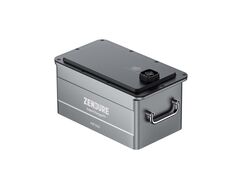
The hub-only route would still carry two genuine justifications if it becomes purchasable. The first: already owning a compatible AB1000 or AB2000 battery from another Zendure device, in which case the bare hub would be the cheapest way into the ecosystem. The second: wanting to try direct feed-in before spending more, with the option to add storage later. Either way, the modular promise holds up on paper: up to six batteries can stack onto the same hub, without ever replacing it, for a ceiling of 11,520 Wh.
The claimed 96% efficiency: what it actually covers
Zendure claims a 96% storage efficiency across the full path, from the panels (MPPT) to the battery and on to the AC output, said to be around 10% better than a conventional AC-coupled setup, where energy passes through an inverter twice rather than one continuous DC conversion. The SolarFlow's DC-coupled architecture explains that gain: it skips a DC-to-AC-to-DC round trip just to charge the battery.
That figure applies to one specific condition, though: direct solar charging, at a power level close to rated output. Like any switch-mode converter, real-world efficiency drops mechanically once output power falls well below rated power, for instance early or late in the day, or under heavy cloud cover: that is a trait inherent to this class of power electronics, not a flaw specific to this model. Zendure does not publish an efficiency curve against load, and no independently measured figure could be cross-checked on this specific point.
A second nuance matters too: charging the battery from the grid rather than from the panels (the off-peak feature covered next) adds an extra AC-to-DC conversion step. Losses there are mechanically higher than on the direct solar path, even though Zendure does not publish a separate figure for that charging mode.
Two MPPT trackers and a 14V start-up voltage
The SolarFlow 800 accepts up to 1200W of panels, split across two independent MPPT trackers of 600W each (two pairs of MC4 connectors visible on the casing). That is a common layout for this power class, matching the tracker count of a Hoymiles HMS-800W-2T.
The real difference lies elsewhere: Zendure states that MPPT tracking begins from as low as 14V, versus 18V for most balcony-solar microinverters.
A lower start-up voltage is a technical advantage readable straight off the spec sheet, holding regardless of usage conditions: it means capturing output at the hours when panel voltage is still weak, typically early morning and late evening. The cumulative effect across a full day could not be cross-checked elsewhere, but the underlying physics is sound and consistent with the DC-coupled architecture described above.
Control, the app and scheduled grid charging
The SolarFlow 800 is set up through the Zendure app, over Bluetooth first and then Wi-Fi for remote monitoring. Wi-Fi pairing can take a few attempts to settle down during first setup, a common friction point for this type of connected device rather than a flaw unique to this model.
Once online, the app shows live output plus a daily and weekly history, and keeps working locally even if the internet connection drops, since the control logic runs on the hub itself. On the tariff side, the SolarFlow 800 can charge its battery from the grid during off-peak hours and release it again at peak times, a feature that only pays off where the local utility actually charges different rates by time of day. Fine-tuning those time slots and priorities still has room to improve, though: it takes some getting used to before it is dialed in properly, and the interplay between the different priorities (solar, grid, battery) still lacks polish in some situations, with default settings that suit most households but leave little room for anyone after truly customized priority logic.
The hub adjusts its output in under 3 seconds and to the nearest watt, to track the home's actual consumption rather than feeding a fixed amount continuously, which limits the risk of giving energy away to the grid for free.
Without a battery, just another microinverter?
Used on its own, without a battery, the SolarFlow 800 joins the ranks of plain balcony-solar microinverters, also covered on this site with the Hoymiles HMS-800W-2T and the APsystems EZ1-M. The raw comparison, on manufacturer data, does not really favor it on that specific ground: both rivals are listed a little more expensive, but neither has any hybrid function to justify, and neither is currently listed as purchasable in the US either.
| Criterion | Zendure SolarFlow 800 | Hoymiles HMS-800W-2T | APsystems EZ1-M |
|---|---|---|---|
| AC power | 800W | 800W | 800W |
| MPPT trackers | 2 | 2 | 2 |
| Battery function | Optional (separate) | No | No |
| Grid charging | Yes | No | No |
| Listed price | $201.75 | $226.90 | $162.48 |
The SolarFlow 800's case is therefore never about beating a plain microinverter on its own turf: it is about offering, for a modest price gap, a door into storage that neither the Hoymiles nor the APsystems provide, even as an option, once any of the three actually reach US buyers.
Against the rest of the SolarFlow 800 range
The SolarFlow 800 is only the entry point of a four-model family that all share the same expansion ceiling. The table below places each one on its own merits, using listed reference prices for a market where none of them currently ship.
| Model | SolarFlow 800 | 800 Plus | 800 Pro 2 |
|---|---|---|---|
| AC power | 800W | 800W | 800W |
| Max solar input | 1200W (2 MPPT) | 1500W (2 MPPT) | 2640W (4 MPPT) |
| Built-in battery | None | 1920 Wh | 1920 Wh |
| Expandable up to | 11,520 Wh | 11,520 Wh | 11,520 Wh |
| Listed price | $201.75 | $729.81 | $905.72 |
The SolarFlow 800 Pro 2, with its four MPPT trackers, is better suited to setups with four panels facing different directions (east and west, say), a scenario the base model's two trackers cannot cover as well. On a simple setup with all panels facing the same way, the base model's two trackers are already plenty. Between the bare hub and the 800 Plus, the choice comes down almost entirely to the financial trade-off covered above, whenever US availability catches up with the rest of this comparison.
Why this barely exists as a US purchase yet
The SolarFlow 800 plugs into a standard household outlet, with no electrical panel work needed: that is the definition of plug and play. It is certified for grid feed-in to the European VDE-AR-N 4105 and EN 50549 standards, but those European certifications carry no weight for a US grid connection.
Plug-in, balcony-style solar remains legal in only a small number of US states as of this writing: Utah (capped at 1200W AC, in effect since May 2025), Colorado (capped at 1920W AC, taking effect January 2027), Connecticut (from October 2026), plus Maine, Virginia, Maryland, New Hampshire and Vermont, with New York's own bill passed by both legislative chambers and awaiting the governor's signature. It remains explicitly not legal in states like Florida and Texas, and simply unaddressed almost everywhere else, where feeding power into a home's wiring without a utility interconnection agreement generally falls outside the rules built around NEC 705.12. Even within the states that have acted, the bigger obstacle is certification: as of this writing, no plug-in solar system, from Zendure or any other brand, has obtained the UL 3700 safety certification those state laws require for a compliant connection. That gap, not the price, is why this whole product category is best understood in the US as an emerging, closely-watched space rather than a settled purchase.
Build quality, reliability and warranty
The finely ribbed aluminum casing acts as a passive heatsink: no fan vents are visible on the unit, which fits with its IP67 rating, since an active cooling vent would be incompatible with that level of sealing. Silent operation is therefore likely, even though Zendure does not push it as an explicit selling point. The stated warranty runs to 10 years, a generous figure for this class of electronics with no moving parts.
On brand reliability, one point is worth mentioning in fairness: Zendure has itself documented, in an official statement, a connector overheating issue on the SolarFlow 2400 AC, a much more powerful model in the same family with different connectors. Nothing comparable has been identified to date on the SolarFlow 800 itself.
Another limitation worth knowing regardless of where or when it becomes available: like any device plugged into a plain household outlet without a dedicated transfer switch, the SolarFlow 800 provides no backup power during a grid outage. Anti-islanding protection, a mandatory safety feature on this class of equipment, cuts output the moment the grid goes down, battery or no battery.
Who the SolarFlow 800 is for, and who should look elsewhere
For nearly all US readers today, the honest answer is: this is a product to watch rather than to shop for. Its natural buyers, once it is actually sold and certified here, would be the same two profiles as elsewhere: someone who already owns an AB1000 or AB2000 battery from another Zendure device, or a buyer who would rather try direct feed-in cheaply before committing to a battery's cost.
Anyone outside the roughly nine states with plug-in solar laws should not expect a straightforward legal path to grid-tied use in the first place. Anyone inside those states should still wait for a UL 3700-certified product, since that certification, not this review, is what will make a purchase like this compliant. And anyone hoping for backup power during an outage, or a guaranteed 96% efficiency in every situation, would be disappointed even once the availability and certification questions are settled: those remain real limits of the hardware itself, not just of the US market it has not yet properly reached.