Two batteries, one name: what you're actually buying
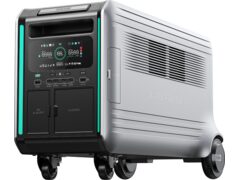
The SuperBase V's spec sheet covers two batteries under a single name, and the difference is nowhere near a simple color choice. The V4600 version runs a conventional LiFePO4 battery rated at 4608 Wh. The V6400 version houses a battery marketed as semi-solid-state, denser, rated at 6438 Wh inside the identical outer shell. Those are the two numbers that show up everywhere this product gets mentioned, and they stand for two genuinely different cell packs.
Across the five markets where this site links out to this product (the United States, France, Germany, Italy, Spain), the exact model listed on every one of those pages is consistently the V4600, the LiFePO4 version. That's not a footnote: it's the version that gets the least attention in the brand's own marketing, where the semi-solid-state battery hogs the spotlight, yet it's the one that actually ends up in the cart at checkout.
| Version | V4600 (the one sold here) | V6400 |
|---|---|---|
| Capacity | 4608 Wh | 6438 Wh |
| Chemistry | LiFePO4 (LFP) | Semi-solid-state, 228 Wh/kg |
| Rated cycles | 6000+ | 3000+ |
| Base unit weight | 121.3 lb (55 kg) | 130.1 lb (59 kg) |
Pricing has swung a lot since launch, too: the very first units, sold through crowdfunding in late 2022, ran over $3,800 for the base unit alone, and up to $7,000 with a first satellite battery. What's charged today, including on this page, sits well under those original numbers, with frequent deals that sometimes more than double the gap from the launch price. The rest of this review covers the version you can actually reach through the links on this page, the V4600, and flags it every time a figure comes specifically from the other version instead.
The semi-solid-state pitch, and why it doesn't apply here
Nearly all the marketing buzz around the SuperBase V rides on its semi-solid-state battery, pitched as a world first for a station in this power class. The actual mechanism behind the name: an electrolyte that's half liquid and half locked into a solid membrane, versus a fully liquid electrolyte in a conventional lithium cell. The claimed payoff is an energy density about 42% higher than a comparable LiFePO4 cell, rated at 228 Wh/kg. That's what lets the V6400 pack 40% more capacity (6438 versus 4608 Wh) for only 7% more weight on the base unit, 130.1 pounds versus 121.3 pounds (59 versus 55 kg).
That density gain comes with a catch the product's marketing doesn't spell out: the manufacturer's own technical documentation rates the semi-solid-state battery in the V6400 for a 3000-cycle lifespan, against 6000 for the LiFePO4 version in the V4600 sold on this page. So on this specific measure, the version marketed as more technologically advanced is only half as durable as the plainer LFP version. Neither number is wrong on its own, but they rarely show up in the same sentence.
For anyone buying the V4600, this trade-off is beside the point: its battery is a standard LiFePO4 cell, with the endurance and safety track record already well established for that chemistry, minus the density bump but also minus the cycle penalty of the other version. The rest of this review sticks to that trade-off, not the one facing V6400 buyers.
Power output and real-world loads
The SuperBase V is rated for 3800 W continuous, the same on both versions since the inverter and power electronics are shared between the V4600 and the V6400: only the battery differs. Peak output hits 5000 W on a single unit, and two units paired in parallel combine their continuous output to 7600 W, a handy setup for backing up a heavier panel without going through the satellite-battery expansion path.
On real loads, an electric kettle pulling over 2200 W causes zero trouble, a resistive load that's normally considered a stress test for an inverter because of its startup inrush current. No independent testing has pushed the unit to its full 3800 W continuous rating over an extended stretch, so strictly speaking, the margin between that kettle test and the rated maximum hasn't been fully confirmed, though nothing in the available material points to an early cutoff either.
The dual-voltage output is worth calling out: the station puts out 120 V and 230/240 V at the same time depending on which outlet you use, a rare bit of flexibility that matters directly to anyone running imported gear or a mixed setup. The RV-friendly outlet, a NEMA TT-30, adds to an already generous lineup of AC outputs, on top of the six 100 W USB-C ports and two 18 W USB-A ports already on the spec sheet; the European version of the unit swaps that layout for four 230 V outlets and four 12.6 V outputs instead.
One of the AC outlets, a NEMA 6-20 rated 240 V at 16 A, stays awkward in everyday use: the format is properly documented, but few off-the-shelf cables plug straight into it. The protective flaps over the outlets also take more force to open than feels necessary. These are real, if small, annoyances on a unit this size, worth flagging for anyone who'll be plugging in large appliances on a regular basis.
Recharging: one promise it actually keeps
With an AC input that tops out at 3600 W, the SuperBase V is rated for a full 0 to 100% recharge in about 120 minutes. That number holds up closely in practice: the measured time for a full AC charge also lands near two hours, which isn't something you can take for granted at this price point, where the gap between the marketing claim and reality often runs past 50%.
On the solar side, input tops out at 3000 W across a wide voltage window (12 to 150 V), run through a single MPPT tracker. Under clear skies with a panel array sized to match, a full charge takes roughly two and a half hours, an order of magnitude that lines up with the AC figure. Battery switchover during a grid outage stays under 13 milliseconds, plenty fast for nearly all home electronics, computers and networking gear included.
What ties these three numbers together: none of them shows a real gap between what's claimed and what's measured, which sets the SuperBase V apart from several direct rivals whose advertised fast charging turns out to be noticeably slower once checked under real conditions.
Real-world efficiency: a careful estimate, not a direct measurement
Measured against its rated capacity, the V6400 version puts out between 5.58 and 5.77 kWh of usable energy from the 6.43 kWh on board, depending on the charge-and-discharge session, an efficiency of 87 to 90%. That's a solid result for a station in this power class, though it stops short of the best efficiency numbers at this price point, which sometimes clear 95% near maximum power.
No independent measurement specific to the V4600 turned up anywhere: its LiFePO4 battery is a different animal from the V6400's, so the figure can't just be copied over. The inverter, charger and conversion electronics are shared between the two versions, though, so a similar efficiency, somewhere in that 87 to 90% window, is a reasonable guess rather than a confirmed number. Applied to the V4600's rated 4608 Wh, that would put usable capacity somewhere around 4000 to 4150 Wh. That's the figure used in this review's rating block, with this caveat spelled out plainly: it's estimated by carrying over a number from a related model, not measured directly on this specific version.
This gap points to a broader pattern in what's out there on this product: independent write-ups almost all cover the V6400, the flashier version to show off, which leaves the version actually sold on this site noticeably less documented than its identical outer shell would suggest.
Expansion: how far the system really goes
The real selling point of the SuperBase V isn't its starting capacity, which is fairly modest next to some direct rivals, but its expansion path. Each base unit takes up to four satellite batteries at 4608 Wh apiece (model B4600, the same LiFePO4 chemistry as the base unit), pushing a single station to 23040 Wh. Two base units paired up, each with its own four satellites, reach 46080 Wh, enough to cover a home's power draw for several days.
Each satellite is controlled and charged on its own (its own XT90 input, 12 to 150 V), measures roughly 27.2 x 11.2 x 10.8 in (69 x 28.5 x 27.4 cm), and sells, deals included, for around $2,000, notably less than a full base unit since it skips both the inverter and the control screen. That architecture, more than the starting capacity, is what makes it fair to call the SuperBase V an expandable home storage system rather than just a big portable battery.
Noise: the most consistent knock against it
Noise is the reservation that comes up most consistently on this station. At rest or under light load, it drops to around 40 dB, a background hum that's still noticeable but easy to live with. Once power draw picks up, especially during a full-power AC recharge (3600 W), the level climbs to somewhere between 55 and 70 dB, a range most people would call disruptive for working nearby in a closed room.
That sensitivity to noise traces back to the product's own architecture: a 3800 W inverter paired with a 3600 W AC charger throws off real heat, and the fans have to move it out fast to protect the electronics and the battery. That's not an unusual trade-off for a station in this power class, but it leaves the SuperBase V trailing the best options in the segment, which manage to stay quiet up to a noticeably higher power draw before their cooling kicks in hard.
App, controls, and a handful of software rough edges
Remote control runs through a mobile app over WiFi (2.4 GHz only, no 5 GHz support) plus Bluetooth for the initial pairing. The app tracks charge level and consumption, lets you schedule recharge windows, and includes an automated mode that prioritizes solar power whenever it's available.
A handful of software rough edges have shown up across updates: a charge-level readout that's sometimes out of step with the battery's actual state, an unprompted fan restart with no extra load on the unit, and, on the very first units shipped, voice-assistant integration (Alexa, Google Assistant) that didn't work right. Firmware updates have come out frequently since launch, which is a good sign for ongoing support, though it also means a unit fresh off the line might not behave exactly like one that's been updated for months.
None of these software quirks touches the station's core electrical function: they're about the comfort of remote monitoring, not the actual delivery of power, which keeps running independently of the app if a connection drops.
A crowdfunded launch, and the marks it left behind
The SuperBase V didn't launch as a standard big-box retail product: it was first funded through a crowdfunding campaign in late 2022, then carried over to a second platform while the first units were already shipping. That launch path comes with a known downside: delays to the original delivery schedule were announced mid-campaign, and the stretch that followed saw phone support that was hard to reach, with support tickets left unanswered for a long time for some early buyers.
On the hardware side, at least one satellite battery unit showed up fully discharged, which kept it from being put into service right away, and one station went through an unexplained full charge-then-discharge cycle with no diagnosis ever pinned down, despite correctly configured charge and discharge thresholds. Those cases don't look widespread given everything else on record, which leans positive on the unit's mechanical build, but they're worth flagging on a purchase at this price point.
On warranty terms, the SuperBase V carries a 3-year base warranty, extendable to 5 years by registering the unit in the manufacturer's app, a length that sits at the top end of the power station market. The brand is still active in 2026, with several newer product lines launched since, but no recent independent data confirms whether the support friction seen at this particular model's launch has eased since then.
Up against the direct competition
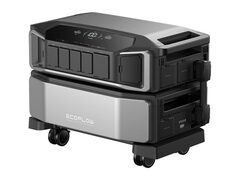
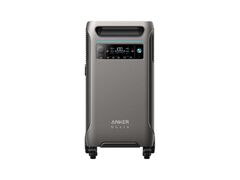
The market for expandable home systems already has well-established names. Against the EcoFlow Delta Pro Ultra, the SuperBase V starts with a more modest base capacity (4608 versus 6144 Wh) and a lower expansion ceiling (46 versus 90 kWh), but it delivers on its recharge claim almost exactly where the measured gap on its rival runs to nearly double the stated time. Against the Anker Solix F3800, the continuous-power gap narrows (3800 versus 6000 W), and the SuperBase V keeps the edge on expansion ceiling per unit (46 versus 26.9 kWh).
| Criterion | SuperBase V4600 | Market benchmark |
|---|---|---|
| Rated vs. measured recharge | 120 min rated, ~120 min measured | A frequent gap among direct rivals |
| Maximum expansion | 46 kWh, 2 units | 26.9 to 90 kWh depending on the rival |
| Warranty | 5 years (3 years + 2 years on registration) | At the top end of the segment |
The sharpest difference here isn't a power or capacity number at all, but how closely the recharge claim matches the recharge measurement, set against a lingering knock on noise and the relative youth of the distribution and support network, two spots where the segment's longer-established names, which have been on this market longer, have had more time to earn trust.
Who the SuperBase V4600 actually makes sense for
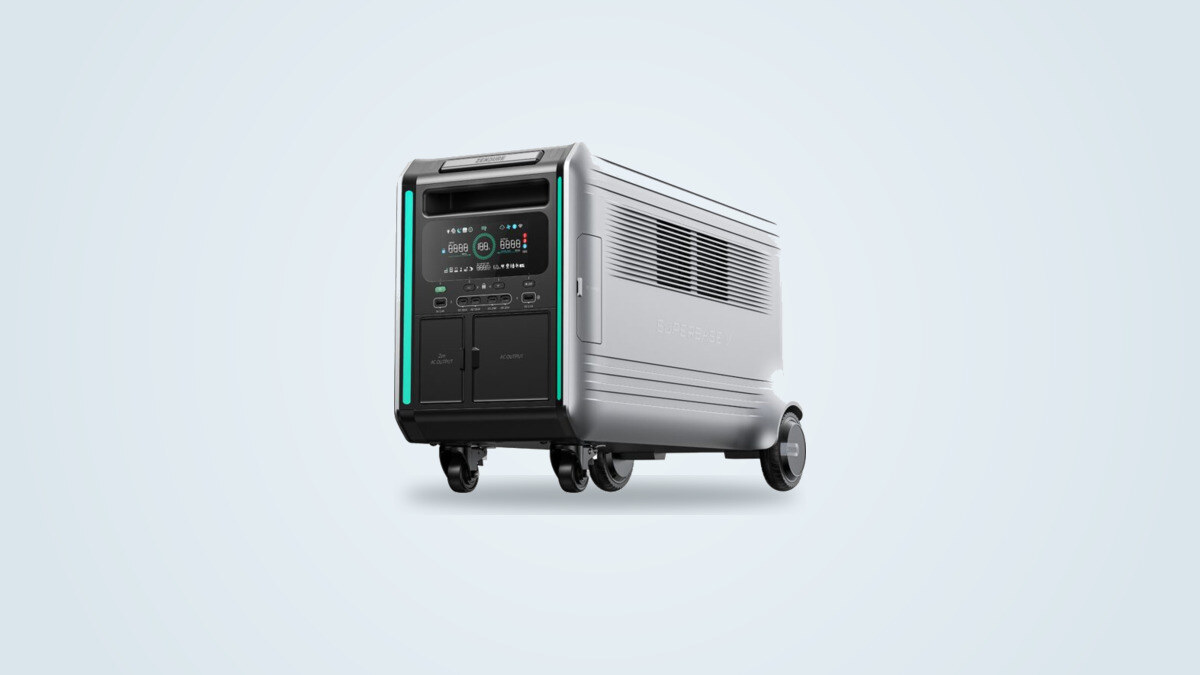
The SuperBase V4600 is built first for a deliberate home energy storage project: an expandable residential backup setup, an off-grid solar system sized out over several years, or a remote property where being able to bolt on satellites as the budget allows matters more than the starting capacity. Its 121.3 lb (55 kg), motorized wheels and telescopic handle make it movable around a house or garage, but it isn't built for everyday nomadic use: it's an appliance that gets installed, not one that goes along for the ride.
For a more occasional backup need, a handful of sensitive devices to keep running through an outage, a much smaller, cheaper station does the job just fine. For a full residential project aiming at several dozen kWh, the expansion-ceiling gap against the segment's most established names deserves a hard look before committing. Between those two uses, the SuperBase V4600 lands in a credible spot: it delivers on its power and recharge claims, it genuinely expands the way it says it will, and its shortcomings, noise chief among them, are laid out rather than buried. The name on the box plays up a technology this exact version doesn't carry, but that's not necessarily bad news for anyone who wants a proven LiFePO4 chemistry above all else.