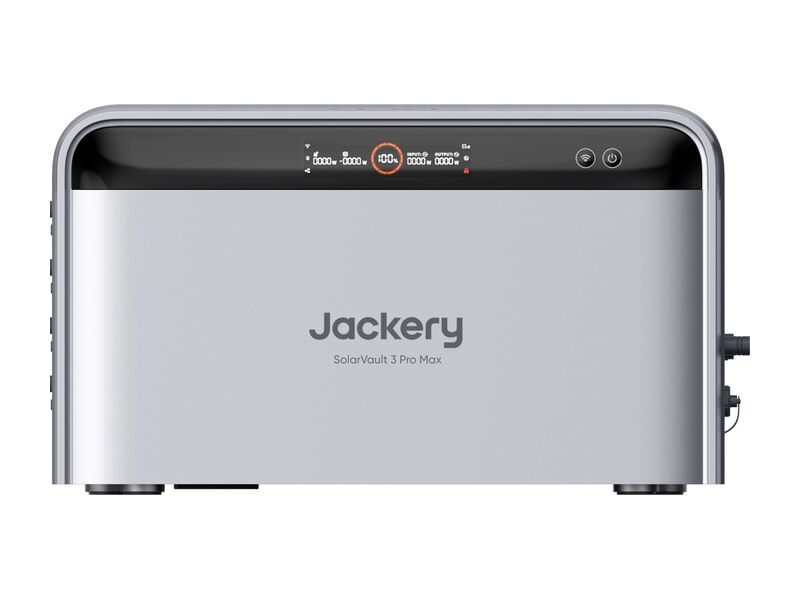
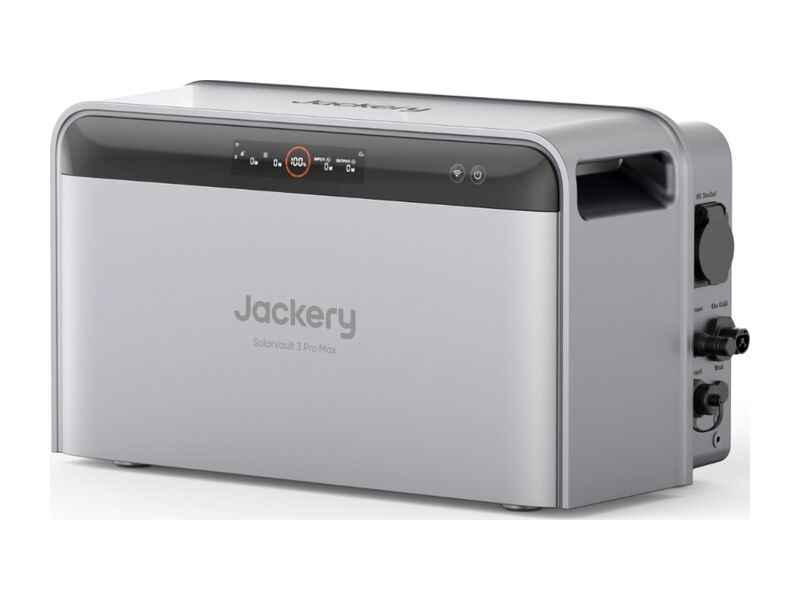
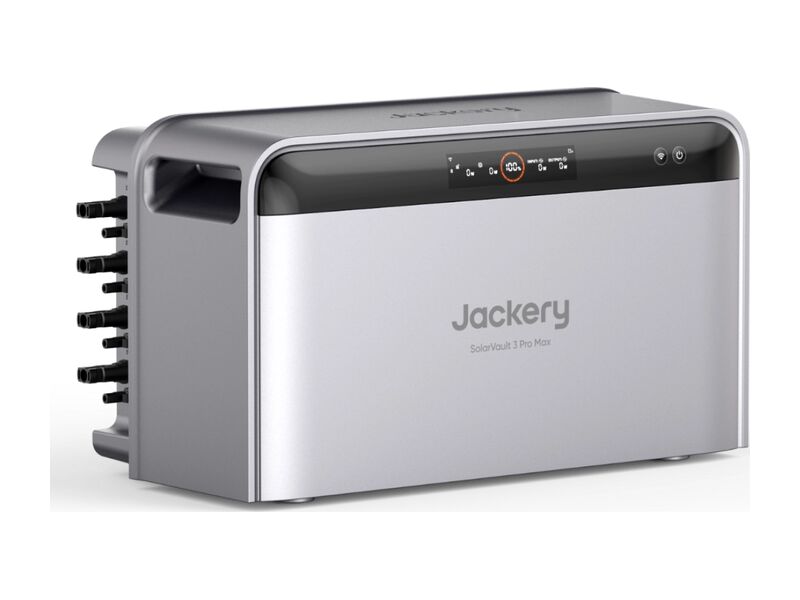
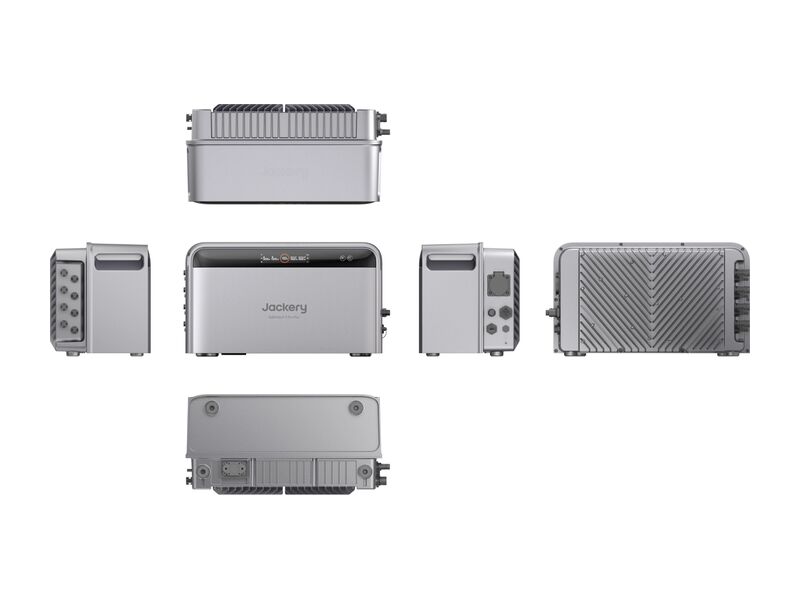
Jackery SolarVault 3 Pro Max
(7 reviews)
Jackery's hybrid balcony battery that goes up to 2500 W: built-in inverter, 4 MPPT for your panels and integrated fire suppression, in an IP65 case.
Characteristics
- Capacity: 2520 Wh LiFePO4, expandable to 15.12 kWh
- Solar: 4 MPPT, up to 4000 W of panels (+ 2500 W via AC coupling)
- Inverter: 2500 W bidirectional, built in, 800 W grid injection by default
- All weather: IP65, self-heating, -4 °F to 131 °F (-20 °C to 55 °C)
- Built-in 2500 W inverter and aerosol fire suppression
Detailed overview: Jackery SolarVault 3 Pro Max - photo 2
The Jackery SolarVault 3 Pro Max is the most powerful hybrid model in the SolarVault 3 series: a hybrid solar storage battery with its own bidirectional inverter. Unlike batteries that need a separate microinverter, the panels connect straight to the unit, which handles charging, storage and delivery to the home network. Compared with the SolarVault 3 Pro, limited to 1200 W of AC output, the Pro Max goes up to 2500 W and is aimed at households that consume a lot.
On the solar side, four independent MPPT controllers each accept up to 1000 W, for 4000 W of panels in total, and up to 8 panels can be connected using Y cables. An AC-coupled input of up to 2500 W can also pick up the output of an existing rooftop installation or recharge the battery from the grid at off-peak times: Jackery quotes up to 6500 W of combined input. In plug-and-play use, grid injection stays set at 800 W; raising it to 2500 W requires a qualified electrician and registration with the grid operator.
The 2520 Wh LiFePO4 battery is rated for 6000 cycles at 90% depth of discharge and expands with BP2500 modules of 2520 Wh each, up to 15.12 kWh per unit. During a power cut, the off-grid socket takes over in under 20 ms according to Jackery: up to 1600 W with the unit alone, 2500 W with an additional battery. IP65 case, operation from -4 °F to 131 °F (-20 °C to 55 °C) with automatic heating, temperature monitoring and a built-in aerosol fire suppression module.
Control is handled by the Jackery app (Wi-Fi, Bluetooth or Ethernet cable) and its AI mode (tariffs of more than 860 European suppliers), and it connects to Shelly, Everhome or HomeWizard meters as well as Home Assistant. The unit weighs 58.4 lb (26.5 kg) for 19.1 x 9.8 x 11.1 in (485 x 248 x 282 mm) and carries a 10-year warranty.
A few limits are worth knowing: independent measurements put round-trip efficiency at around 85 to 86%, standby draw reaches several tens of watts until economy mode is enabled, and parallel operation of several units is announced but not yet available. The Pro Max AC variant, without a direct solar input, is aimed at installations that already have panels. This is a 230 V, 50 Hz model designed for the European market.
Full specifications
Detailed characteristics (EAN: 0810182244327)
Battery
| Technology?Battery chemistry; LiFePO4 lasts far longer and can be fully discharged, gel/AGM is maintenance-free and cheaper. | LiFePO4 (lithium) |
|---|---|
| Nominal voltage?Battery voltage (12, 24 or 48 V). | 41.6 V |
| Capacity?Capacity in amp-hours; multiply by voltage to get energy in Wh. | 60.6 Ah |
| Energy?Stored energy in watt-hours. | 2520 Wh |
| Cycle life?Rated number of charge/discharge cycles, at the stated depth of discharge. | 6000 cycles (90 %) |
| Expandable up to?Maximum capacity reachable with add-on modules. | 15120 Wh |
Power and protection
| Output power?Maximum power delivered (for storages with a 230 V output). | 2500 W |
|---|---|
| Max discharge current (BMS)?Maximum current the BMS allows on discharge. | 48.8 A |
| Low-temperature protection / heating?Cuts off or heats charging in cold weather to protect the lithium cells. | Yes |
Solar section
| MPPT controllers?Number of built-in MPPT solar controllers (lets you connect panels facing different directions). | 4 |
|---|---|
| Max solar input?Maximum connectable PV power. | 4000 W |
| Micro-inverter?Power of the inverter that feeds energy back into the home grid. | 2500 W |
Connectivity
| Bluetooth?Monitoring and settings via an app over Bluetooth. | Yes |
|---|---|
| Wi-Fi?Remote control and updates over Wi-Fi. | Yes |
Durability and format
| Ingress protection?Water and dust resistance (IP rating). | IP65 |
|---|---|
| Weight?Weight of the battery. | 58.4 lb (26.5 kg) |
| Dimensions (L × W × H)?Length × width × height, in millimetres. | 19.1 × 9.8 × 11.1 in (485 × 248 × 282 mm) |
Availability and warranty
| Market launch?Date the model first became available on the European market. Useful to place its generation: technology moves fast in this segment, and a device several years old may be at the end of its commercial life. | March 2026 |
|---|---|
| Warranty?Length of the manufacturer's warranty. | 10 years |
Comparison
How does the Jackery SolarVault 3 Pro Max compare with other high-end balcony batteries, for searches like "SolarVault 3 Pro Max vs SolarFlow 2400 Pro" or "best 2500 W solar battery"? Here is how it stacks up against three references already in the catalog: the Zendure SolarFlow 2400 Pro, the Anker Solix Solarbank 3 E2700 Pro and the EcoFlow Stream Ultra X.
| Criterion | SolarVault 3 Pro Max | SolarFlow 2400 Pro | Solarbank 3 E2700 Pro | Stream Ultra X |
|---|---|---|---|---|
| Base capacity | 2520 Wh | 2400 Wh | 2688 Wh | 3840 Wh |
| AC output | 2500 W bidirectional (800 W grid injection by default) | 2400 W bidirectional | 1200 W bidirectional (800 W grid injection by default) | 1200 W on sockets + 800 W grid |
| Solar input | 4000 W (4 MPPT) + 2500 W via AC coupling | 3000 W (4 MPPT) + 1800 W via AC coupling | 3600 W (4 MPPT) | 2000 W (4 MPPT) |
| Expandable to | 15.12 kWh | 16.8 kWh | 16 kWh | 23.04 kWh |
| Weight | 58.4 lb (26.5 kg) | 61.3 lb (27.8 kg) | 64.4 lb (29.2 kg) | 86 lb (39 kg) |
| Observed price | ≈ $1073 | ≈ $1759 | ≈ $1214 | ≈ $1759 |
In short, the SolarVault 3 Pro Max is the most powerful of this comparison, both in AC output (2500 W) and in combined solar input (up to 6500 W with AC coupling), and the lightest of the group at 58.4 lb (26.5 kg). The Zendure SolarFlow 2400 Pro comes close on output (2400 W) and expandability, the Anker Solarbank 3 E2700 Pro offers slightly more base capacity but stops at 1200 W, and the EcoFlow Stream Ultra X wins on capacity (3.84 kWh), at the cost of 86 lb (39 kg) on the scales. For a home that wants to run big appliances from its battery, the Pro Max is the most complete option.
Related video
Video: Jackery SolarVault 3 Pro Max Battery Review & Setup Guide - Published on 16/05/2026
Our tester's review: Julien De Jurquet
The SolarVault 3 Pro Max is the muscular version of the series: where the Pro stops at 1200 W, it reaches 2500 W of AC output, with a built-in inverter and four 1000 W MPPT inputs that cope with panels facing different directions. On paper, it is the balcony battery that can also feed a clothes dryer. In practice, grid injection stays capped at 800 W in plug-and-play mode, and the 2500 W off-grid output needs an extra BP2500. Published measurements put round-trip efficiency at around 85 to 86%, decent but not among the best, and standby draw at roughly 35 W until economy mode is switched on by hand. In return it is practically inaudible in use, the app is polished and the IP65 case copes with outdoor use; only the Wi-Fi is temperamental, and an Ethernet cable solves it. The announced parallel mode is still awaited. A convincing scalable choice for a high-consumption home. It is a 230 V European model, not sold in the US.
Frequently asked questions: Jackery SolarVault 3 Pro Max - photo 2
The Pro Max is hybrid: 4 MPPT inputs (4000 W of panels) and 2500 W of AC output. The Pro Max AC has no direct solar input and couples via AC (2500 W) to an installation that already has panels. The Pro keeps the 4 MPPT inputs but tops out at 1200 W of AC output.
Technically yes, but not in plug-and-play mode. Injection is set to 800 W from the factory; above that, Jackery requires installation by a qualified electrician, registered with the grid operator in line with local regulations.
For the off-grid output, yes: Jackery quotes up to 1600 W for the unit on its own and 2500 W when combined with BP2500 expansion batteries. Each BP2500 also adds 2520 Wh of capacity to the system.
Yes, with BP2500 batteries of 2520 Wh each: up to 5 per unit, for 15.12 kWh. Jackery quotes 45.36 kWh with 3 units in parallel and 15 BP2500, but that parallel operation is described as "coming soon".
Jackery quotes a switchover in under 20 ms to the off-grid socket, with up to 1600 W for the unit alone and 2500 W with at least one BP2500: enough to keep a home's essential appliances running.
Not at the moment. It is a 230 V, 50 Hz model sold in France and Germany, and Jackery's US store does not list the SolarVault 3 series. Jackery UK has opened a pre-launch page, with early-bird sales announced for October 2026.
Need help choosing?
Other products in the "Plug and play solar batteries" category
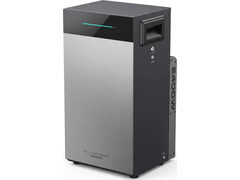
Allpowers BS2500 Pro
$1149.00
A capable 2600Wh plug-and-play balcony battery that has done well in Europe, but not yet sold through a US store or Amazon.com as of 2026.
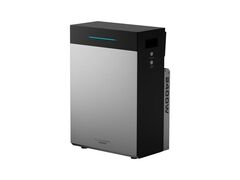
Allpowers BS5000 Pro
$2124.00 (1)
A 5.2 kWh plug-and-play balcony battery with 2400W backup, but a 230V European model that Allpowers does not currently sell in the United States.
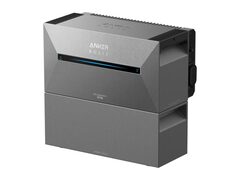
Anker Solix Solarbank 2 E1600 AC
$946.45 (7)
1.6 kWh of AC-coupled solar storage for your balcony: built-in 800W microinverter, dual MPPT, IP65 rating and a capacity expandable up to 9.6 kWh.
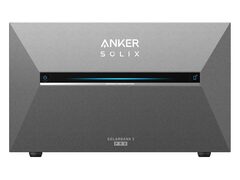
Anker Solix Solarbank 3 E2700 Pro
$1214.40 (7)
2688Wh of plug-and-play solar storage: 4 MPPT, a bidirectional 1200W microinverter and an AI that optimizes your self-consumption on its own. Balcony solar finally pays off.
Published on 08/10/2026