Why AGM rather than a traditional lead-acid battery?
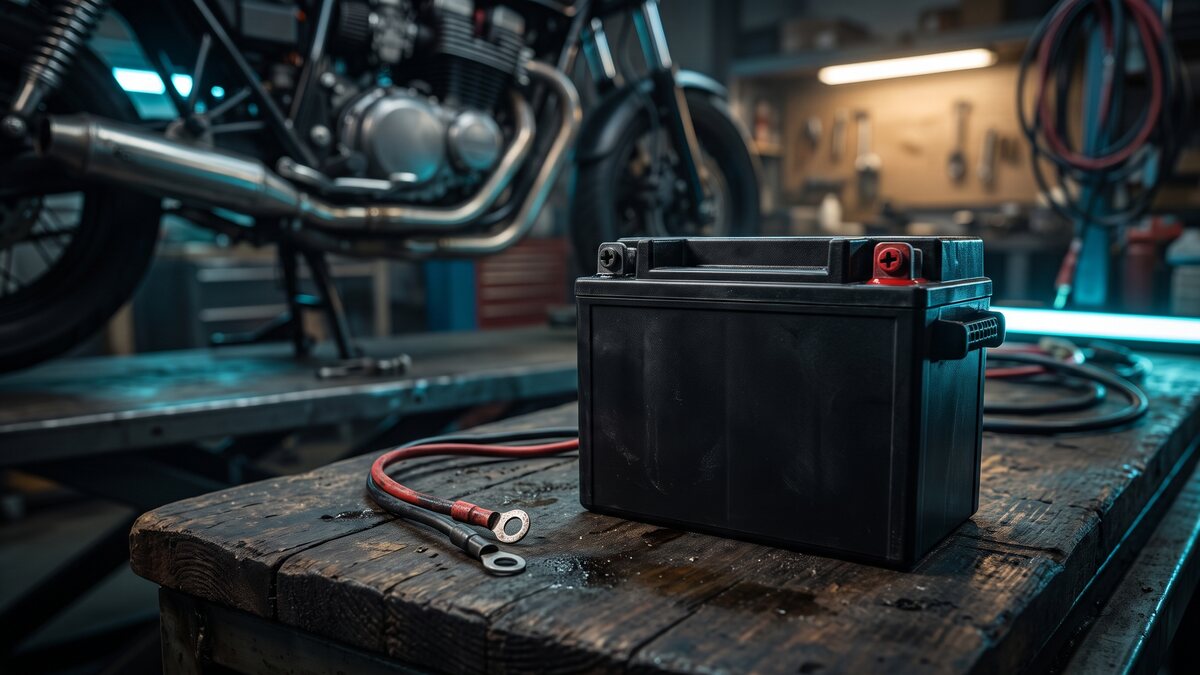
If your motorcycle or scooter is still running on its original battery, chances are it is already AGM (Absorbed Glass Mat): since the early 2000s, almost every new two wheeler sold has dropped the old flooded lead-acid battery, the kind that needed topping up with acid at delivery and whose electrolyte level had to be checked every season. AGM seals that electrolyte inside an absorbent glass fiber mat, which makes it completely maintenance free, leak proof even if tipped over, and far more resistant to vibration, a real advantage on a two wheeler whose engine sits directly on the frame.
In practice, an AGM battery charges at the same voltage as a traditional lead-acid one, but it copes better with road vibration and keeps a more stable resting voltage over time. That is why it remains, to this day, the reference technology for motorcycle and scooter starting, well ahead of LiFePO4 lithium, which is lighter but mostly reserved for lightened race bikes or very specific replacements.
The number one mistake: picking the size, not just the brand
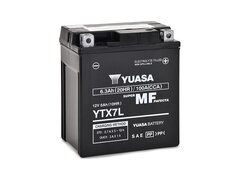
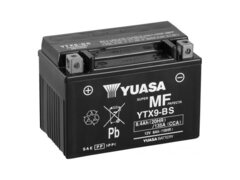
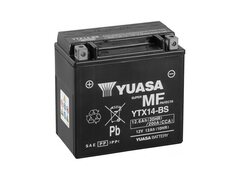
The most common mistake is not picking the wrong brand, but picking the wrong size. A motorcycle starter battery is defined by a code (YTX7L-BS, YTX9-BS, YTX14-BS...) that encodes its capacity in amp hours (Ah), its cold cranking amps (CCA) and its exact dimensions. Two batteries with different capacities are almost never interchangeable: a YTX14-BS will not fit the housing designed for a YTX7L-BS, and the reverse would leave too much play with the terminals badly positioned for the original leads.
CCA measures a battery's ability to deliver a short, intense burst of current at low temperature, a condition set under SAE J537 at 0 °F ( -17.8 °C). The colder your bike sits or rides, the more this figure actually matters: a brand new battery that is undersized on CCA will struggle to crank the engine on a cold morning, even if its Ah capacity looks sufficient for everyday use. Finally, check the polarity (position of the positive and negative terminals): depending on the code, it is not always the same from one model to the next.
Our comparison: three Yuasa batteries, from scooter to big-bore tourer
We picked three Yuasa references, the long-standing reference brand on the two wheeler market, covering everything from urban 125cc scooters to large touring motorcycles.
| Model | Capacity | CCA | Weight | Fits | Price |
|---|---|---|---|---|---|
| Yuasa YTX7L-BS | 6 Ah | 100 A | 5.5 lb (2.5 kg) | 125cc, urban scooters | $74.99 |
| Yuasa YTX9-BS | 8.4 Ah | 135 A | 6.8 lb (3.1 kg) | 600cc, large scooters | $73.00 |
| Yuasa YTX14-BS | 12 Ah | 200 A | 10.1 lb (4.6 kg) | Large tourers and road bikes | $90.89 |
One detail that often surprises buyers: price does not always scale linearly with capacity depending on stock levels at any given time. That changes nothing about how to choose: it is the original code and dimensions that decide, never the price tag on the shelf.
Making your AGM battery last: the maintenance that actually matters
An AGM motorcycle battery lasts, on average, 3 to 5 years under normal use. With careful maintenance, 6 to 8 years is well within reach: the difference comes almost entirely from how the battery is charged and stored, far more than from the brand chosen.
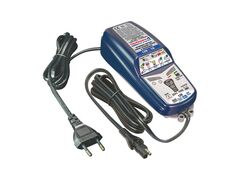
Good practice is to connect a dedicated maintainer as soon as the bike sits idle for more than two or three weeks, typically for the whole winter. A model like the OptiMate 4 Dual Program is built exactly for this: it detects the battery type, charges it through several stages, then switches to maintenance mode without ever overcharging it, which is far safer than a charger left permanently connected with no regulation. To confirm a battery is genuinely at the end of its life rather than simply flat, our comparison of battery testers and diagnostic tools helps settle the question before you buy a replacement.
Replacing and recycling: two steps not to skip
Replacing the battery itself is straightforward if you keep the terminal order right: always disconnect the negative terminal first, then the positive, to avoid any accidental short circuit with a metal tool. When reconnecting, do the reverse: positive first, then negative. Check that the terminals are snug without overtightening, and clean them if corroded before reconnecting.
An AGM battery is still a lead-acid battery: it contains lead and sulfuric acid, two materials that must never go in household trash. Most states require it to be returned to a collection point, either a recycling center or directly to the seller of the new battery, who is generally required to take the old one back under core exchange rules. This recycling loop is well established: the lead from a used battery is very largely reused to manufacture new ones. If there is any doubt about the real condition of the old battery before replacing it, our guide to charging, testing and disconnecting a battery walks through the procedure step by step.