VSR isolator or DC-DC charger: why the contest is already decided
Adding a second battery is one of the most useful upgrades on a van or 4x4: it runs the fridge, the lights or any camp appliance without ever touching the battery that has to start the engine the next morning. The remaining question is how to link it to the starting battery, and two families of products have fought over that job for years.
The VSR (Voltage Sensitive Relay, or isolator) is the simpler of the two: a relay that closes the circuit between both batteries once voltage crosses a threshold (around 13.3V), a sign the alternator is running, and opens it again once voltage drops (around 12.8V), a sign the engine has stopped. No charging electronics, just a voltage-triggered switch.
A DC-DC charger does a fundamentally different job: it draws current from the starting battery (or from a solar panel, depending on the model) and turns it into a genuine multi-stage charging profile (bulk, absorption, float), exactly like a shore-power charger would. It does not just link two batteries, it actively regulates what reaches the second one.
Smart alternators: the real reason to drop the VSR
The VSR worked fine as long as every alternator produced a roughly fixed voltage around 14V with the engine running. That is no longer true on most vehicles built roughly since the mid-2010s, which rely on a smart, variable-voltage alternator controlled by the engine computer (ECU) to improve fuel economy, often branded as a “smart charge” or “variable charge” system depending on the automaker.
This alternator constantly varies its output voltage, sometimes between 12.3V and 15V depending on the driving phase (coasting, steady cruising, high electrical demand), and can stay below the VSR's switching threshold for long stretches. The practical result: the relay opens and closes erratically, and the second battery may only receive a partial charge, or no charge at all over an entire trip, with no warning light to alert the driver.
| Sign | Conventional alternator | Smart alternator (variable voltage) |
|---|---|---|
| Voltage, engine running | Stable, around 14V | Variable, 12.3V to 15V depending on driving |
| Sensing wire on the battery | Usually absent | Often present (voltage-sensing wire) |
| VSR compatible | Yes | Not reliably |
| DC-DC charger compatible | Yes | Yes (dedicated “smart alternator” mode) |
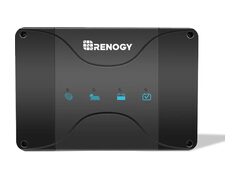
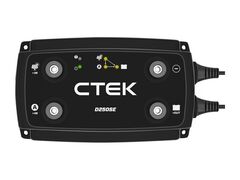
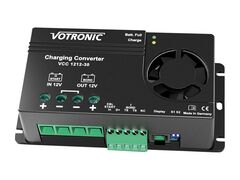
A modern DC-DC charger (Renogy DCC50S, CTEK D250SE, Votronic VCC) includes exactly this kind of mode for smart alternators: it detects that the engine is running through a dedicated ignition wire rather than voltage alone, then applies its own charging profile regardless of what the alternator is doing. That is the technical reason DC-DC has become the default solution, not just a premium option anymore.
Our 2026 pick of the best DC-DC chargers
Three chargers cover almost every need on a converted van or 4x4, alongside a monitor to keep a precise eye on both batteries.
| Model | Current | Battery compatibility | Solar input | Best for |
|---|---|---|---|---|
| Renogy DCC50S | 50A | Flooded/lead-acid, AGM, gel, lithium | Yes (built-in MPPT) | All-in-one setup, alternator and solar in one box |
| CTEK D250SE | 20A | Flooded/lead-acid, AGM, gel, lithium | Yes (built-in MPPT) | CTEK reliability, compact install |
| Votronic VCC 1212-30 | 30A | Flooded/lead-acid, AGM, gel | No | Simple setup without solar, tighter budget |
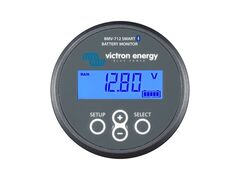
| Victron BMV-712 Smart | - | Monitor (shunt), any chemistry | - | Precise state-of-charge tracking on both batteries |
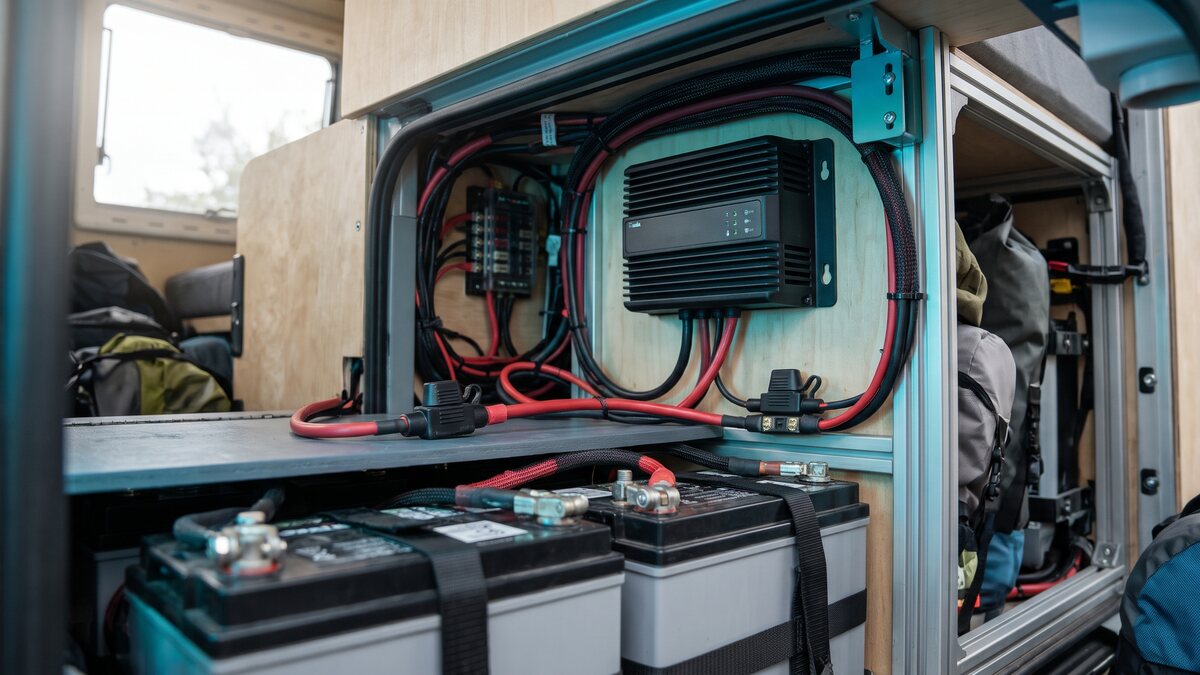
The Renogy DCC50S is our most versatile pick: 50A of alternator charging, a built-in MPPT regulator for a solar panel wired to the same second battery, and a dedicated lithium profile. One box handles both charging sources, which noticeably simplifies the wiring on a full build.
The CTEK D250SE relies on the Swedish brand's reliability and a compact footprint, with the same essential features (smart alternator mode, solar input, lithium profile). Its more modest current (20A) suits a mid-size second battery rather than the largest possible setup.
The Votronic VCC 1212-30 still makes sense for anyone without a solar project who wants a simple, rugged DC-DC solution at a lower price than the two models above.
The Victron BMV-712 Smart is not a charger but a very useful companion: this shunt-based monitor shows the real state of charge of both batteries (not just a voltage guess) and warns before either one drops too low, a genuine safety net once the DC-DC kit is installed.
Sizing your DC-DC charger correctly
The charger's current should be chosen first from the second battery's capacity, not from the longest drive you can imagine. A simple rule, valid for both lithium and modern AGM: aim for 10 to 20 amps per 100 Ah of capacity, to get a full recharge within a few hours of driving without overstressing the wiring.
- 50 to 100 Ah battery: a 20 to 30 amp charger (CTEK D250SE, Votronic VCC 1212-30) is plenty.
- 100 to 200 Ah battery, or a solar project alongside it: a 50 amp charger with built-in MPPT (Renogy DCC50S) avoids installing a second box down the road.
- Cable length between the two batteries: beyond 6.5 to 10 ft (2 to 3 m), voltage drop in the cable run becomes significant. Mounting the DC-DC charger close to the second battery (not the starting battery) limits this loss, since the charger's output is the side most sensitive to cable length.
For a complete cutoff during long periods of inactivity, a dedicated battery disconnect switch on the second battery is still recommended alongside the charger, whichever model you choose.
Installation: the safety points worth getting right
A poorly installed DC-DC charger loses much of its benefit, and can even become a hazard. A few checks worth running through before the first start-up:
- A fuse on both the starting battery side AND the second battery side, as close to each battery as possible, sized according to the manufacturer's manual. An unfused cable turns a simple short circuit into a fire risk.
- Cable gauge matched to the charger's current and the real distance between the two batteries: a cable that is too thin heats up and drops the voltage actually delivered.
- Ventilation around the unit, especially under sustained full load: a charger that overheats automatically reduces its output current, and a fully sealed enclosure only makes this worse with no real benefit.
- Charging profile checked at commissioning (flooded/lead-acid, AGM, gel or lithium matching the battery actually installed): a lead-acid profile applied to a lithium battery chronically undercharges it, with no visible symptom day to day.
For the second battery itself, our feature on lithium battery thermal runaway explains the risks a properly set charger helps keep away.