Why a battery you’re not using still wears out
A lithium battery sitting in a garage never truly discharges to zero, but it doesn’t stay frozen in place either. Two things happen in parallel for the whole time it sits in storage.
The first is the cells’ own chemical self-discharge: for a healthy LiFePO4 cell this stays low, roughly 2 to 3% per month at room temperature, and climbs noticeably with heat. Nothing alarming over a few weeks on its own.
The second is far less known, and it’s the one behind most of the failures discovered in spring: the BMS, the protection circuit built into the battery, draws a small current of its own at all times to monitor the cells, even with nothing plugged in. On a battery left connected for months with no recharge, that draw adds to the self-discharge and can pull the voltage down to the BMS’s low-voltage cutoff. The result: the battery trips into protection, sometimes irreversibly if the cutoff happened too late.
If it’s an e-bike or e-scooter battery you’re trying to winterize, the same broad principles apply, with a few nuances specific to those batteries, covered in our e-bike battery care guide.
What charge level for winter storage? The real number, not the 50% myth
Plenty of guides online recommend storing a lithium battery at 40 to 60% charge. That rule is real, but it comes largely from the smartphone and laptop world, where NMC (nickel manganese cobalt) chemistry ages faster when it sits near 100% for long stretches, a stress on the cathode.
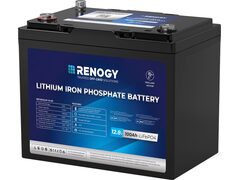
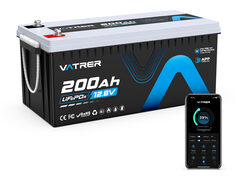
LiFePO4 (lithium iron phosphate) chemistry, the kind used in RV batteries, power stations and home solar batteries, is far more tolerant: its voltage curve stays flat across almost the whole charge range, and the stress tied to charge level alone is much lower. Manufacturers that build these batteries with a real BMS, such as Victron Energy, don’t actually recommend storing at 50%: their technical documentation states that before a long period of inactivity, the battery should be nearly full before disconnecting it, and that the cells should spend at least two hours a month in absorption charge to stay balanced (source).
In practice, there are two clearly different cases:
- You can recharge periodically (an accessible outlet, a LiFePO4-compatible maintenance charger): leave the battery near 100%, the BMS will handle balancing at every absorption charge. This is the safest situation.
- You won’t be able to touch it for months (an unpowered garage, a battery pulled and stored in a closet): aim for 50 to 70% before disconnecting it fully. That margin absorbs natural self-discharge without ever flirting with the BMS’s low-voltage cutoff, while not stressing it with a maximum voltage held for months on end.
| Situation | Charge level when storing | Recharge frequency |
|---|---|---|
| Outlet access, LiFePO4 charger available | Near 100% | Automatic absorption charge, at least once a month |
| Battery isolated, no access all winter | 50 to 70% | One check before and after winter storage is enough |
What temperature keeps the cells from degrading in storage
Temperature matters at least as much as charge level, and it explains most of the capacity loss seen after repeated winters in storage. Manufacturers generally recommend a storage range of 32 °F (0 °C) to 77 °F (25 °C): above that, self-discharge and calendar aging speed up noticeably (extended storage above 95 °F to 104 °F (35 °C to 40 °C), typically a garage baking in full sun, ages the battery far faster than cold does); below 32 °F (0 °C), a different risk shows up entirely.
One safety point to know without exception: never charge a lithium battery whose internal temperature is below 32 °F (0 °C). Charging lithium cells in deep cold causes metallic lithium plating on the negative electrode, which can permanently destroy the cell or create an internal short circuit. Most modern BMS units already block charging below that threshold (some RV battery brands set the cutoff a bit lower, around 25 °F (-4 °C), so check your battery’s manual), but that’s no reason to force it with an unregulated external charger. Discharging (using) a LiFePO4 battery in cold weather is a different matter and stays possible over a much wider range, something we cover in our feature on battery range in cold weather.
For actual winter storage, favor a frost-free spot that’s also shielded from leftover summer heat: a utility room, an insulated garage, or the inside of an RV parked in the shade all beat an unheated shed baking in full sun.
RVs and travel trailers: winterizing the auxiliary battery
RVs and camper vans are this guide’s most common use case: an island-mounted LiFePO4 battery that barely gets used from November through March, yet stays wired into a whole network of parasitic loads its owner often doesn’t even realize are there.
This checklist largely mirrors the advice Battle Born Batteries, a US LiFePO4 maker built specifically for RVers, gives owners heading into the off-season (source): bring the battery to a full charge before storing it, then disconnect it completely, inverters, battery monitors, any small parasitic load, since even minor draws can slowly drain it over time if left connected.
- Cut the parasitic loads: the propane detector, the control panel clock, the alarm, a radio with memory. Each one draws only a few milliamps on its own, but added up over four months they can drain a small battery.
- Disconnect rather than leave it “resting under power”: a LiFePO4 battery that’s genuinely isolated, negative terminal disconnected, no longer carries the BMS’s active-monitoring draw, only the cells’ much slower self-discharge. LiFePO4’s very low self-discharge rate means a fully disconnected battery can often sit for months without attention.
- If you can pull the battery, store it somewhere frost-free rather than leaving it in an unheated RV all winter, especially in regions with harsh winters.
- Use a charger built for LiFePO4, never a plain maintenance charger designed for lead-acid or AGM: charge voltages and absorption profiles differ, and a poorly matched lead-acid charger can overvolt lithium cells.
Check in every couple of months even while disconnected: confirm the battery is still holding voltage and that it hasn’t been left connected to any load. Before hitting the road again in spring, check the battery visually, no swelling, no corrosion on the terminals, and let it run through a full charge cycle before the first long trip: it’s the BMS’s chance to rebalance the cells after months of inactivity.
Home solar batteries: does the battery really need to hibernate?
For a small grid-tied solar setup with a storage battery, think Anker Solix Solarbank or Zendure Solarflow, the question looks different. These systems stay connected to the home’s electrical grid through their micro-inverter: even with solar output cut right down in the depths of winter, the battery keeps charging and discharging on whatever trickle of sun it gets, and the electronics stay powered by the grid at all times. In the vast majority of cases there is therefore no hibernation to plan for: the setup simply keeps ticking along at a reduced pace until spring.
The different case is a system actually taken down for winter, for instance ground-mounted panels removed because of snow, or a deck or patio setup exposed to storms. If the battery is disconnected from the setup, the same rules as for an RV battery apply: near-100% charge if you’ll still have grid access to top it up occasionally, a temperature-controlled spot, and a check before putting it back into service.
The checklist before you put a lithium battery into storage
To sum up the right moves, in order:
- Fully charge the battery before a long shutdown, unless you know no recharge will be possible for months (in that case, aim for 50 to 70%).
- Cut every parasitic load still connected (alarm, propane detector, clock).
- Disconnect the negative terminal if the battery stays in the vehicle or system, or pull it entirely if you can.
- Store it somewhere frost-free, ideally between 32 °F (0 °C) and 77 °F (25 °C), never behind glass in full sun.
- Set a reminder for a check-up charge every 6 to 8 weeks, or connect a LiFePO4-compatible maintenance charger if you have one.
- On restart, check for swelling or corrosion, then let it run a full charge cycle before the first heavy use.
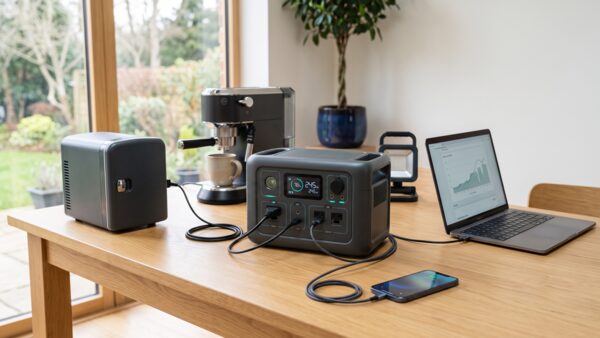
Browse our selection of LiFePO4 batteries and solar gear and power stations to keep your RV or home solar setup running for years.