What Actually Happens Inside a Battery in the Cold?
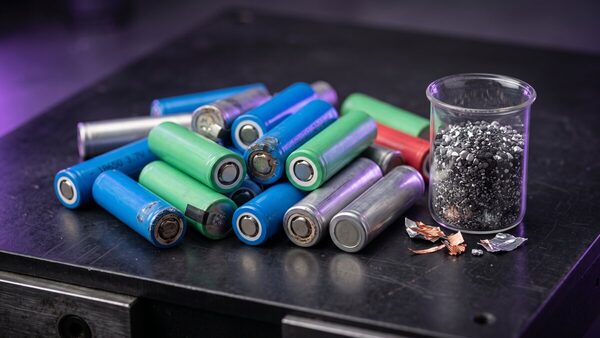
A lithium battery (Li-ion or LiFePO4) stores its energy chemically: with every charge and discharge, lithium ions migrate between the two electrodes through a liquid electrolyte. That migration is a physico-chemical reaction, and like any chemical reaction, it slows down as temperature drops.
Two things combine in the cold. First, the electrolyte becomes more viscous, which slows ion movement. Second, the cell's internal resistance rises mechanically. The result: under the same load (a phone drawing current, an engine cranking), the battery's voltage sags faster than at room temperature. Most devices cut power as soon as a minimum voltage threshold is reached, to protect the cell. So the battery appears « empty » well before it has actually delivered all its stored energy.
A Temporary Range Drop, Not Always Permanent Damage
Good news: most of this cold-induced capacity drop is reversible. Bring a chilled power bank or portable battery back into a warm room, let it come back up to temperature for a few tens of minutes, and much of the « lost » range returns. The chemical energy was always there; only its delivery was slowed down.
That reversibility has a limit, though: repeated cycles at very low temperatures, especially below 14 °F (-10 °C), still accelerate long-term cell aging, even without charging. The safety margin built in by manufacturers (automatic BMS cutoff, the operating temperature range listed on the datasheet) exists precisely to limit that cumulative effect.
The Real Danger: Charging a Lithium Battery Below 32 °F (0 °C)
A drop in discharge range is only an inconvenience. The serious risk happens during charging. Below 32 °F (0 °C), lithium can no longer intercalate cleanly into the negative electrode's structure (the graphite): it deposits on the surface as metallic lithium instead, a phenomenon called lithium plating. Unlike the voltage sag described above, this deposit is irreversible: it permanently reduces the cell's capacity and, in the worst cases, can form dendrites capable of piercing the internal separator and causing a short circuit.
That is why a good battery management system (BMS) automatically blocks or limits charging below 32 °F (0 °C), even if that frustrates a user in a hurry to top off their power station in the middle of winter. It is never a bug: it is the protection that keeps the battery from sacrificing its lifespan, or even its safety.
LiFePO4 vs Li-ion: Which Handles Cold Better?
The two main lithium chemistries found in our products (standard Li-ion in most power banks, LiFePO4 in the majority of recent power stations) do not behave quite the same way in the cold.
| Criterion | Li-ion (NMC) | LiFePO4 |
|---|---|---|
| Typical discharge range | -4 °F (-20 °C) to 140 °F (60 °C) | -4 °F (-20 °C) to 140 °F (60 °C) |
| Typical charge range | 32 °F (0 °C) to 113 °F (45 °C) | 32 °F (0 °C) to 113 °F (45 °C) (often stricter) |
| Energy density | Higher | Lower |
| Cycle life | Decent | Excellent (often 3,000 to 6,000 cycles) |
On paper, both chemistries share similar ranges. In practice, a quality LiFePO4 unit almost always ships with a more cautious BMS that cuts charging earlier as a precaution: that is why some LiFePO4 power stations « refuse » to charge outdoors in the depths of winter, while a less protected Li-ion power bank keeps accepting current... at the cost of accelerated aging you will only notice months later.
What Suffers Most in Winter, Category by Category
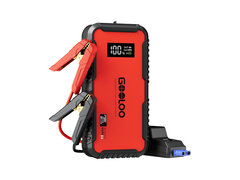
The car battery (lead-acid). This is the best-known case, and the most cumulative one: cold slows the lead-acid chemical reaction (up to 50% less available capacity around 0 °F (-18 °C)) exactly when the engine, with thicker oil, demands the most current to start. That is why a jump starter or a battery maintainer in the trunk makes sense in winter.
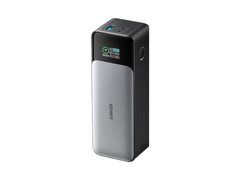
The power bank. Tucked into a jacket pocket at 23 °F (-5 °C), it sometimes shows a percentage that suddenly plummets in use, then « climbs back up » once warmed in an inside pocket. Nothing wrong there: it is the reversible effect described above.
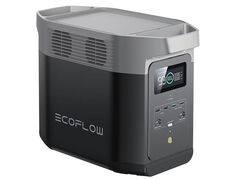
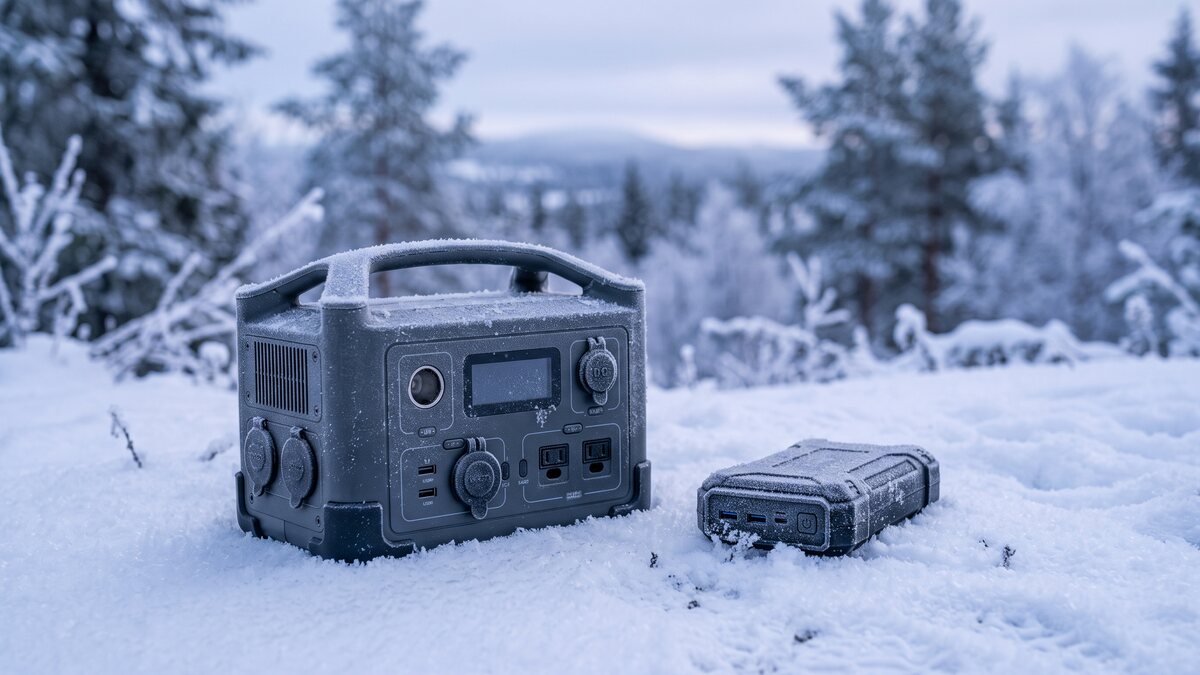
The power station. On a winter camping trip or in a van, a LiFePO4 power station left outside overnight can simply refuse to recharge in the morning until it has warmed back up above freezing. That is expected behavior, not a fault.
The electric car. Between the reduced efficiency of the large battery and the energy spent heating the cabin, some independent range tests find a drop of roughly 20 to 30% in severe cold. Recent models fitted with a heat pump, rather than a simple resistive heater, narrow that gap noticeably.
How to Limit Cold-Weather Battery Damage: Our Tips
A few simple habits apply to every lithium battery in the house:
- Store and carry batteries somewhere warm whenever possible (an inside pocket, the cabin rather than the trunk, indoors rather than an unheated garage).
- Never force a charge onto a battery straight out of the cold: let it warm up to room temperature for 20 to 30 minutes before plugging it in.
- For a car that is rarely driven in winter, connect a battery maintainer rather than letting the battery slowly drain in the cold.
- For a camping power station, use an insulated cover or bring it inside the vehicle or a heated tent overnight instead of leaving it outdoors.
- Do not panic over a percentage that suddenly drops in severe cold: check the actual range again once the device has warmed up.