15 W, 25 W: what the headline figure actually means
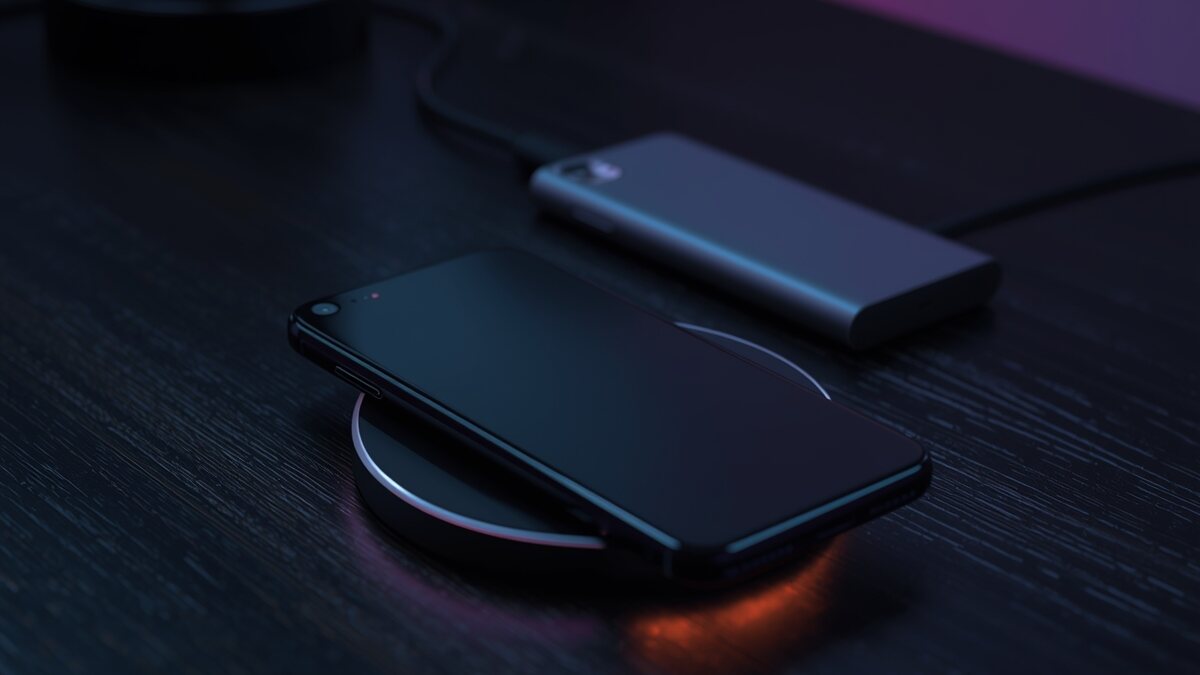
Qi2 is the standard maintained by the Wireless Power Consortium (WPC), the same body that defined the original Qi. Its base version caps out at 15 W, directly matching MagSafe's original limit. A more recent revision, marketed as Qi2 25W (technically Qi v2.2.1), promises nearly 70% more power and a 0 to 50% charge in about 30 minutes under good conditions, according to the WPC itself.
The key point: this figure is a peak power rating under ideal conditions (perfect alignment, a cool charger and phone, stable mains voltage), not a guaranteed rate for the entire charging session. That is true of wired charging too, but the gap between the headline number and the lived experience has historically been wider for induction, for the physical reasons explained below.
Why induction charging runs hotter than a wired cable
Wired USB-C charging moves current through direct electrical contact: losses are small, typically a few percent, well documented for modern USB-PD circuits. Wireless charging instead transfers energy through an electromagnetic field between two coils, one in the charger and one in the phone (or MagSafe power bank). That conversion carries an unavoidable physical cost: eddy currents in nearby metal parts, resistive losses in the coils that dissipate as heat, and switching losses in the electronics.
In this independent, non-commercial study, 19% to 45% of the energy pulled from the wall never reached the battery: it was dissipated as heat, both in the charger and in the back of the phone. That is exactly the warmth you feel when the back of your phone gets lukewarm, or genuinely hot, on an induction pad.
Why real-world speed varies so much with alignment and temperature
This is exactly the flaw Qi2 partly fixes. Its Magnetic Power Profile, built directly on the MagSafe technology Apple contributed to the WPC, mechanically aligns the two coils with a ring of magnets. The result is less misalignment, so fewer coupling losses, and a more consistent charging speed than a classic Qi pad with the phone placed roughly in the right spot.
But alignment does not remove the underlying principle of induction, it only limits the worst case. Three other factors keep changing the speed you actually see from one session to the next:
- Phone and charger temperature: the charging electronics automatically cut power as soon as they detect an abnormal temperature rise, a mandatory safeguard for cell safety. The advertised rate is therefore often held only for the first few minutes.
- Case thickness and material: a thick case, or one with metal elements, pushes the coils further apart and weakens the coupling, hurting both speed and the heat generated for the same useful transfer.
- Ambient temperature: charging in direct sunlight, in a car, or near a heat source adds thermal stress that triggers the safeguard sooner, slowing the charge earlier.
Does this heat really speed up battery wear?
This is the real question hiding behind the marketing, and the answer is nuanced. Battery University, a well-established reference on lithium battery electrochemistry, has long documented the effect of temperature on Li-ion cell aging: a battery stored for a year at full charge loses roughly 20% of its capacity at 77 °F (25 °C); at 104 °F (40 °C), the loss climbs to roughly 35%. The worst-case scenario this documentation identifies is not heat alone, nor a full charge alone, but the combination of both: a cell that is hot AND nearly full at the same time.
That combination is exactly the most common scenario during fast wireless charging: the phone heats up from induction right as its battery approaches 100%. These Battery University figures cover long-term storage, not a direct measurement of daily wireless charging, so this should not be stretched into too mechanical an extrapolation. But the physical mechanism that worries battery engineers, electrolyte aging accelerated by heat, is strictly the same whether it is the phone's own cell or the cell inside a MagSafe power bank sitting on top of it.
The real limits: capped power, fragmented Android support
Beyond heat, two structural limits deserve to be stated plainly, away from the marketing pitch:
- No high-power wireless charging without active cooling. Wired chargers at 65 W, 100 W or more, common for large phones and compact power banks, have no mainstream wireless equivalent: dissipating that much power through induction without a fan would push temperatures to unsafe levels for the cell. Qi2 25W remains, for now, the real high end of the passive wireless market.
- Android compatibility is still partial. Some recent phones ship with built-in Qi2 magnets and get the full benefit of magnetic alignment. Others are only ‘Qi2 Ready’: compatible with the standard but without built-in magnets, so they only regain Qi2's alignment and speed with an added magnetic case. Without it, they fall back to the speed and imprecision of classic Qi.
None of this makes wireless charging bad: these are simply the limits worth knowing, so you do not expect something it cannot yet deliver.
What is genuinely real: convenience and a connector that does not wear out
It would be unfair to list only the downsides. Two advantages of wireless charging are entirely real, not marketing claims:
- Everyday convenience: setting the phone down instead of plugging in a cable every time, keeping it topped up overnight with no fumbling, snapping on a magnetic power bank on the go without hunting for the right cable in a bag.
- A USB-C port that does not wear out. Every wired plug-in mechanically stresses the phone's port; over several years and thousands of plug cycles, that repeated friction is a known cause of connectors becoming loose or degraded. Induction charging has zero mechanical contact: no wear of that kind, a genuine long-term durability benefit for the device.
For topping up, overnight charging, or keeping a desk charge maintained, Qi2/MagSafe largely delivers on its promise. It is on peak advertised speed and heavy high-power use that the gap between promise and reality widens.
So, should you be wary of Qi2/MagSafe wireless charging?
No, but it should be chosen for what it actually is: a convenient, reliable solution that keeps getting faster thanks to Qi2's magnetic alignment, but not (yet) the equal of fast wired charging in raw speed or energy efficiency. The heat it generates is a real physical phenomenon, not a manufacturing flaw, and a few simple habits (a thin case, no confinement, switching to wired for big top-ups) are enough to limit its impact on battery lifespan.
Looking to pick a specific model instead? Our comparison of the best MagSafe and Qi2 power banks of 2026 covers the models that best deliver on speed and thermal management.