What did DJI actually announce?
DJI showed off a new balcony solar system at IFA 2026, the major Berlin consumer electronics show that ran September 3 to 8 on the DJI stand (Hall 20-129), with a dedicated media event on September 3. Best known in the US for drones and, more recently, for its Power line of portable power stations, the company is stepping into balcony solar, a category that barely exists in the American market but is already common across parts of Europe.
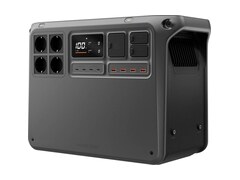
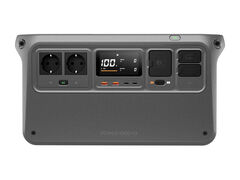
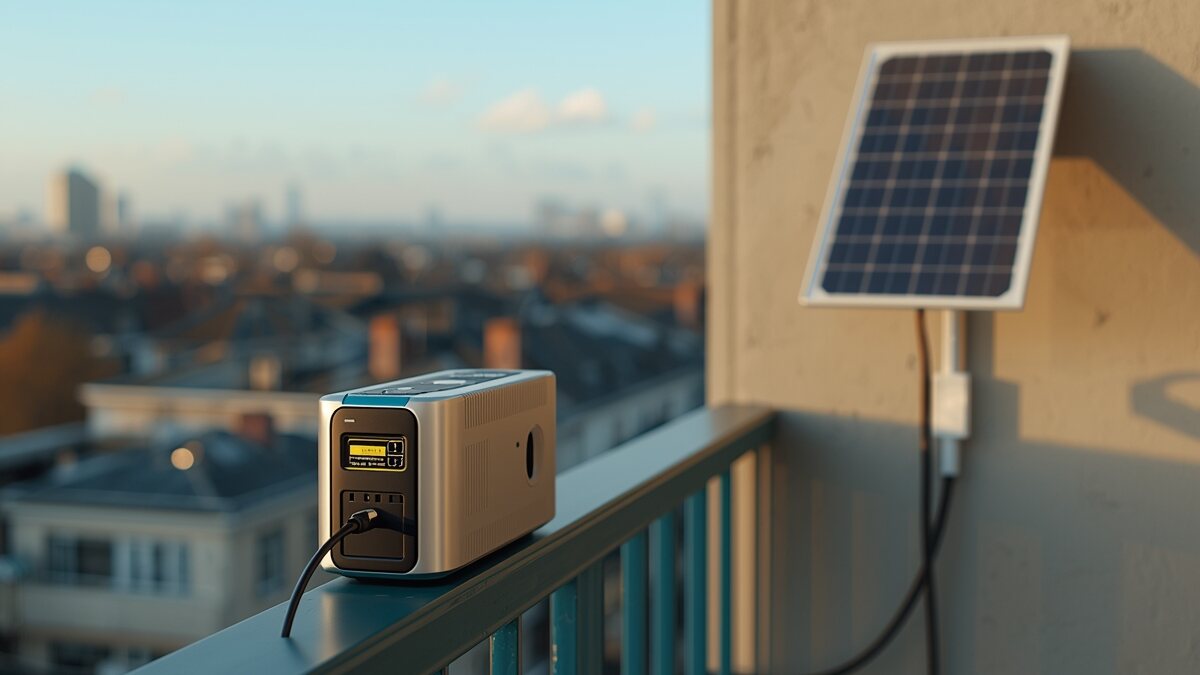
The system isn't a new device: it's the DJI Power 2000, already sold in the US and already covered in our full review. This 2048 Wh station, rated for 3000 W of continuous output and expandable up to 22,528 Wh with add-on batteries, becomes the storage core of a solar kit meant to plug into a home's wiring through a wall outlet, an approach known in Germany as Balkonkraftwerk.
How does the system work, and why doesn't the US allow it the same way?
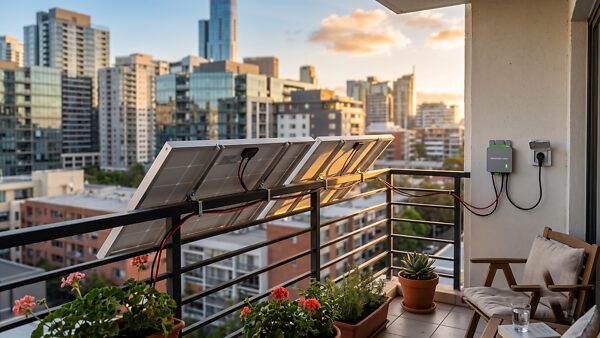
The setup pairs solar panels with a microinverter that converts the panels' DC output into AC power and feeds it directly into a home's circuit through a standard wall outlet, a so-called grid-tied configuration. The Power 2000 sits in that chain to store any surplus produced during the day and release it later, instead of letting it go to waste.
Plug-in grid-tied solar is common in Germany, where a simplified process lets homeowners and renters register a small system with the grid operator without a full utility interconnection study. The US doesn't have an equivalent nationwide shortcut. Feeding power back into a home's wiring here generally requires an inverter listed to UL 1741 and, in most cases, a formal interconnection agreement with the local utility, a process built around larger rooftop solar installations rather than a small plug-in kit. That's the main reason balcony solar hasn't taken off in the US the way it has in Germany, independent of anything DJI does.
DJI's 680-euro savings claim: a European number that doesn't translate directly
On its stand, DJI floated an estimated saving of 680 euros a year (roughly $730 to $760 at recent exchange rates), based on two assumptions set by DJI itself: annual solar output of 2,160 kWh and a self-consumption rate of 90%.
| System | Claimed output | Claimed savings |
|---|---|---|
| Typical 400 to 800 W balcony kit | 300 to 950 kWh/year | 60 to 180 €/year |
| DJI Power 2000 kit (DJI's own assumption) | 2,160 kWh/year | 680 €/year |
Beyond the currency conversion, the figure was calculated for European electricity prices and a European regulatory setup, and DJI itself notes it excludes equipment cost, installation, maintenance, taxes and incentives. US electricity rates and net-metering rules vary enormously by state and utility (see the US Energy Information Administration for regional averages), so this number shouldn't be treated as a US estimate even if the feature does eventually arrive here.
Where it's launching: Germany, France and Spain
Rollout begins in Germany, the historic home of balcony solar, where DJI will bundle the kit with the Power 2000. Grid-tied firmware is reportedly also enabled for France and Spain, suggesting a fairly quick expansion to those markets, though no firm timeline has been given. All three benefit from national or EU-level frameworks that make small plug-in solar systems comparatively simple to register and use.
None of that infrastructure exists at the federal level in the US. A handful of states and utilities have started experimenting with simplified interconnection for very small systems, but there's no nationwide equivalent to Germany's process, and DJI hasn't indicated any plan to pursue one yet.
Why this feature stays locked on US units
Grid-tied mode is not enabled on Power 2000 units sold in the United States, for two separate regulatory reasons. First, an inverter that feeds power back into the grid needs UL 1741 certification plus utility approval, a process separate from standard FCC authorization. Second, devices that include a Wi-Fi chip fall under FCC rules that block certain network functions by default until they're specifically cleared, and every DJI Power station ships with Wi-Fi built in.
In other words, this isn't a business decision DJI could reverse with a firmware update alone. Getting grid-tied solar approved for US units would mean going through UL certification and, likely, utility-by-utility or state-by-state approval, a much longer path than simply enabling a feature already built for the European units.
Our take: a European launch worth watching, not a US product yet
For US readers who already own a Power 2000, the logic behind this move still matters: DJI is trying to make its existing hardware, detailed in our full review, do double duty as home solar storage rather than launching a dedicated battery. If DJI eventually pursues UL 1741 certification and utility partnerships, this same setup could plausibly find its way to states with simpler interconnection rules first.
For now, though, this is a European product story. No US price, no confirmed timeline, and no indication yet that DJI is pursuing the certification path that would be required here. We'll update this article if that changes.