What the claimed 3840 Wh are really worth
The Aferiy P310 carries a 51.2 V LiFePO4 battery rated for 4000 cycles before dropping below 80 percent of its original capacity, roughly a decade of daily use. As with any inverter-based station, part of that energy is lost in conversion before it reaches an outlet: usable capacity sits between 89 and 92 percent of the rated value depending on the load, with around 9 percent lost on charging and 11 percent on discharging.
Two technical details explain part of that gap. The manufacturer keeps a reserve of around 5 percent of capacity even once the screen reads 0 percent, to protect long-term cell health, and recommends against letting the battery sit too often below 20 percent. On top of that, as long as the AC output switch is left on, the unit draws roughly 20 to 25 Wh per hour just to keep the inverter on standby, even with nothing plugged in, worth knowing for anyone who leaves it running as a safety net.
3600 W continuous, 7200 W peak: power that holds up in daily use
The most advertised figure, 3600 W continuous, holds up all the way to full output: that is precisely the load level at which the unit's noise reaches its maximum, which implies the inverter genuinely sustains that output rather than tripping or drifting under it. That covers the vast majority of household and job-site uses, including an induction cooktop, whose rated draw of 2000 to 3000 W stays well within the available margin.
The 7200 W peak figure, on the other hand, remains a manufacturer number with no independent confirmation to date. It mainly serves to absorb the startup surge of a motor or heating element (a compressor, a well pump, a circular saw), not to power an appliance continuously at that level.
Wall outlet and solar charging: a genuinely fast combination
On this US configuration, at a full input of 1500 W from a standard outlet, the P310 reaches a full charge in about 2.5 hours. The solar input accepts up to 2000 W through an MPPT controller and an XT90 connector, across a voltage range of 12 to 160 V. Combined, wall power and solar reach 99 percent charge in as little as 1.5 hours, a fast pace for a battery of this size.
| Source | Max power | Time reference |
|---|---|---|
| Wall outlet only | 1500 W | 100% in about 2.5h |
| Solar only (MPPT, XT90) | 2000 W | heavily dependent on actual sunlight |
| Wall outlet and solar combined | ≈ 3500 W | 99% in 1.5h |
Pass-through charging (recharging while powering connected devices) is supported, a real plus for home backup use where the station stays plugged in permanently. The manufacturer also states an operating range of 14 °F to 104 °F (-10 °C to 40 °C): below 32 °F (0 °C), charging stops automatically and resumes on its own once the temperature rises again, a standard safeguard for this battery chemistry but one worth knowing before winter outdoor use.
From near-silent to 65 dB at full output
The P310's noise behavior follows a clear curve. Below 1000 W of output, the unit stays near-silent, with the fans only kicking in intermittently. From around 50 percent of rated output, roughly 1800 W, noise rises to about 46 dB. At full output of 3600 W, it climbs to around 65 dB, with the fans running continuously to shed heat, especially if the surrounding temperature is already high.
Expanding to 11520 Wh: what it really costs
The P310 accepts up to two AF-P310-B expansion batteries of 3840 Wh each, bringing total capacity to 11520 Wh without changing the main unit. A comfortable option for anyone who wants to start small and grow into their needs, rather than replacing the whole station with a bigger one later.
A 7-year warranty, with a condition attached
The widely promoted 7-year figure does not apply automatically from the moment of purchase. The manufacturer's policy sets a base period of 24 months, valid with no extra step. The remaining 5 years, which bring the total to 7, require a free online registration of the product within a set window after purchase.
Even accounting for that condition, this stays more generous than direct rivals: the closest matches on paper cap out at 5 years, with no registration requirement at all. Registering shortly after delivery is enough to lock in the full 7 years, a free step that falls on the buyer rather than the seller.
Ports and app: strong hardware, modest software
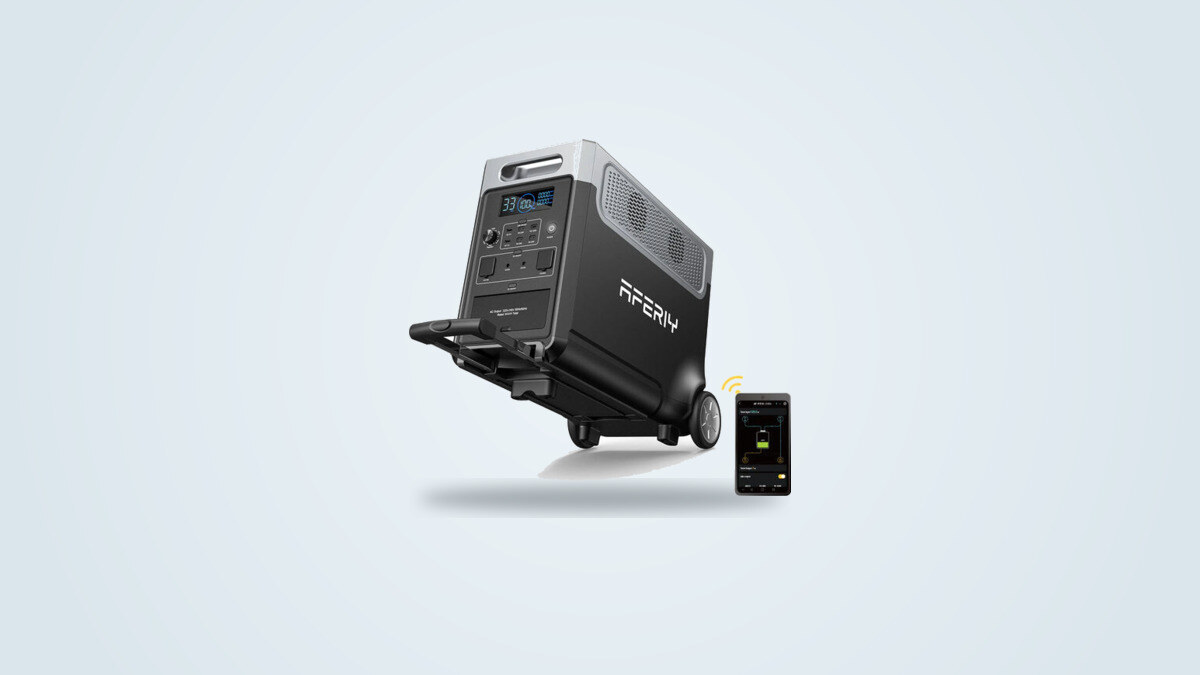
This US configuration lines up 13 simultaneous outputs across 5 AC receptacles, 4 USB-C ports up to 100 W each, 2 USB-A ports at 18 W, two DC5521 outputs, an XT60 port and a 12 V car-style socket. A generous line-up, built to power several heavy devices at once without juggling adapters.
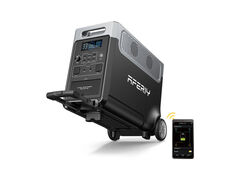
Control runs through the Bright EMS app over Bluetooth and Wi-Fi, alongside a front LCD screen that shows charge percentage and input/output power live. The app stays basic on one specific point: it keeps no history of charge and discharge cycles, and offers no scheduled charging, two features present on several direct rivals. Its protocol is nonetheless open enough to have allowed integration with third-party home automation platforms, a welcome sign for anyone keen to tinker beyond the official app.
92.6 lb on wheels: a near-stationary station
At 92.6 lb (42 kg) and 23 by 12.6 by 18.3 in (584 by 321 by 464 mm), the Aferiy P310 clearly owns its status as a heavy-duty station. The wheels and telescopic handle make moving it across flat ground easy, from garage to van or to the far end of a yard, but there is no carry system built in for frequent hand transport.
This choice of format fits a coherent range from the same maker: a far more compact 1024 Wh station from the same brand weighs a little over 25 lb (11 kg), and the entry-level 256 Wh model barely 9 lb (4 kg). The P310 sits at the other end of that catalog, built for extended home backup or job-site use rather than a backpack.
Against direct rivals
Around $1300, the Aferiy P310 goes straight after the most searched-for 3 to 4 kWh stations. Here is how it stacks up against three alternatives in the same power class.
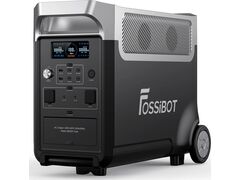
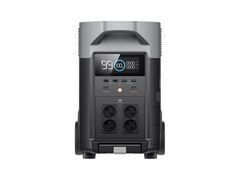
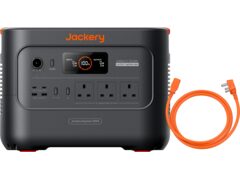
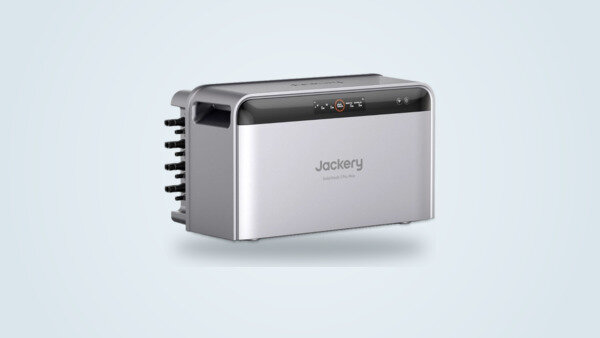
| Criterion | Aferiy P310 | FOSSiBOT F3600 Pro | EcoFlow Delta Pro | Jackery Explorer 3000 v2 |
|---|---|---|---|---|
| Capacity | 3840 Wh (11520 Wh max) | 3840 Wh (11520 Wh max) | 3600 Wh (25000 Wh max) | 3072 Wh (not expandable) |
| Continuous / peak power | 3600 W / 7200 W | 3600 W / 7200 W | 3600 W / 7200 W | 3600 W / 7200 W |
| Cycles at 80% capacity | 4000 | 6500 | not comparable (50% threshold) | not comparable (70% threshold) |
| Warranty | 7 years (2 automatic + 5 with registration) | 5 years | 5 years | 5 years |
| Price found | ≈ $1299 | ≈ $1700 | ≈ $1899 | ≈ $1992 |
On paper, the P310 matches the FOSSiBOT F3600 Pro's spec sheet almost point for point at a noticeably lower price, with the longest warranty of the comparison thrown in. FOSSiBOT still holds a real edge in rated battery longevity, at the same measurement threshold (6500 against 4000 cycles at 80 percent). Against the EcoFlow Delta Pro, which allows a far larger expansion up to 25 kWh, and the Jackery Explorer 3000 v2, whose brand carries a longer track record on the market, the P310 remains the cheapest option in the comparison for a base capacity that matches or beats them.
Who it suits, and who it does not
It suits anyone after high-capacity home backup, power for a converted van, or a job site that needs a large amount of energy on a noticeably smaller budget than the best-known names. Taking the time to register the product online shortly after delivery secures the full 7-year warranty. For a need that is likely to grow, expansion batteries avoid having to replace the whole station down the line.
It suits less anyone who needs genuinely nomadic use day to day: at 92.6 lb (42 kg), the unit is built for a fixed spot, not a backpack. For extended use at high power in an enclosed, lived-in space, the near-65 dB noise at full load is worth planning around. And for anyone who wants the highest possible cycle count at this capacity, a near-identical rival on paper does better on that specific point.