28.7 lb for 2400W: what this lightness is really worth
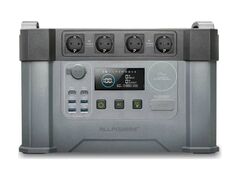
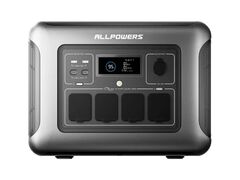
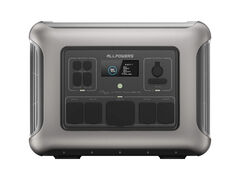
The most visible selling point of the Allpowers S2000 Pro comes down to one figure: 28.7 lb (13kg) on the scale for 2400W of continuous power and 1451Wh of capacity. For direct comparison, the same brand's R1500 LITE weighs 33.1 lb (15kg) despite lower power and capacity (1600W, 1056Wh), and the R2500 climbs to 63.9 lb (29kg), more than double, for 2500W and 2016Wh.
This weight gap is no accident: it comes down to the battery chemistry, covered in the next section. That contained weight changes daily use in concrete ways. For home backup, the unit stores easily in a closet or garage and comes out on its own for the length of an outage. In a van or RV, it slides under a bench seat or into a locker without eating into the vehicle's payload. On a job site, it moves from one spot to another without needing two people or a hand truck, a real time saver against stations of comparable power that often exceed 44 lb (20kg).
The real price of that lightness: NMC chemistry and its 2500 cycles
That light weight has a precise explanation, and a real cost. The S2000 Pro uses a ternary lithium (NMC) battery, a chemistry with a higher energy density per pound than the LiFePO4 used on the R1500 LITE and R2500. It's this choice of chemistry, not just a design refinement, that explains most of the weight gap seen in the previous section.
The trade-off: NMC structurally handles fewer full charge-discharge cycles before losing capacity. Allpowers rates the battery for 2500 cycles before it drops to 80% of its original capacity, versus 3500-plus cycles for the LiFePO4 batteries used on other models in the range.
At one full cycle a day, 2500 cycles still add up to nearly seven years before hitting that threshold, comfortably covering occasional backup use or a road trip a few dozen times a year. The gap matters most for very intensive, daily use spread over several years, a profile where a LiFePO4 battery remains the better pick.
Versus the base S2000: what "Pro" really changes
Allpowers also sells an S2000 without the Pro badge, a model close on paper but whose real differences from the Pro version show what that badge actually means, beyond the marketing.
| Criterion | S2000 Pro | S2000 (base) |
|---|---|---|
| Continuous power | 2400W | 2000W |
| Full mains recharge | about 1.5 hours (combined solar) | about 4 hours |
| UPS function | Yes | No |
| App control | Yes (Bluetooth) | No |
| Weight | 28.7 lb (13kg) | 32 lb (14.5kg) |
| Advertised warranty | 5 years (conditional) | 2 years |
The result is a surprising one: the Pro version is both lighter and more powerful than the base version, a combination rarely seen, since one usually comes at the expense of the other. Most of the price gap between the two comes down to the notably faster recharge, the UPS function and app control, three real additions rather than a simple marketing dress-up of the word "Pro".
The 1.5-hour combined recharge, and what it actually requires
Allpowers advertises a full recharge in 1.5 hours for the S2000 Pro. That figure assumes stacking the mains input (1500W maximum) with the solar input (up to 1000W), for 2500W of total input. On mains alone, without any solar contribution, the arithmetic of the capacity (1451Wh against 1500W of input) puts a full charge at around one hour in theory, before accounting for the usual slowdown near the top of the charge curve common to any lithium battery.
On solar alone, with an array close to the 1000W maximum and favorable sunlight, expect closer to two to three hours for a full charge, a duration that stretches out with a smaller array or overcast skies. The solar input accepts a wide voltage range of 12 to 150V and up to 13A, through an XT60 connector, which allows real flexibility in wiring: several panels can be wired in series to cut line losses over a long cable run.
One compatibility point is worth checking on arrival rather than discovering on the road: one case exists, isolated, of a third-party 200W panel (21V, 6A, within the advertised range) not being recognized through the XT60 connector, with no sign of a widespread issue. With panels from Allpowers' own range, this compatibility risk does not arise.
A 1000W solar input, matching Allpowers' higher-end models
With 1000W of maximum solar input, the S2000 Pro matches the R2500, the highest-capacity model in the Allpowers range already covered on this site, and clearly outpaces the R1500 LITE's 650W. That's a real asset for anyone relying on solar on the road or off-grid, at a level usually reserved for pricier or higher-capacity stations from the competition.
This generous solar spec contrasts with another choice from the manufacturer: the S2000 Pro offers no battery expansion or parallel connection, unlike some stations in the R range. Its 1451Wh capacity therefore stays fixed for the product's entire lifespan, worth knowing before buying for anyone expecting their needs to grow.
2400W continuous, 4000W peak: what they deliver in practice
On paper, 2400W continuous covers the vast majority of common household and job-site needs: a fridge, a microwave, a kettle, or a single demanding power tool. In practice, a 2300W space heater, close to the unit's continuous ceiling, runs without a shutdown or reported overheating, a sign that the advertised headroom is real, not just theoretical.
The 4000W peak mainly exists to absorb the inrush current when motor- or resistance-based appliances start up: an 1800W circular saw and a water pump have been able to start at the same time without tripping a protection, a scenario close to what real job-site use demands. This peak margin, nearly double the continuous rating, secures startups without forcing anyone to oversize the unit for day-to-day use, which stays well under that ceiling.
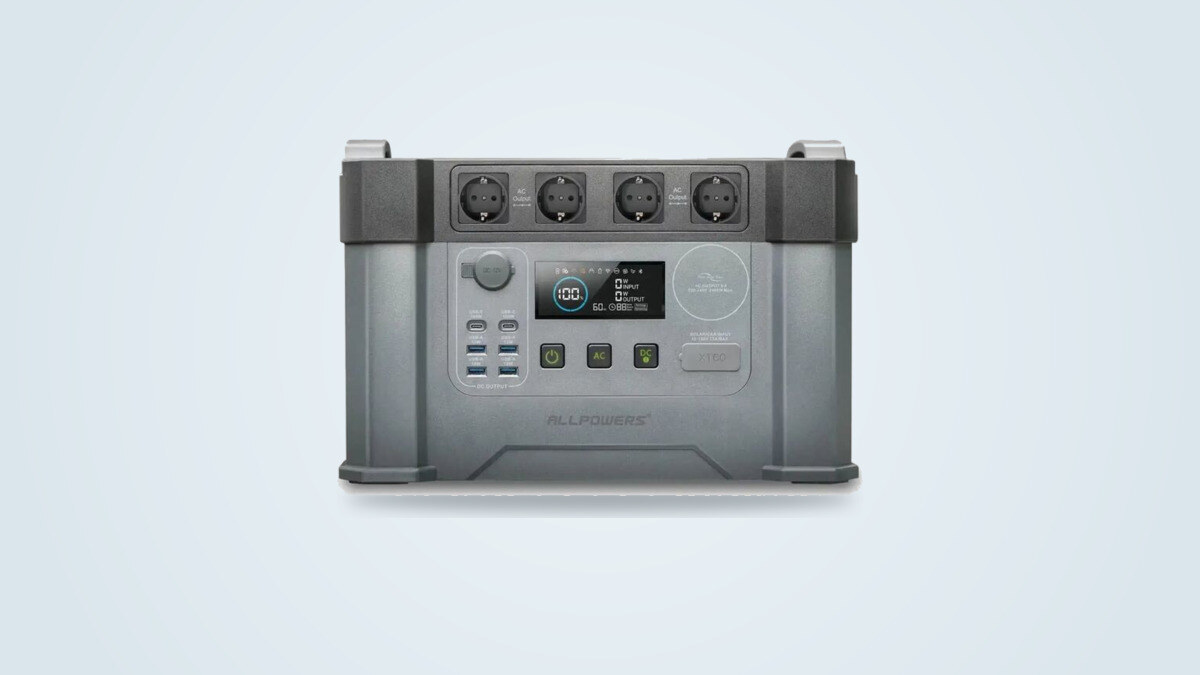
Beyond the four outlets, the 12V output, up to 120W, can power a device built for a vehicle's cigarette lighter socket (cooler, pump, lighting) directly, bypassing the inverter and avoiding the conversion losses that come with any mains output. Combined with the two 100W USB-C ports and the four USB-A ports, the station covers most mixed appliance-and-electronics needs at once, without needing an extra power strip.
One reservation remains on how load is shared across the four outlets: as on most multi-outlet stations of this power class, each outlet is individually protected, which can trip a protection cutoff for a single high-inrush appliance plugged into one outlet, even below the total power available across all four. Spreading heavy loads across several outlets rather than one remains the best workaround.
Ports and control: complete on paper, Bluetooth-only in practice
The output lineup covers the usual needs for this class of station: four pure sine wave outlets, two USB-C ports up to 100W each, enough to fast-charge a laptop at full speed, four USB-A ports up to 18W, and a 12V output up to 120W in a car-socket format. The currently shipping version, however, no longer includes the 30A RV outlet found on the very first S2000 Pro units, a removal Allpowers attributes to improved reliability rather than a cost cut presented as such.
Control runs through the Allpowers app, Bluetooth-only, at an advertised range of about 10 meters. Unlike the same brand's R2500 V2, which adds WiFi for remote monitoring away from home, the S2000 Pro is limited to close-range supervision: charge level, instantaneous power, toggling the mains or DC mode from a phone within range of the unit, but no alerts and no monitoring once out of range.
The built-in LCD screen continuously shows the charge percentage, instantaneous input and output power, and an estimated time remaining to full charge. Enough to track the essentials without opening the app, as long as the unit stays in sight. For a fixed home-backup setup or a nearby outbuilding, the Bluetooth-only limit rarely matters; it becomes more of a constraint for an off-grid site someone would want to monitor remotely.
What the cold rules out: charging stops below 32 °F (0 °C)
The manufacturer's documentation sets precise temperature ranges, worth knowing before any winter outdoor use. Charging, whether from the mains, solar or 12V, is only allowed between 32 °F and 104 °F (0 °C and 40 °C); below 32 °F (0 °C), thermal protection automatically halts charging, a safety mechanism common to most lithium batteries regardless of chemistry. Discharging remains possible down to 14 °F (-10 °C), and storage down to -4 °F (-20 °C), with a recommended range of 68 to 86 °F (20 to 30 °C) for extended storage without premature degradation.
In practice, an S2000 Pro left in an unheated van on a below-freezing night won't recharge until its internal temperature climbs back above 32 °F (0 °C), even with sunlight or an outlet available. Discharging, meaning drawing on energy already stored, remains possible under those conditions, down to 14 °F (-10 °C). This is a limit set by lithium chemistry in general, not a flaw specific to this model, but it's worth planning for anyone considering unheated outdoor use in winter.
Fan noise, warranty and current US availability
The cooling fan kicks in as soon as mains charging or mains output is in use, even at low power, and stays clearly audible once running. No precise decibel figure is available for this model to date; absent such a number, plan for that noise in a bedroom or small enclosed space overnight.
Allpowers advertises a 5-year warranty on its power stations, the S2000 Pro included. That figure follows a general policy from the manufacturer, which sets a 24-month base coverage and makes the extension beyond that period conditional on registering the product on the official website after purchase. Without that step, a failure after 24 months would only fall under the base warranty.
No safety recall is associated with the Allpowers brand to date, and the general perception around the build quality and sturdiness of the casing stays positive. One reservation exists around the consistency of the charge-level reading on older S2000 Pro units, with no sign of a widespread flaw on the currently shipping version. One more point specific to the US market: at the time of writing, the S2000 Pro is listed as a pre-order on Allpowers' own US store, with new stock estimated to ship around September 21, 2026, rather than being available for immediate delivery.
Versus the R1500 LITE and the R2500: who each one suits
Within the Allpowers range, the S2000 Pro sits deliberately between the R1500 LITE and the R2500. The table below covers the gaps that matter most for the choice.
| Criterion | S2000 Pro | R1500 LITE | R2500 |
|---|---|---|---|
| Capacity | 1451Wh | 1056Wh | 2016Wh |
| Continuous / peak power | 2400W / 4000W | 1600W / 3200W | 2500W / 4000W |
| Chemistry | NMC | LiFePO4 | LiFePO4 |
| Max solar input | 1000W | 650W | 1000W |
| Weight | 28.7 lb (13kg) | 33.1 lb (15kg) | 63.9 lb (29kg) |
Against the R1500 LITE, the S2000 Pro wins on nearly every axis, power, capacity, solar, for just 4.4 lb (2kg) less weight, at the cost of a less durable chemistry. Against the R2500, it offers nearly identical continuous power and the same solar input for less than half the weight, with 565Wh less capacity and, again, NMC rather than LiFePO4. For anyone who values lightness and fast charging over maximum runtime, the S2000 Pro remains the most coherent pick of the three.
Who the S2000 Pro suits, and who it doesn't
It suits anyone after a serious home backup reserve in a format that's easy to store and move, van or RV use where every pound counts, or a job site where the unit needs to change spots often. Its fast recharge and generous solar input also make it a good base for anyone switching between mains and panels while on the move.
It doesn't suit anyone planning intensive daily use over several years, where a more durable LiFePO4 chemistry remains preferable, nor anyone needing remote monitoring beyond Bluetooth range, nor anyone counting on a direct 30A RV outlet. It also doesn't suit unheated outdoor winter use, since charging stops below 32 °F (0 °C), or anyone who needs the unit in hand today rather than on order.